Mapping Ancient Africa Quaternary International Special Issue #10
Kinyanjui, R. N., Mashaka, H. K., Chritz, K. L., Wemanya, S. N., Ndiema, E. K., Braun, D. R., & Bamford, M. (2026). Holocene vegetation dynamics of the Koobi Fora Basin, East Turkana, Kenya: Insights from phytolith analysis. Quaternary International, 759, 110131. https://doi.org/10.1016/j.quaint.2026.110131
To find the complete list of articles in the Mapping Ancient Africa special issue of Quaternary International click here.
Ivory, S.J., MacDougal, E., Mason, A., Pereboom, E., Garelick, S., Ficken, K., Wooller, M.J., Nakileza, B. & Russell, J. (2024) Highland forest dynamics across equatorial East Africa during the end of the African humid period. Quaternary International. DOI: 10.1016/j.quaint.2024.10.007
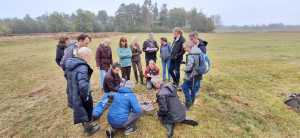
During the seminar afternoon (17 October) we heard four talks. The first from Harm Smeenge and Ariët Kieskamp (both Bosgroep) introduced the sites we were to visit on the excursion the next day. This focused on the landscape ecology and ecological history of the bogs on the eastern slopes of the Veluwe. The second talk, by Roy van Beek (Wageningen University & Research), focused on the Celtic field systems around the Veluwe. He explained the latest archaeological and archaeobotaincal work investigating the age and origins of these field systems. The third presentation was by Jasper Candel (Wageningen University & Research) and focused on the geomorphological features from glacial activity in the Veluwe region and how this has effected the development of mire ecosystems. I (William Gosling) gave the final talk, presenting the outputs of the research theses of Sanna Wessel, Chiara Raino and Roos Dik who all completed projects at the University of Amsterdam and worked together to investigate how different mega-herbivore populations in the Dutch landscape were represented by the dung fungal spores preserved in the soil.
The Southern African Society for Quaternary Research (SASQUA) is hosting its 24th congress 19-24 May 2024 in the Cango Valley, South Africa. The congress will bring together scientists working on all aspects of the Quaternary in southern Africa. Poster and oral presentations possible.
Abstract submission and student support application deadline: 31 March 2024
Applications are invited for a fully-funded three-year PhD to commence in October 2024 with Adele Julier (University of Portsmouth, UK).
The project will focus on disentangling the history of human ignited and natural fire regimes in Britain. This will be achieved through the analysis of charcoal fragments extracted from sedimentary sequences.
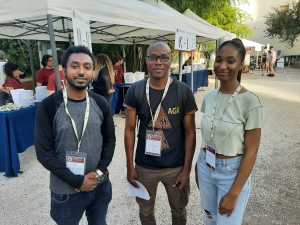
Mapping Ancient Africa participants at the INQUA Rome ice breaker event ready for action! Left to right: Bahru Zinaye Asegahegn, Alfred Houngnon, Busisiwe Hlophe.
The Mapping Ancient Africa (MAA) project has a double session of talks and a poster session at the INQUA congress in Rome 2023. Our session will be on Wednesday 19 July. Unfortunately a number of the originally planned speakers could not make it to Rome due to a combination of not obtaining visas, logistical challenges and ill health. We wish them all well and hope that they will continue to be involved in the project. Further, many thanks to all those who have agreed to step up and give a presentation at a late notice. Below is an updated schedule correct as of Sunday 16 July based on the information contained on the INQUA Rome App; if you are aware of any further problems or changes please let me know ASAP!
Giosan et al. When the desert was a lake: Providing context for Homo sapiens development in the northern Kalahari
Chase et al. Paleolakes and socioecological implications of glacial “greening” of the South African interior
Blinkhorn et al. Evaluating refugia in recent human evolution in Africa
Aureli et al. Homo sapiens behaviour and adaptation in East Africa. New evidence from an open-air site in a modern Ethiopian savannah environment: the GOT10 site
Effiom et al. Late Holocene palaeoecological studies at Lake St Lucia, KwaZulu-Natal
Tallavaara et al. Pan-African Climate and Vegetation over the Quaternary and Implications for Human Distribution
Quick et al. Palaeoenvironments of the Cape Floristic Region: New research & current developments
Strandberg, N.A., Edwards, M., Ellison, J.C., Steinbauer, M.J., Walentowitz, A., Fall, P.L., Sear, D., Langdon, P., Cronin, S., Castilla-Beltrán, A., Croudace, I.W., Prebble, M., Gosling, W.D. & Nogué, S. (2023) Influences of sea level changes and volcanic eruptions on Holocene vegetation in Tonga. Biotropica. DOI: 10.1111/btp.13231
The 11th Mapping Ancient Africa seminar took place on Thursday 16 March (2023). The seminar was delivered by Hannah Keller (Yale University) and highlighted her ongoing research into ostrich egg shells and environmental change she is undertaking as part of the “Malawi Ancient Lifeways and Peoples” project.
I am excited to announce that I have recently joined the “Advisory Editorial Board” of The Holocene journal. Many thanks to editor-in-chief John Matthews for the invitation. Interesting to join a very experienced team, which includes both my PhD and post-doc supervisors; the esteemed Frank Mayle and Mark Bush! I look forward to receiving interesting new papers to examine.
The Holocene journal publishes research, review and forum papers focused on environmental change during the Holocene (last 11,700 years). It encourages the submission of manuscripts with an interdisciplinary approach covering palaeoenvironments, palaeoclimate, palaeoecology, palaeohydrology, palaeopedology, palaeoceanography and geo-archaeology. So if you have a some research in this area that you are looking for a home for please check out the details aims and scope, and criteria on the journal web page, click here.
Title: Ostrich eggshell taphonomy: Forager subsistence strategies and environmental indicators in northern Malawi during the Late Pleistocene and Early Holocene
The seminar will be delivered via Zoom. The link for the seminar can be obtained from the MAA Slack channel or by contacting the chair of this seminar Lynne Quick. If you want to know more about the Mapping Ancient Africa project visit our web pages and please do not hesitate to get in contact if you want to get involved.







 Ecology of the past