Mapping Ancient Africa: Writing workshop 2024

March 7, 2024
WDG

A workshop will be held at the National Museums of Kenya (Nairobi, Kenya) in June 2024. The aim of the workshop is to help authors prepare articles for the Mapping Ancient Africa (MAA) special issue proposed for publication in Quaternary International and lead by Dr. Stefanie Kaboth-Bahr. The workshop will be associated with the “1st Joint International Scientific Conference” (3-6 June). The MAA workshop is being organized by Dr. Rahab Kinyanjui, and the congress organization is being lead by Dr. Emmanuel Ndiema (click here to watch his 2022 MAA seminar) and Dr. Esther Kioko (Acting Director National Repository and Research).

For further information on attending the MAA workshop please contact Rahab directly.

To find out more about the Mapping Ancient Africa project click here.

INQUAlogo

Wet and dry events influenced colonization of a mid-elevation Andean forest

March 5, 2024
WDG

Sales, R.A., McMichael, C.N.H., Peterson, L.C., Stanley, A., Bennett, I., Jones, T.E., Walker, A.S., Mulhearn, M., Nelson, A., Moore, C., O’Connor, M., Sinkler, W., Banner, C., Church, W., VanValkenburgh, P. & Bush, M.B. (2024) Wet and dry events influenced colonization of a mid-elevation Andean forest. Quaternary Science Reviews 327, 108518. DOI: 10.1016/j.quascirev.2024.108518

Scientific international mobility fellowships

January 25, 2024
WDG

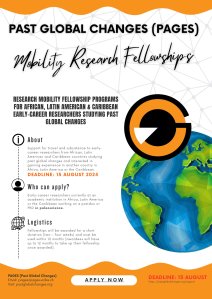
The call for the PAst Global changES (PAGES) research mobility fellowships for African, Latin American and Caribbean early career researchers studying past global changes is currently open.

Deadline: 15 August 2024

To find out more and how to apply click here.

Mapping Ancient Africa: Video of Seminar 10

January 12, 2024
WDG

The 10th Mapping Ancient Africa seminar took place on Tuesday 7th February 2023. The seminar was delivered by Cecile Blanchet (Helmholtz-Zentrum Potsdam) and highlighted recent work linking river sediments from the Nile with change in global climate systems, including El Nino.

Details of this seminar can be found here. You can find more Mapping Ancient Africa seminar videos on the “Ecology of the Past” YouTube channel.

References

  • Blanchet, C.L., Osborne, A.H., Tjallingii, R., Ehrmann, W., Friedrich, T., Timmermann, A., Brückmann, W. & Frank, M. (2021) Drivers of river reactivation in North Africa during the last glacial cycle. Nature Geoscience 14, 97-103. DOI: 10.1038/s41561-020-00671-3
  • Blanchet, C.L., Tjallingii, R., Schleicher, A.M., Schouten, S., Frank, M. & Brauer, A. (2021) Deoxygenation dynamics on the western Nile deep-sea fan during sapropel S1 from seasonal to millennial timescales. Climate of the Past 17, 1025-1050. DOI: 10.5194/cp-17-1025-2021
  • Blanchet, C.L., Ionita, M., Ramisch, A., Tjallingii, R., Brauer, A., Laruelle, L., Bagge, M. & Klemann, V. (2023) Pacemakers of extreme floods during warmer and wetter climates of the “Wild Nile” stage. PREPRINT (Version 1) available at Research Square DOI: 10.21203/rs.3.rs-3051876/v1
INQUAlogo

New PODCAST: Human & Biosphere

January 11, 2024
WDG

INQUAlogo

The International Union for Quaternary Research (INQUA) supports a number of commissions which focus on more specific aspects of Quaternary research. One of these, the Human & Biosphere Commission, or HABCOM, has recently launched a podcast introducing its members and activities. To find out more about HABCOM listen to the podcast below, or click this link to visit the related INQUA web pages.

Mapping Ancient Africa: Structuring a scientific article

December 19, 2023
WDG

INQUAlogo

The Mapping Ancient Africa (MAA) project is currently (late 2023 until early 2024) in the process of collecting submissions for a special issue of the INQUA (our sponsors) journal Quaternary International. The special issue will showcase research developed at the MAA workshop in Rome, and presented at the MAA sessions at the INQUA Rome congress. However, the editorial team is open to considering manuscripts relevant to the MAA goals that come from people not already involved in the project – so please contact us if you have ideas.

The process of developing articles for the special issue will be supported by the MAA community through a series of events. The first of these was a online workshop (2 October 2023) set out the frame of reference for the special issue, and included a short presentation on tips for structing a scientific article for this journal. If you missed the event and are thinking about writing an article for the special issue, or in a similar style, you can catch up with this on the Ecology of the Past YouTube channel. In person writing workshops are planned for 2024 in Africa. As full details emerge information will be published here.

Mapping Ancient Africa: Scientists (part 3)

September 1, 2023
WDG

The third instalment of interviews with Mapping Ancient Africa scientists is now available. Watch ‘the final four’ below, and check out the other videos by clicking on the names below:

Interview 10: Markus Fisher (University of Potsdam)

Interview 11: Soléne Boisard (University of Montréal) – in French

Interview 12: Trevor Hill (University of KwaZulu-Natal)

Interview 13: Jemma Finch (University of KwaZulu-Natal)

To find out more about the Mapping Ancient Africa project click here.

INQUAlogo

Mapping Ancient Africa: Special Issue

August 31, 2023
WDG

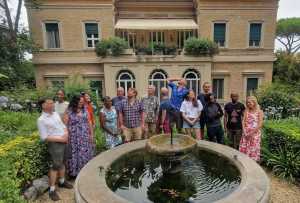
Mapping Ancient Africa participants on the Rome workshop (2023)

The Mapping Ancient Africa (MAA) project has an open call for contributions to a Special Issue of Quaternary International; the journal of our funder the International Union for Quaternary Research (INQUA). The concept for the special issue is agreed in principle with the journals editor-in-chief so now it is our task to collate a collection of manuscripts suitable to published in this international peer reviewed journal. The special issue will be based around papers discussed and presented at the MAA workshop in Rome and session at the INQUA congress in Rome in July 2023, but we are also happy to consider other manuscripts that fit within the MAA project area.

To find out if your manuscript idea might fit either explore the MAA web pages or contact a member of the editorial team:

Continue Reading

Mapping Ancient Africa: Scientists

August 25, 2023
WDG

During the Mapping Ancient Africa workshop in Rome I conducted short interviews with the scientists involved. The first of these, Alfred Houngnon can be viewed here, below are four more, and more will follow as I get them uploaded. I hope they provide interesting insights into the diverse range of skills and backgrounds our scientists have.

Interview 2: Busisiwe Hlophe (University of the Witwatersrand)

Interview 3: Angela Effion (University of the Witwatersrand)

Interview 4: Bahru Zinaye Asegahegn (University of Cologne)

Interview 5: Michela Leonardi (University of Cambridge)

To find out more about the Mapping Ancient Africa project click here.

INQUAlogo

Mapping Ancient Africa: INQUA Rome – session 1

August 18, 2023
WDG

On Wednesday 19 July 2023 the Mapping Ancient Africa session of the INQUA Rome congress took place. We were delighted to have an full program of speakers despite some late cancellations. The first session featured seven speakers.

No panic as we set up for session 1…

The first two talks focused on southern Africa. The first talk by Liviu Giosan (Woodshole Oceanographic Institute) focused on new sediment cores extracted from the Okavango – Makgadikgadi region and new efforts to obtain sediment cores that can provide information on the dispersal of hominins. Brian Chase (CNRS) then looks us to the Karoo highlighting recent findings that suggest that this currently arid region was more habitable in the past and that a proliferation of stone tools suggests past peoples utilised the region extensively (Carr et al., 2023).

Continue Reading
Blog at WordPress.com.