Supervisory team: Prof. David Sear, Prof. Justin Sheffield, Prof Ian Croudace (National Oceanographic Centre, Southampton).
Rationale: Because of their small size and isolation, islands in the Pacific have limited and fragile natural resources, making them more vulnerable to climate hazards and stresses than are continents1. Pacific Island Nations (PINS) also occupy the region of the earth’s surface most immediately impacted by ENSO events. The impacts of El Nino events are felt across 3,975 islands, 13 island nations, affecting a population of 12.9 million who rely on rainfall for freshwater and food security. To date our understanding of the mechanisms of drought, their frequency and duration, and their biophysical effects in PINs remain poorly quantified. In addition island types experience droughts differently, varying according to their location, topography, geological history and ecology. Droughts are also thought to have been important drivers of the human colonization of the Pacific2. Drought frequency is likely to increase in the tropical pacific but again its specific impacts are largely unknown. This PhD seeks to develop a step change in our understanding of droughts based on novel coupling of long term data on drought frequency with process based drought modelling.
Title: When was the South Pacific colonised? A lake sediment approach to understanding climate:human drivers of ecosystem change on remote Pacific Islands
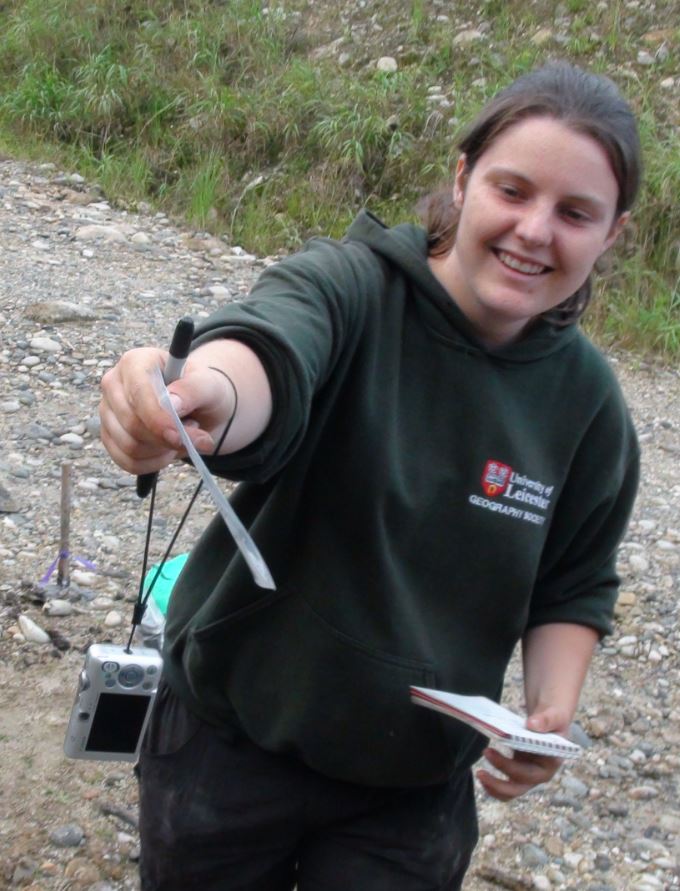
Hayley Keen getting excited about sediments during fieldwork in Ecuador (2012). Photo: J. Malley
Keen, H.F. (2015) Past environmental change on the eastern Andean flank, Ecuador. PhD Thesis, Department of Environment, Earth & Ecosystems, The Open University.
Abstract The eastern Andean flank of Ecuador (EAF) contains some of the world’s most biodiverse ecosystems. Andean montane forests are threatened due to anthropogenic pressures and both current and projected climate change. This thesis examines the palaeoecological history of two stratigraphic sequences (Mera Tigre West [MTW] and Mera Tigre East [MTE]) obtained from the Ecuadorian modern lower montane forest. The sediments preserved were analysed using eight analytical techniques, allowing an insight into the ecosystem’s potential response to projected changes derived from their past responses. Palaeoecological studies on the EAF are rare, and those that do exist are debated relating to: i) the inference of robust ecological data from pollen records in floristically diverse locations, and ii) the past source area of sediments preserved in fluvially exposed sequences, potentially leading to contamination with older material.
A statistical sub-sampling tool was developed (debate i), capable of producing statistically robust count sizes for each pollen sample; MTW and MTE count sizes ranged from 196-982 showing the diversity within sequences. The depositional environment of MTE was analysed, investigating sediment provenance throughout (debate ii). Results found that large scale volcanic events were critical in the preservation of the sediments, whereas fluvial influence caused a regional sediment source area in the upper stratigraphy, impacting on the palynological interpretation of MTE. Pollen records demonstrated the presence of a diverse vegetation community with no modern analogue at MTE (abundant taxa (>15 %): Hedyosmum, Wettinia, Ilex) and upper montane forest at MTW (Alnus, Hedyosmum, Podocarpus). Fire was not the main driver for the vegetation reassortment at either site (MTW correlation coefficient: -0.37, MTE: 0.16). The two sites have demonstrated the EAF plays host to floristically dynamic ecosystems, susceptible to drivers of change (fire and landscape) and should be considered when predicting the montane forests’ future response to environmental change.
Characterization of Neotropical ecosystems by their modern pollen spectra and organic chemical composition
Develop skills in pollen identification, pollen chemical characterization, and the analysis of organic biomarkers.
Examine ecological variation across an altitudinal gradient of nearly 4000 meters on the tropical western Andean flank.
Improve understanding of how ecosystems function in a biodiversity hotspot, and how they might be identified in the fossil record.
The considerable biodiversity of Neotropical ecosystems is under pressure from projected climate change and human activity. Modern ecosystems can be characterized by their pollen rain and organic chemistry, which can in turn provide information about ecosystem health and functioning. However, little is known about how pollen assemblage and chemical composition (of pollen and plants) vary along environmental gradients. Altitudinal transects provide an opportunity to study a range of environments and ecosystems with a relatively small geographic area. By improving our understanding of modern ecosystems we can improve our interpretation of fossil records, and consequently better understand how modern ecosystems came into being.
The main objectives of this PhD project are to:
Generate the first modern pollen assemblage and chemical data set for the Neotropics,
Characterize the landscape-scale variation in pollen assemblage and chemistry composition, and
Identify the key environmental drivers that determines pollen assemblage and chemistry composition variation.
Publication date: 27 July 2015 Closing date: 18 September 2015
Level of education: University (Masters)
Hours: 38 hours per week
Salary indication: €2,125 to €2,717 gross per month
Vacancy number: 15-286
Applications should be emailed to application-science@uva.nl, with in the subject line the position you are applying for and vacancy number (15-286). Please make sure all your material is attached in only one pdf. Applications should include a detailed CV including educational experiences, a list of research projects and/or publications, a letter of motivation, relevant work experience, and the names and contact addresses of two academic referees from whom a reference for the candidate can be obtained.
For more details, including information on how to apply, click here (UvA), or here (via academic transfer).
Alice Kennedy (far right) celebrating post-viva examination.
It is been a while since the Milton Keynes’s part of the group have manifested in the blog. The main reason is that we have been a bit busy basically…submitting theses!!!!
Valencia Castillo, B.G. (2014) From glacial to modern conditions: Vegetation and climate change under human influence in the Central Andes. PhD Thesis, Department of Environment, Earth & Ecosystems, The Open University.
Abstract
Conservation, restoration and management strategies are employed to maintain Earth’s biological diversity and physical environment to a near “natural” state. However, the concept of “natural” is generally inexact and may include degraded landscapes. In absence of long-term empirical data of natural baselines, impacted assemblages (human altered baselines) could be falsely assumed to be natural and set as conservation or restoration goals. Therefore, the identification of long-term ecological baselines becomes a pressing requirement especially in threatened biodiversity hotspots such as the tropical Andes that were under human pressure for several millennial.
This thesis aims to identify ecological baselines for tropical Andean ecosystems based on multi-proxy palaeoecological reconstructions from three Andean lakes. Trends of vegetation change are used to identify when landscapes became anthropogenic in the Andes. Because vegetation assemblages at c. 10 ka experienced negligible anthropogenic impacts and had modern-like climate condition, this time was considered the most recent period likely to provide insight into natural ecological baseline conditions.
Changes in vegetation assemblages were evaluated over time departing from 10 ka around Miski and Huamanmarca, two sites that remained virtually impervious to human impacts. Baselines in Miski and Huamanmarca drifted continuously over time and showed that baselines are dynamic entities. The vegetation assemblages derived from Miski and Huamanmarca suggest that that human impact was not homogeneous throughout the Andean landscape.
Once baselines were defined it was possible to evaluate if the spatial distribution of Andean woodlands represented by Polylepis was a product of human impacts. A MaxEnt model generated based on 22 modern environmental variables and 13 palaeoecological vegetation reconstructions showed that Polylepis woodlands were naturally fragmented before humans arrived in South America (14 ka). However, the influence of humans during the mid and late Holocene enhanced the patchiness of the forest generating a hyper-fragmented landscape.
Williams, J.J. (2011) Human and climate impacts on tropical Andean ecosystems. PhD Thesis, Department of Earth & Environmental Sciences, The Open University.
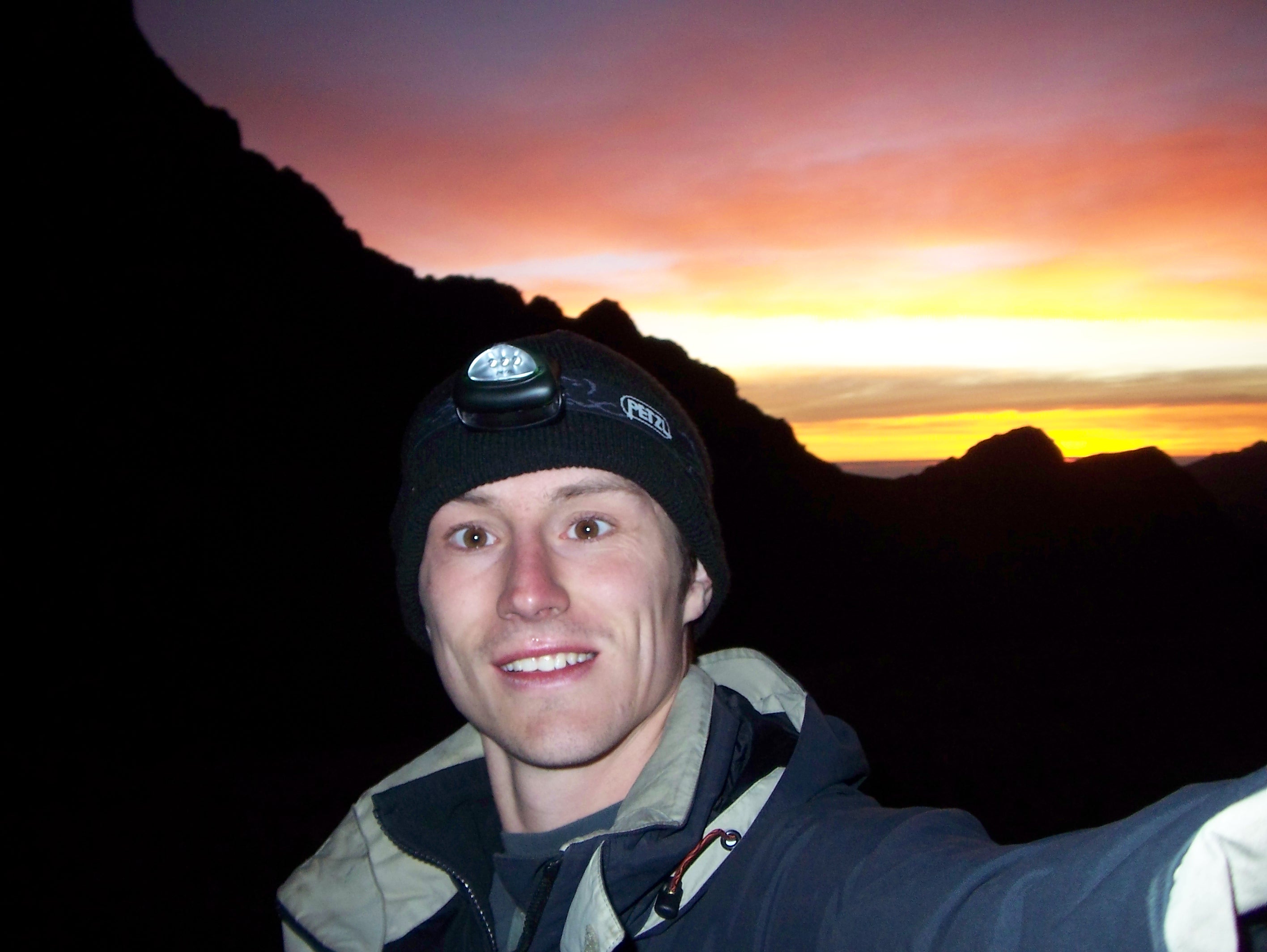
JJW Bolivia (2007)
Abstract:
Population growth and predicted global climate change are applying new, and increasing, pressure to mountain environments, but the consequences of these changes upon the biodiverse and vulnerable Tropical Andean ecosystems are poorly understood. This thesis explores past human-climate-ecosystem interactions using multi-proxy palaeolimnological investigations (fossil pollen, spore, charcoal and Chironomidae (midges); elemental abundance, colour spectra and magnetic susceptibility) of two sites in the eastern Bolivian Andes (Lake Challacaba and Laguna Khomer Kocha Upper) over the last c. 18,000 years. During the deglaciation and Holocene ecosystems were exposed to varying climatic stress levels, and pressures imposed by the development of human cultures.
Examination of preserved ecological assemblages, including the first assessment of subfossil central Andean Chironomidae, reveals ecosystem sensitivity to changes in temperature, moisture, fire regime, lake level and salinity. Charcoal analysis from Laguna Khomer Kotcha Upper reveals changes in burning at c. 14,500, 10,100 and 6,400 cal yr BP. Concomitant palynological shifts shows this climatically controlled fire regime was a transformative agent of Andean vegetation, particularly for the threatened, high elevation, Polylepis woodlands. Pollen and geochemical data from Lake Challacaba indicate two periods of aridity (c. 4000−3370 and 2190−1020 cal yr BP), these broadly correlated to El Niño/Southern Oscillation variations. Increased Sporormiella abundance after c. 1,340 cal yr BP indicate changes in trade routes and agricultural practices; demonstrating human adaption to environmental change and interconnectivity to Tiwanaku and Inca civilizations.
The long-term response of the terrestrial and aquatic ecosystems, reconstructed from these lakes, has provided insights into how Tropical Andean ecosystems may respond to future changes in temperature, precipitation and human interference. The palaeoenvironmental data has implications for conservation management; it indicates that spatial and temporal variations in site sensitivity, exposure and resilience should be assessed, and that planting strategies should mimic the present day natural patchy distribution of Polylepis woodlands.

 Title: Stress in Paradise: Quantifying the frequency and impacts of ENSO driven droughts in tropical Pacific Island Nations
 Location: University of Soithampton (Geography & Environment)





 Ecology of the past