Posted on behalf of Barry Lomax Linnean Society Palynology Specialist Group meeting Tuesday 24 November 2015
Provisional program
10:30 – 11:00 Barry Thomas (Aberystwyth University). Ecological interpretations of Asturian and Cantabrian lycophyte microspore floras of the Variscan Foreland and the Appalachian Province of the Central Coalfields of the U.S.A
11:00 – 11:30 Adele Julier (Open University). Can FTIR spectroscopy be used to identify grass pollen?
14:00 – 14:30 Viktória Baranyi1 (Oslo Universiy). Morphology and wall-ultrastructure of Froelichsporites traversei, an enigmatic sporomorph from the Late Triassic in North America.
14:30 – 15:00 Hannah Banks (Royal Botanic Gardens Kew). Functional and phylogenetically useful structures in Caesalpinioid legume pollen.
15:00 – 15:30 Sam Slater (Sheffield University). A quantitative analysis of Middle Jurassic vegetation dynamics based on dispersed spore/pollen assemblages from the Ravenscar Group, North Yorkshire, UK.
Afternoon tea 15:30 – 16:00
16:00 – 16:30 Alex Askew (Sheffield University). A palynological investigation of the Middle Devonian of northern Spain: hunting for the Kačák event.
16:30 – 17:00 Phil Jardine (Open University). A new use for old pollen: reconstructing past solar irradiance using pollen chemistry.
Wine reception
To register please contact Barry Lomax (Group secretary)
Posted on behalf of Thomas Giesecke:
EUROPEAN POLLEN DATABASE
Meeting and training workshops
1-3/06/2016
Aix-en-Provence, France
We offer exciting keynote lectures, an extensive poster session to showcase your research, and two days of training with experts in software, databases, and modelling.
We want your opinion on how to develop the European Pollen Database (EPD) to make it a better resource for research, education, and data storage.
NO registration fee
Workshop topics include:
Plotting and archiving palaeoecological data, using Tilia and Neotoma
Charcoal analysis software and database
How to use modern surface samples for ‘analogue’ reconstructions of the past
Bermúdez, M.A., Hoorn, C., Bernet, M., Carrillo, E., van der Beek, P.A., Garver, J.I., Mora, J.L. & Mehrkian, K. (2015) The detrital record of late-Miocene to Pliocene surface uplift and exhumation of the Venezuelan Andes in the Maracaibo and Barinas foreland basins. Basin Research. DOI: 10.1111/bre.12154
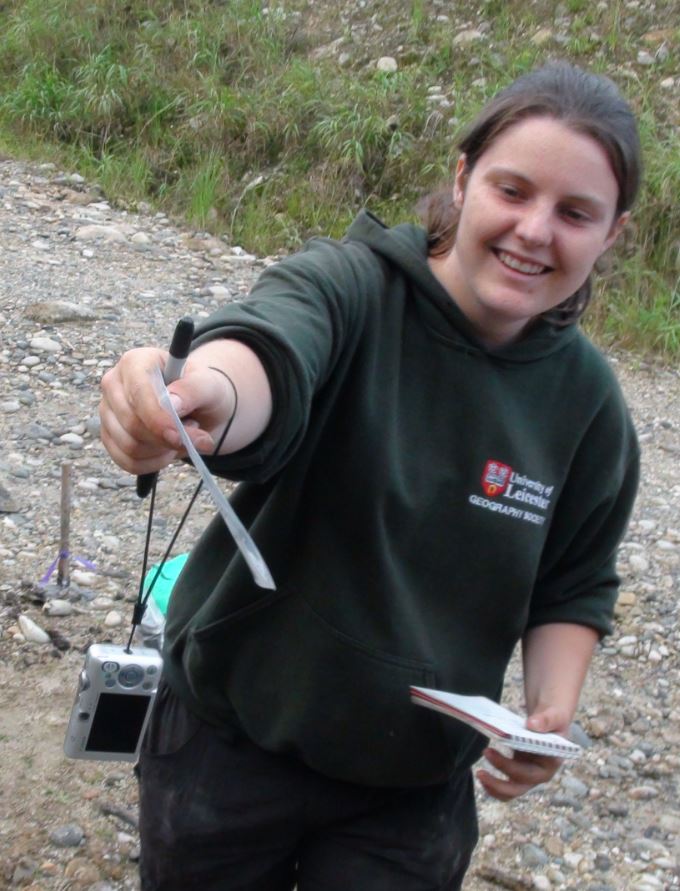
Hayley Keen getting excited about sediments during fieldwork in Ecuador (2012). Photo: J. Malley
Keen, H.F. (2015) Past environmental change on the eastern Andean flank, Ecuador. PhD Thesis, Department of Environment, Earth & Ecosystems, The Open University.
Abstract The eastern Andean flank of Ecuador (EAF) contains some of the world’s most biodiverse ecosystems. Andean montane forests are threatened due to anthropogenic pressures and both current and projected climate change. This thesis examines the palaeoecological history of two stratigraphic sequences (Mera Tigre West [MTW] and Mera Tigre East [MTE]) obtained from the Ecuadorian modern lower montane forest. The sediments preserved were analysed using eight analytical techniques, allowing an insight into the ecosystem’s potential response to projected changes derived from their past responses. Palaeoecological studies on the EAF are rare, and those that do exist are debated relating to: i) the inference of robust ecological data from pollen records in floristically diverse locations, and ii) the past source area of sediments preserved in fluvially exposed sequences, potentially leading to contamination with older material.
A statistical sub-sampling tool was developed (debate i), capable of producing statistically robust count sizes for each pollen sample; MTW and MTE count sizes ranged from 196-982 showing the diversity within sequences. The depositional environment of MTE was analysed, investigating sediment provenance throughout (debate ii). Results found that large scale volcanic events were critical in the preservation of the sediments, whereas fluvial influence caused a regional sediment source area in the upper stratigraphy, impacting on the palynological interpretation of MTE. Pollen records demonstrated the presence of a diverse vegetation community with no modern analogue at MTE (abundant taxa (>15 %): Hedyosmum, Wettinia, Ilex) and upper montane forest at MTW (Alnus, Hedyosmum, Podocarpus). Fire was not the main driver for the vegetation reassortment at either site (MTW correlation coefficient: -0.37, MTE: 0.16). The two sites have demonstrated the EAF plays host to floristically dynamic ecosystems, susceptible to drivers of change (fire and landscape) and should be considered when predicting the montane forests’ future response to environmental change.
The month-long palaeoecology module at UvA is coming to an end. We have had two weeks of lectures and microscope work, an introduction to quantitative palaeoecology, and we just finished a week of fieldwork in Twente, which is in the easternmost part of the Netherlands.
Students working in the field (photo: M. Groot)
Will Gosling and I tried something new for the field excursion this year. We split the class into eight groups, and gave each group a set of pollen and phytolith samples from an ‘unknown location’. Unknown in this context means being from one of the eight primary sites that we would visit during the field excursion. The students were required to perform vegetation surveys and characterize soils at each of the primary sites that we visited. The goal of each group was to figure out which location their set of ‘unknown’ samples came from. Basically, we had them doing forensic palynology, with idea that they could then better visualize the different vegetation assemblages seen in the palaeoecological records. Continue Reading
As part of my MSc research project on Early-Miocene paleodiversity shifts due to marine incursions in the Amazon basin, I recorded and photographed large numbers of palynomorphs. The database consists of a set of images (Teunissen van Manen, 2015a) that I took with my smartphone (bundled in pdfs for sharing purposes) and an Excel overview file (Teunissen van Manen, 2015b) where each of the entries is described. Some of the entries are well documented taxa (C’mon, who hasn’t heard of Zonocostites ramonae and Mauritidites franciscoi before?) while others are “types” that are not formally described – mainly because in Amazonian sediments new, unseen palynomorphs pop up all the time. Indeed, this was the reason why I started the database in the first place: I was merely trying to keep up with the vast diversity that I encountered during sample counting.
Mauritidites franciscoi
TP 100
Seeing the added value of having a digital record of the palynological diversity from the Amazon basin samples, my project supervisor, Carina Hoorn (UvA), encouraged me to publish the database online so others could also access it. I’d like to invite you to take a look. I hope it can maybe help you with identifying taxa or, who knows, linking taxa across the Amazon basin… if you do, please let me know!
…or maybe it will have you rejoice in the huge diversity and alien beauty of pollen morphology, just as it rejoiced me as I was working through my (seemingly endless) samples.
Last year I was told that my fieldwork in Samoa and New Caledonia was the best I’d ever experience; turns out that was a lie. This year I was fortunate enough to return to Samoa, and even more fortunate to go to the small island of Atiu in the Cook Islands. There was one very simple reason for me, along with Prof. David Sear and Dr Pete Langdon, to return to the South Pacific: we needed more sediment from the lakes on these islands. This sediment is crucial to determine how a massive band of rain – called the South Pacific Convergence Zone (SPCZ) – has moved in the past. Millions of people are dependent on the SPCZ for drinking water. Data from satellites has shown that various climatic phenomena that operate in the Pacific Ocean cause the South Pacific Convergence Zone to move. With future climate change likely…
Valencia Castillo, B.G. (2014) From glacial to modern conditions: Vegetation and climate change under human influence in the Central Andes. PhD Thesis, Department of Environment, Earth & Ecosystems, The Open University.
Abstract
Conservation, restoration and management strategies are employed to maintain Earth’s biological diversity and physical environment to a near “natural” state. However, the concept of “natural” is generally inexact and may include degraded landscapes. In absence of long-term empirical data of natural baselines, impacted assemblages (human altered baselines) could be falsely assumed to be natural and set as conservation or restoration goals. Therefore, the identification of long-term ecological baselines becomes a pressing requirement especially in threatened biodiversity hotspots such as the tropical Andes that were under human pressure for several millennial.
This thesis aims to identify ecological baselines for tropical Andean ecosystems based on multi-proxy palaeoecological reconstructions from three Andean lakes. Trends of vegetation change are used to identify when landscapes became anthropogenic in the Andes. Because vegetation assemblages at c. 10 ka experienced negligible anthropogenic impacts and had modern-like climate condition, this time was considered the most recent period likely to provide insight into natural ecological baseline conditions.
Changes in vegetation assemblages were evaluated over time departing from 10 ka around Miski and Huamanmarca, two sites that remained virtually impervious to human impacts. Baselines in Miski and Huamanmarca drifted continuously over time and showed that baselines are dynamic entities. The vegetation assemblages derived from Miski and Huamanmarca suggest that that human impact was not homogeneous throughout the Andean landscape.
Once baselines were defined it was possible to evaluate if the spatial distribution of Andean woodlands represented by Polylepis was a product of human impacts. A MaxEnt model generated based on 22 modern environmental variables and 13 palaeoecological vegetation reconstructions showed that Polylepis woodlands were naturally fragmented before humans arrived in South America (14 ka). However, the influence of humans during the mid and late Holocene enhanced the patchiness of the forest generating a hyper-fragmented landscape.

 Tuesday 24 November 2015



 Ecology of the past