INQUA fellow Alfred Hougnon continues his research into past environmental change in the Dahomey Gap (Benin). In the fourth video documenting his progress a short background to the project, and insights into field work, are given. Field work took place near the Ewe-Adakplame forest in the south east of Benin and involved the recovery of sediments using a Russian corer. The video also shows how interactions and engagement with the local community was developed during the research expedition.
To find out more above Alfreds project read posts on:
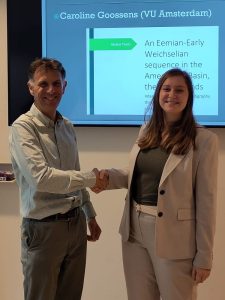
On Friday 24 May 2024 the Palynologische Kring (Dutch palynological society) held a seminar series and laboratory workshop at the Institute for Biodiversity & Ecosystem Dynamics (University of Amsterdam). During the afternoon we had the annual meeting of the society, the presentation of our MSc Thesis prize, four seminars and two laboratory demonstrations. The MSc thesis prize “Florschütz Award” was won by Caroline Goossens (VU Amsterdam) for her thesis entitle: “An Eemian-Early Weichselian sequence in the Amersfoort Basin, the Netherlands”; the project was supervised by Natalie Van der Putten, Cees Kasse and Jeroen Schokker. We hope that Caroline will present her thesis at a future Palynologishe Kring meeting.
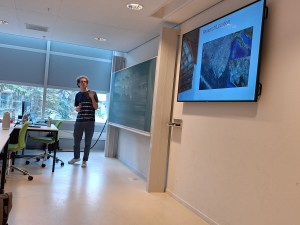
Teye Aukes presenting on the diatoms of ancient Rome
The talk series was kicked off by Nina Witteveen (University of Amsterdam) who presented part of her PhD thesis (currently awaiting defense), entitled: “Long-term forest recovery in Amazonia insights from phytolith analysis”. Nina discussed the impact of past peoples on the vegetation of Suriname based on her work identifying phytoliths in soil samples collected at varying distances from an archaeological site. The second talk was given my Amanda Henry (Leiden University) who demonstrated how the analysis of starch grains extracted from archaeological context can provide insights in to past diets. She used these evidences to suggest that early humans and Neanderthals had a similar diversity of plants in their diets. The third talk was given by University of Amsterdam MSc researcher Teye Aukes and focused upon his identification of diatoms from an swampy lagoon environment near Ostia (Italy). He drew conclusions from these data about the antiquity of salt production in ancient Rome. The final talk was given online by Welmoed Out (Moesgaard Museum) who presented a detailed analysis of inter- and intra-analyst variability in phytolith morphometric analysis.
After the seminars we moved upstairs to the microscope laboratory where Nina Witteveen and Ana Smuk (University of Groningen) showed off phytoliths from their study site in South America and the Netherlands.
Some of the Palynologische Kring members enjoying some refreshment after the event.
de Weger, L.A., Verbeek, C., Markey, E., O’Connor, D.J. & Gosling, W.D. (2024) Greater difference between airborne and flower pollen chemistry, than between pollen collected across a pollution gradient in the Netherlands. Science of The Total Environment 172963. DOI: 10.1016/j.scitotenv.2024.172963
Alfred Houngnon was awarded an INQUA Fellowship in 2024 to develop his work on past environmental change in the Dahomey Gap (western Africa). Through the project Alfred is making a series of videos about his fellowship journey. In the first video Alfred introduced his project and collaborators (click here to watch the first part). In the two latest instalments (below) Alfred explains: (i) one of his key methodological approaches (modern pollen trapping), and (ii) the modern vegetation of the region and current threats to the vegetation.
Poaceae (the grass family) is one of the most diverse angiosperm families on Earth, comprising close to 12,000 species. The history of grass-dominated biomes extends back over 20 million years, yet the spatial and temporal development of these biomes and the underlying drivers remains unresolved. This thesis addresses these questions in South America, focusing on modern grass pollen and ancient samples dating from the early Miocene to the present. The thesis reveals several key points: (i) Grass pollen size varies significantly both among genera and species and within species. Pollen size shows no correlation with (a)biotic factors, indicating its limited utility as a generally applicable proxy for reconstructing past vegetation and climate; (ii) Grass pollen exhibits high diverse on surface ornamentation. The morphotypes identified by descriptive terminology are well-supported by a combination of SEM images of pollen surface patterns and computational image analysis. The findings reveal that pollen sculpture is unrelated to (a)biotic variables but is diverse across the phylogeny; (iii) Tropical grass pollen morphology suggests a gradual rather than punctuated evolution, based on the trend toward a less dense ornamentation of the exine since c. 23 Ma. The changes in the exine of grass pollen since the early Miocene might be driven by evolutionary processes (evolutionary drift and/or directional selection), and potentially immigration at the continental scale. In summary, the thesis reveals the trajectory of grass pollen morphological changes over time and examining the drivers that have contributed to their evolution and geographical expansion at the continental scale.
Sales, R.A., McMichael, C.N.H., Peterson, L.C., Stanley, A., Bennett, I., Jones, T.E., Walker, A.S., Mulhearn, M., Nelson, A., Moore, C., O’Connor, M., Sinkler, W., Banner, C., Church, W., VanValkenburgh, P. & Bush, M.B. (2024) Wet and dry events influenced colonization of a mid-elevation Andean forest. Quaternary Science Reviews 327, 108518. DOI: 10.1016/j.quascirev.2024.108518
I am delighted to be able to report that Alfred Houngnon (University of Abomey-Calavi, Benin) has beenawarded an INQUA Fellowship for 2024 to develop his research into past environmental change in the Dahomey Gap. This research will link up my laboratory, at the Institute of Biodiversity & Ecosystem Dynamics (University of Amsterdam), and the group of Dr Mireille S.S. Toyi(Laboratory of Applied Ecology, University of Abomey-Calavi). Below, and in the associated video report, Alfred explains the project and what he hopes to achieve during the project.
The Dahomey Gap project is designed to gain new insights on the West African palaeoenvironments using pollen, charcoal and dung fungal spore records to reconstruct past vegetation, fire and animal abundances. These empirical data will then be compared against paleoclimate models. Specifically, we will explore the interactions between fire, animals and vegetation around the Ewe-Adakplame forest in the south east of Benin Republic and highlight the role humans would have previously played in the modification of the landscape for millennia.
On November 17, 2023, Caixia Wei (魏彩霞) accomplished a pivotal milestone by successfully defending her thesis titled “Morphometrics of Modern and Fossil Poaceae Pollen from South America” at the distinguished Agnietenkapel (University of Amsterdam). During the defense ceremony, Caixia showcased her professional knowledge and expertise in the field of paleoecology in a relaxed and cheerful manner. The committee members, promoters (Carina Hoorn, William Gosling, Phillip Jardine), and attendees (~50 people) responded with frequent smiles, laughter, and numerous rounds of applause! After the defense, a delightful reception and dinner were held, where Caixia was showered with an abundance of hugs, kisses, heartfelt wishes, and thoughtful gifts. These wonderful memories will support Caixia on her journey ahead…
For a glimpse into the event, you can watch Caixia’s insightful 10-minute project presentation here:
Additionally, most of Caixia’s thesis is available for download at this link:




 Ecology of the past