The 17th online Mapping Ancient Africa seminar took place on Thursday 16 May 2024. The seminar was delivered by N’dji dit Jacques Dembele and was entitled “Evidence of recent seismicity in the West African Craton: The Bamako seisemites Mali”. In the seminar surprising new evidence for Quaternary seismic activity within the West African Craton – which was thought to be tectonically stable – was presented. Specifically, the identification of clastic dykes and deformation within sedimentary and lacustrine deposits was used to suggest past high magnitude earth quakes in the last 170,000 years.
The next Mapping Ancient Africa seminar will take place online at 17:00 CEST on 16 May 2024.
Speaker: N’dji dit Jacques Dembele (President of WAQUA, Université des sciences sociales et de gestion de Bamako, Mali)
Title: Quaternary period seismicity on the West African Craton
The seminar will be delivered via Zoom. The link for the seminar can be obtained from the MAA Slack channel or by contacting the chair of this seminar (Stefanie Kaboth-Bahr). If you want to know more about the Mapping Ancient Africa project visit our web pages and please do not hesitate to get in contact if you want to get involved.
The Mapping Ancient Africa (MAA) special issue of Quaternary International (QI) will open for submission on 30 April and will close 30 July 2024. To submit your article go to the QI submission portal and click “submit new article”, you will then be asked to “select article type”. From the drop down list select “SI: Mapping Ancient Africa”. This will ensure that your manuscript is directed to the guest editorial team. Submissions should follow the standard QI guideline (click here for details) and take account of the advice for submission to this special issue (click here for details).
The special issue is centered around work and papers presented in the MAA Rome workshop and sessions at the INQUA Rome congress (session 1, session 2), however, if you have a manuscript that you think would be appropriate for inclusion given the research themes of the project please also consider submitting. If you have any questions feel free to contact the editorial team in advance.
The Southern African Society for Quaternary Research (SASQUA) is hosting its 24th congress 19-24 May 2024 in the Cango Valley, South Africa. The congress will bring together scientists working on all aspects of the Quaternary in southern Africa. Poster and oral presentations possible.
Abstract submission and student support application deadline: 31 March 2024
A workshop will be held at the National Museums of Kenya (Nairobi, Kenya) in June 2024. The aim of the workshop is to help authors prepare articles for the Mapping Ancient Africa (MAA) special issue proposed for publication in Quaternary International and lead by Dr. Stefanie Kaboth-Bahr. The workshop will be associated with the “1st Joint International Scientific Conference” (3-6 June). The MAA workshop is being organized by Dr. Rahab Kinyanjui, and the congress organization is being lead by Dr. Emmanuel Ndiema (click here to watch his 2022 MAA seminar) and Dr. Esther Kioko (Acting Director National Repository and Research).
For further information on attending the MAA workshop please contact Rahab directly.
To find out more about the Mapping Ancient Africa project click here.
The Mapping Ancient Africa (MAA) project is currently (late 2023 until early 2024) in the process of collecting submissions for a special issue of the INQUA (our sponsors) journal Quaternary International. The special issue will showcase research developed at the MAA workshop in Rome, and presented at the MAA sessions at the INQUA Rome congress. However, the editorial team is open to considering manuscripts relevant to the MAA goals that come from people not already involved in the project – so please contact us if you have ideas.
The process of developing articles for the special issue will be supported by the MAA community through a series of events. The first of these was a online workshop (2 October 2023) set out the frame of reference for the special issue, and included a short presentation on tips for structing a scientific article for this journal. If you missed the event and are thinking about writing an article for the special issue, or in a similar style, you can catch up with this on the Ecology of the Past YouTube channel. In person writing workshops are planned for 2024 in Africa. As full details emerge information will be published here.
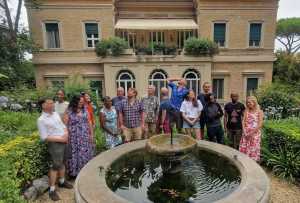
Mapping Ancient Africa participants on the Rome workshop (2023)
The Mapping Ancient Africa (MAA) project has an open call for contributions to a Special Issue of Quaternary International; the journal of our funder the International Union for Quaternary Research (INQUA). The concept for the special issue is agreed in principle with the journals editor-in-chief so now it is our task to collate a collection of manuscripts suitable to published in this international peer reviewed journal. The special issue will be based around papers discussed and presented at the MAA workshop in Rome and session at the INQUA congress in Rome in July 2023, but we are also happy to consider other manuscripts that fit within the MAA project area.
To find out if your manuscript idea might fit either explore the MAA web pages or contact a member of the editorial team:
The Mapping Ancient Africa (MAA) project has a double session of talks and a poster session at the INQUA congress in Rome 2023. Our session will be on Wednesday 19 July.
Giosan et al. When the desert was a lake: Providing context for Homo sapiens development in the northern Kalahari
Chase et al. Paleolakes and socioecological implications of glacial “greening” of the South African interior
Biddulph et al. Spatiotemporal variability in the initiation and development of peatlands across the central Congo Basin
Blinkhorn et al. Evaluating refugia in recent human evolution in Africa
Aureli et al. Homo sapiens behaviour and adaptation in East Africa. New evidence from an open-air site in a modern Ethiopian savannah environment: the GOT10 site
Dembele Climatic fluctuations during the last millenium and their impact on political history and human settlements in West Africa
Porchier et al. Annually resolved hydroclimate variability in the East African Rift Valley at a time critical for hominin dispersion
Effiom et al. Late Holocene palaeoecological studies at Lake St Lucia, KwaZulu-Natal
Related publication: Blanchet, C.L., Osborne, A.H., Tjallingii, R., Ehrmann, W., Friedrich, T., Timmermann, A., Brückmann, W. & Frank, M. (2021) Drivers of river reactivation in North Africa during the last glacial cycle. Nature Geoscience 14, 97-103. DOI: 10.1038/s41561-020-00671-3
The seminar will be delivered via Zoom. The link for the seminar can be obtained from the MAA Slack channel or by contacting the chair of this seminar Stefanie Kaboth-Bahr. If you want to know more about the Mapping Ancient Africa project visit our web pages and please do not hesitate to get in contact if you want to get involved.









 Ecology of the past