Phytoliths, starch grains and diatoms

May 29, 2024
WDG

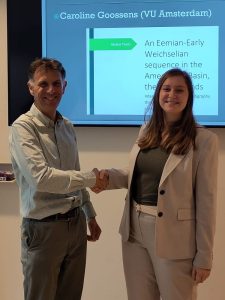
Caroline Goossens receives the Florschütz Award.

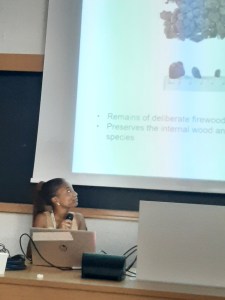
On Friday 24 May 2024 the Palynologische Kring (Dutch palynological society) held a seminar series and laboratory workshop at the Institute for Biodiversity & Ecosystem Dynamics (University of Amsterdam). During the afternoon we had the annual meeting of the society, the presentation of our MSc Thesis prize, four seminars and two laboratory demonstrations. The MSc thesis prize “Florschütz Award” was won by Caroline Goossens (VU Amsterdam) for her thesis entitle: “An Eemian-Early Weichselian sequence in the Amersfoort Basin, the Netherlands”; the project was supervised by Natalie Van der Putten, Cees Kasse and Jeroen Schokker. We hope that Caroline will present her thesis at a future Palynologishe Kring meeting.
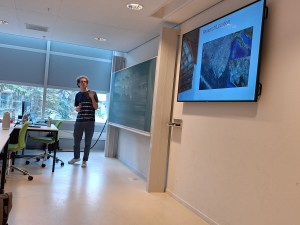
Teye Aukes presenting on the diatoms of ancient Rome

The talk series was kicked off by Nina Witteveen (University of Amsterdam) who presented part of her PhD thesis (currently awaiting defense), entitled: “Long-term forest recovery in Amazonia insights from phytolith analysis”. Nina discussed the impact of past peoples on the vegetation of Suriname based on her work identifying phytoliths in soil samples collected at varying distances from an archaeological site. The second talk was given my Amanda Henry (Leiden University) who demonstrated how the analysis of starch grains extracted from archaeological context can provide insights in to past diets. She used these evidences to suggest that early humans and Neanderthals had a similar diversity of plants in their diets. The third talk was given by University of Amsterdam MSc researcher Teye Aukes and focused upon his identification of diatoms from an swampy lagoon environment near Ostia (Italy). He drew conclusions from these data about the antiquity of salt production in ancient Rome. The final talk was given online by Welmoed Out (Moesgaard Museum) who presented a detailed analysis of inter- and intra-analyst variability in phytolith morphometric analysis.

After the seminars we moved upstairs to the microscope laboratory where Nina Witteveen and Ana Smuk (University of Groningen) showed off phytoliths from their study site in South America and the Netherlands.

Some of the Palynologische Kring members enjoying some refreshment after the event.

What has biogenic silica ever done for us?

April 3, 2024
WDG

Siliceous Microfossils Meeting

  • Date: Friday 24 May 2024
  • Location: Institute for Biodiversity & Ecosystem Dynamics, University of Amsterdam

Program

  • 13:00-14:00 – Palynologische Kring society annual meeting
  • 14:00-14:15 – Coffee
  • 14:15-15:45 – Seminar series
    • Using phytolith analysis to detect palm enrichment in Amazonia Nina Witteveen (University of Amsterdam)
    • Starch grains as indicators of plant food consumption in Neanderthals and Early Modern Humans Amanda Henry (University of Leiden)
    • Paleoenvironmental history of an archaeological lagoon in Central Italy: Insights from diatom analysis Majoi Nacimiento, Teye Aukes & Jan Sevink (University of Amsterdam)
  • 15:45-17:30 – Laboratory activities
    • Advances in topical phytolith identification Nina Witteveen (University of Amsterdam)
    • Finding Suitable Grounds – combining the on/off site approach through phytolith investigation in Flevoland Ana Smuk (Rijksuniversiteit Groningen)

If you are not already a member and would like to attend please contact the society via email or the web portal: https://www.palynologischekring.nl/contact/

To find out more about the Palynologische Kring click here to visit the web site.

Mapping Ancient Africa: INQUA Rome – session 2

August 24, 2023
WDG

The second part of the Mapping Ancient Africa session at the INQUA Rome congress contained eight talks. Busisiwe Hlophe (University of the Witwatersrand) kicked us off by showing us the power of looking at wood anatomy preserved in charcoal microfossils to determine the nature of past vegetation and climate. Rahab Kinyanjui (National Museums of Kenya) presented phytolith work from archaeological sites revealing a mixed woody and grassy vegetation associated with archaic Homo sapiens in Kenya.

Three talks from the Cape Region in South Africa then followed with Saul Manzano (University of Leon), Stella Moscher (University of Utah), and Asithandile Ntsondwa (Nelson Mandela University) using various palaeo ecological approaches to explore climate, vegetation and fire regime shifts during the Holocene. Adele Julier (University of Portsmouth) then took us a little further north to Namibia to think about the challenges of parameterising modern pollen-vegetation relationships in arid regions. The final southern African talk was given by Gemma Poretti (University of Cape Town) explored a new approache to tracking change in past rainfall patterns using charcoal material.

Continue Reading

Mapping Ancient Africa: Rome workshop

July 14, 2023
WDG

The Mapping Ancient Africa workshop took place at the Royal Netherlands Institute in Rome on the 12 and 13 July 2023. Participants engaged with two different approaches to palaeoclimate modelling:

  • Interfacing palaeoclimate models through the “pastclim” R package. Lead by Michela Leonardi.
  • Reconstrucing palaeclimate on the basis of ancient pollen data using the CREST program. Lead by Manu Chevalier.

The aim of the workshop was to promote interaction between scientists working across Africa and across disciplines (palaeoclimate, palaeoecology, archaeology, modelling). The plenary session was joined by participants who could not make it to Italy via Zoom. This session was recorded and you can watch it below. In the plenary session outputs from the workshop, the planned special issue of Quaternary International, and the future of the Mapping Ancient Africa project were discussed.

To find out more about the workshop click here.

INQUAlogo
Continue Reading

Mapping Ancient Africa: INQUA Rome session

July 3, 2023
WDG

The Mapping Ancient Africa (MAA) project has a double session of talks and a poster session at the INQUA congress in Rome 2023. Our session will be on Wednesday 19 July.

If you are at the INQUA Rome congress please come along to our talks and posters in Session 64: Mapping Ancient Africa: Climate, Vegetation & Humans.

Part 1: 08:30-10:30

  • Giosan et al. When the desert was a lake: Providing context for Homo sapiens development in the northern Kalahari
  • Chase et al. Paleolakes and socioecological implications of glacial “greening” of the South African interior
  • Biddulph et al. Spatiotemporal variability in the initiation and development of peatlands across the central Congo Basin
  • Blinkhorn et al. Evaluating refugia in recent human evolution in Africa
  • Aureli et al. Homo sapiens behaviour and adaptation in East Africa. New evidence from an open-air site in a modern Ethiopian savannah environment: the GOT10 site
  • Dembele Climatic fluctuations during the last millenium and their impact on political history and human settlements in West Africa
  • Porchier et al. Annually resolved hydroclimate variability in the East African Rift Valley at a time critical for hominin dispersion
  • Effiom et al. Late Holocene palaeoecological studies at Lake St Lucia, KwaZulu-Natal

Part 2: 11:00-13:00

Continue Reading

Mapping Ancient Africa in Rome

February 3, 2023
WDG

I am pleased to announce that we will be holding a two day Mapping Ancient Africa (MAA) workshop at the “Royal Netherlands Institute in Rome” on the 12 and 13 July (just before the INQUA 2023 Rome congress). We invite all MAA members to participate. Workshops will be lead on the two days by myself, Stefanie, Rahab and Lynne. We will cover the development of manuscripts for the proposed Quaternary International special issue, and planning for the future of the MAA network (future meetings and potential grant applications). If there are particular items that you would like to cover during the workshops then please let us know and we will do our best to include them. This event will be designed primarily for “in person” activities, however, we hope to have opportunities for people to also link in online at some plenary moments.

IMPORTANT: If you plan to attend the MAA Rome meeting in person please email me to register with the words “MAA Rome event registration” in the subject line. I can then organize appropriate levels of catering.

If you are not already involved with MAA and would like to know more visit our web pages and get in contact.

This event, and the Mapping Ancient Africa multi-year project, is supported financially by the Palaeoclimates Commission (PALCOM) of INQUA.

INQUAlogo

Mapping Ancient Africa: INQUA congress support

October 4, 2022
WDG

The Mapping Ancient Africa (MAA) project is offering five bursaries to help African based and/or early career researchers^ attend the up coming INQUA Rome congress. Each bursary will around Euro 1000 and should be used towards covering the cost of registration, accommodation and/or travel for the congress.

Application criteria:

  • Abstract submitted to INQUA Rome congress either to the Mapping Ancient Africa session, or to another session on a related topic (Deadline 1 November 2022).
  • Commitment to contributing an article for consideration to be published in the proposed MAA special issue of Quaternary International; for frame of references of the MAA project click here.

To apply submit the following information via emails to William Gosling as the corresponding Principle Investigator of the project. Applications should be clearly marked MAA-Application-YourName in the subject line:

  • Evidence of submission of an abstract to the INQUA Rome congress (copy of confirmation email and abstract).
  • Letter of motivation, including fit of the proposed article to the MAA aims and goals and statement of commitment to submit an article for consideration to be published in the Mapping Ancient Africa special issue of Quaternary International^^ (not more than 1 page)
  • Short academic CV, including highlight of up to 5 published articles indicating the scientific importance and your role in the publication (not more than 2 pages).

In the event of more applications being received than funding is available awards will be made by the MAA team (PIs and co-PIs) on the basis of the fit of the research to the MAA aims and goals. To receive funding receipts for all the expenses incurred will need to be provided (following INQUA regulations).

Deadline for application: 7 November 2022

Announcement of funding: 14 November 2022

INQUAlogo

^ following definition for Early Career Researchers (ECR) or Developing Country Researchers (DCR) provided by INQUA.

^^ please note that no guarantee of final publication is given or implied by this commitment. All submitted manuscripts will be subject to the usual rigorous peer review procedures for the journal.

Blog at WordPress.com.