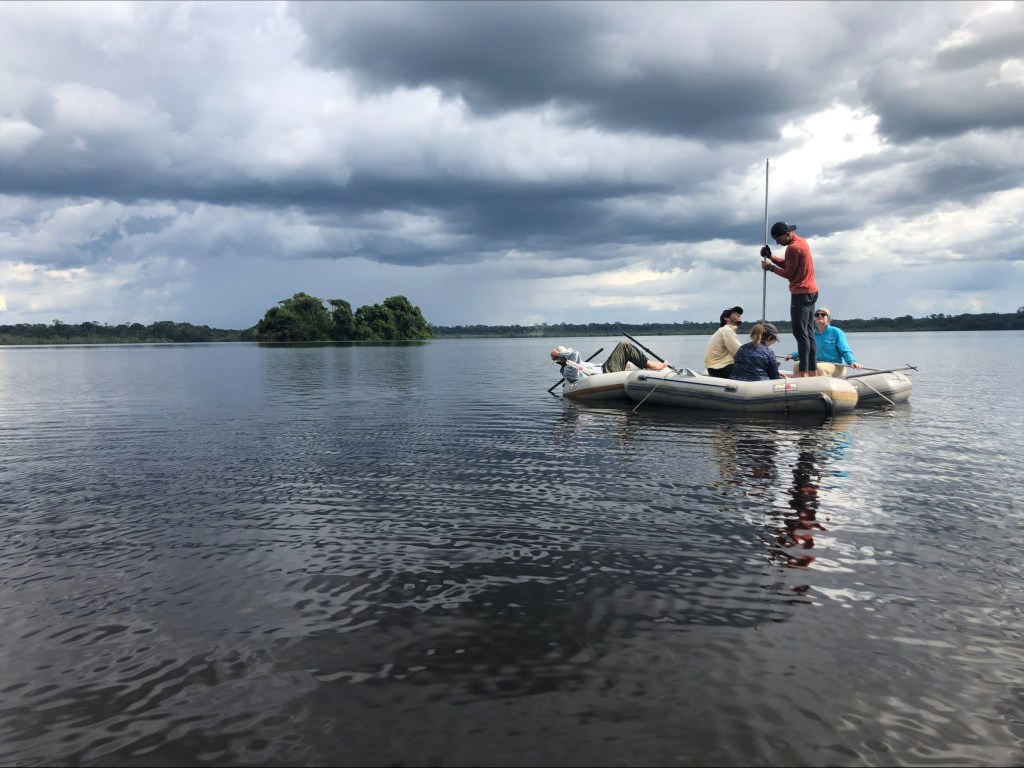
Fieldwork in Ecuador, Lake CubeCoring lake Zancudo Cocha (Ecuador)
Ansis Blaus is a Latvian postdoctoral research associate exploring patterns of climatic and anthropogenic change in the Neotropical Paleoecology Research Group led by Mark Bush at Florida Institute of Technology. He earned his Ph.D. in Earth Sciences from Tallinn University of Technology, Estonia. Supervised by Dr. Triin Reitalu he worked on modern pollen-plant relationships and palaeoecological reconstructions of peatlands and calcareous spring fens with an emphasis on biodiversity and plant functional trait reconstructions.
Currently, at Florida Tech, Ansis works on pollen data and other proxies from the sediment cores collected in the tropical Amazon. He investigates the tropical forest changes in relation to the global climate from a historical perspective, particularly during the Last Glacial Period and the Last Interglacial ca. 130 thousand years ago. His work will shed light on the history of dynamics and climate tipping points in the Amazonian rainforest. This research is particularly important in the face of the current global climate crisis and could help to anticipate the tropical forest response to the changing climate in the future.
Another objective of Ansis’s work is to study the pollen signature of human disturbance in the Amazon Basin as a means to model and interpret human presence and activities in the past and to understand human-nature interactions in tropical forest ecosystems in different spatial and temporal scales. For that, he is collaborating with the University of Amsterdam, Institute for Biodiversity and Ecosystem Dynamics, and working on a project aiming to quantify tropical pollen assemblages led by Crystal McMichael.
Ansis is fascinated by the potential revelations that come with the intersection of neoecology and paleoecology and human interactions. His interest in paleoecology, biodiversity, and various natural processes comes through the sense of pursuing a higher purpose for society and the well-being of our planet, and from the concern that humans have altered tropical forests and most other ecosystems in the world to the level of a negative rebound effect. Ansis believes that we must study and understand these ecosystems from different perspectives to decrease the current damage, predict future scenarios and to develop conservation strategies for both nature and human well-being.
14:10-14:30: Characterization of phytoliths in mid-elevation Andean forestsSeringe Huisman (University of Amsterdam/Treub grant awardee)
14:30 –14:50: Extinction-driven changes in frugivore communities on tropical islands: worldwide and in MauritiusJulia Heinen (University of Copenhagen, Denmark)
14:50 – 15:10: Are the current Amazonian fires unprecedented?Crystal N.H. McMichael (University of Amsterdam)
15:10 – 15:30: On the relationship between tiger conservation and water managementJasper Griffioen, Hanne Berghuis & Ewa van Kooten (Utrecht University)
15:30-16:00: TEA
16:00 – 16:45: Assembling the diverse rain forest flora of SE Asia by evaluating the fossil and molecular record in relation to plate tectonicsRobert J. Morley (Palynova, and Southeast Asia Research Group, Royal Holloway University of London, UK)
We are currently looking for a new representative to join the British Ecological Society (BES) Education and Careers Committee (ECC) of which I am currently the chair. I have been involved with the BES for may years first attending a conference in 2000 (Warwick University), running the Tropical Ecology special interest group (2006-2009), as an ordinary member of council (2010-2014), and chairing the ECC (2014-2020). Throughout my envolvement with the BES I have had positive experiences and enjoyed contributing to a society that can get things done. Since I have been involved with ECC we have launced under-graduate and A-level summer schools, introduced a mentoring scheme for acadmices, and helped to encourage academics to engage the public with science. If you are interested in helping us to develop the activity of the society please consider joining us!
For full details visit the advert on the BES web page by clicking here. Closing date: 22 March 2019
The Netherlands Annual Ecology Meeting (NAEM) 2019 takes place in the 12 and 13 February. This annual showcase of predominantly Dutch based ecological research will take place, as usual, at Conference Centre “De Werelt” (Lunteren). I am particularly excited this year as, along with Marielos Pena Carlos and Patrick Jansen, I am co-convening a session on “Tropical Ecology”. The first time I have contributed to the program in this way. Our session will be on the second day of the conference and contain the following exciting presentations:
15:00 Predator avoidance and prey tracking in a Neotropical forest (Constant Swinkels, Wageningen University & Research)
15:20 The role of fig volatiles in pollinator specificity and fig diversity (Aafke Oldenbeuving, Naturalis Biodiversity Center)
15:40 Mangrove Atlantis: Can mangroves keep up with extreme land-subsidence? (Celine van Bijsterveldt, Royal Netherlands Institute for Sea Research)
16:00 Break
16:10 The fate of forests in agro-forest frontier landscapes, implications for conservation (Madelon Lohbeck, Wageningen University & Research)
16:30 Trends in the variability of Specific Leaf Area of paramo vegetation during succession (Marian Cabrera, University of Amsterdam)
16:50 Succession dynamics of tree and soil fungal communities in regenerating tropical rainforests are strongly influenced by regional species pool and abiotic factors (Irene Adamo, Naturalis Biodiversity Center)
13.45-14.15: Dr Robert-Jan Wille
History Department, Utrecht University Dutch colonial science in the age of Melchior Treub: evolution, development and symbiosis as political and scientific themes in the late nineteenth century
On Jan 1, 2018 I (Crystal McMichael) get to ring in the New Year in the best way possible by heading off to the tropics to do fieldwork! And this time I get to take two students with me. Britte Heijink and Veerle Vink are both in the Biological Sciences MSc program (Ecology and Evolution track), and they are going to work on research projects that are associated with a recent grant that I was awarded through the Smithsonian Tropical Research Institute CTFS-ForestGEO Research Grants Program.
Veerle examines a cliff exposure during the Palaeoecology course, and has loved microfossils ever since!
Britte (far left) raises her first sediment core during the Palaeoecology course in 2016!
Clement, C.R., Denevan, W.M., Heckenberger, M.J., Junqueira, A.B., Neves, E.G., Teixeira, W.G. & Woods, W.I. (2015) The domestication of Amazonia before European conquest. Proceedings of the Royal Society of London B: Biological Sciences 282. DOI: 10.1098/rspb.2015.0813
Oliver, T.H., Heard, M.S., Isaac, N.J.B., Roy, D.B., Procter, D., Eigenbrod, F., Freckleton, R., Hector, A., Orme, C.D., Petchey, O.L., Proenca, V., Raffaelli, D., Suttle, K.B., Mace, G.M., Martin-Lopez, B., Woodcock, B.A. & Bullock, J.M. Biodiversity and Resilience of Ecosystem Functions. Trends in Ecology & Evolution. DOI: 10.1016/j.tree.2015.08.009
Watkins, C. (2015) Oliver Rackham OBE FBA 1939–2015. Landscape History 36, 5-8. DOI: 10.1080/01433768.2015.1044280
COMMENT: One of the books that inspired me to enter this field of research was Rackham’s Trees and woodlands in the British landscape; published the year I was born…
Bush, M.B. (1995) Neotropical plant reproductive strategies and fossil pollen representation. American Naturalist 145, 594-609. Stable URL: http://www.jstor.org/stable/2462970
Cárdenas, M.L., Gosling, W.D., Sherlock, S.C., Poole, I., Pennington, R.T. & Mothes, P. (2011) The response of vegetation on the Andean flank in western Amazonia to Pleistocene climate change. Science 331, 1055-1058. DOI: 10.1126/science.1197947
Logan, A.L. & D’Andrea, A.C. (2012) Oil palm, arboriculture, and changing subsistence practices during Kintampo times (3600–3200 BP, Ghana). Quaternary International 249, 63-71. DOI: 10.1016/j.quaint.2010.12.004
After six successful meetings, the legendary BES-TEG Early Career Research Meeting returns. Day one will focus on Ecology and Ecosystem Processes, while day two will focus on Practical Applications and links to Policy such as conservation, livelihood, policy and development.
All early-career researchers, both PhD and Post-Docs, are welcome to present their tropical ecology related research with a poster and/or oral presentation. There shall be a competition for both with prizes. This event will take place at Derwent College (D/L//047) and the accommodation at Alcuin College (see map link below).





 Ecology of the past