Mapping Ancient Africa Quaternary International special issue article #5
Kiely, R.E., Paine, A.R., McMichael, C.H. & Gosling, W.D. (2025) Heat, hydroclimate and herbivory: A late-Pleistocene record of environmental change from tropical western Africa. Quaternary International 717, 109636. DOI: 10.1016/j.quaint.2024.109636
To find the complete list of articles in the Mapping Ancient Africa special issue of Quaternary International click here.
The next Mapping Ancient Africa seminar will take place online at 17:00 CEST on 16 May 2024.
Speaker: N’dji dit Jacques Dembele (President of WAQUA, Université des sciences sociales et de gestion de Bamako, Mali)
Title: Quaternary period seismicity on the West African Craton
The seminar will be delivered via Zoom. The link for the seminar can be obtained from the MAA Slack channel or by contacting the chair of this seminar (Stefanie Kaboth-Bahr). If you want to know more about the Mapping Ancient Africa project visit our web pages and please do not hesitate to get in contact if you want to get involved.
The first Mapping Ancient Africa online seminar of 2024 will take place on 28 February (17:00 CET).
Speaker: Mathias Vinnepand (Leibniz-Institute for Applied Geophysics Hannover, Germany)
Title: An age-depth model for Lake Bosumtwi (Ghana) to reconstruct one million years of West African climate and environmental change
Related publication: Vinnepand, M., Zeeden, C., Wonik, T., Gosling, W., Noren, A., Kück, J., Pierdominici, S., Voigt, S., Abadi, M.S., Ulfers, A., Danour, S., Afrifa, K. & Kaboth-Bahr, S. (2024) An age-depth model for Lake Bosumtwi (Ghana) to reconstruct one million years of West African climate and environmental change. Quaternary Science Reviews325, 108478. DOI: 10.1016/j.quascirev.2023.108478
The seminar will be delivered via Zoom. The link for the seminar can be obtained from the MAA Slack channel or by contacting the chair of this seminar (Stefanie Kaboth-Bahr). If you want to know more about the Mapping Ancient Africa project visit our web pages and please do not hesitate to get in contact if you want to get involved.
I am delighted to be able to report that Alfred Houngnon (University of Abomey-Calavi, Benin) has beenawarded an INQUA Fellowship for 2024 to develop his research into past environmental change in the Dahomey Gap. This research will link up my laboratory, at the Institute of Biodiversity & Ecosystem Dynamics (University of Amsterdam), and the group of Dr Mireille S.S. Toyi(Laboratory of Applied Ecology, University of Abomey-Calavi). Below, and in the associated video report, Alfred explains the project and what he hopes to achieve during the project.
The Dahomey Gap project is designed to gain new insights on the West African palaeoenvironments using pollen, charcoal and dung fungal spore records to reconstruct past vegetation, fire and animal abundances. These empirical data will then be compared against paleoclimate models. Specifically, we will explore the interactions between fire, animals and vegetation around the Ewe-Adakplame forest in the south east of Benin Republic and highlight the role humans would have previously played in the modification of the landscape for millennia.
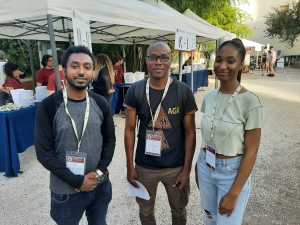
Mapping Ancient Africa participants at the INQUA Rome ice breaker event ready for action! Left to right: Bahru Zinaye Asegahegn, Alfred Houngnon, Busisiwe Hlophe.
The Mapping Ancient Africa (MAA) project has a double session of talks and a poster session at the INQUA congress in Rome 2023. Our session will be on Wednesday 19 July. Unfortunately a number of the originally planned speakers could not make it to Rome due to a combination of not obtaining visas, logistical challenges and ill health. We wish them all well and hope that they will continue to be involved in the project. Further, many thanks to all those who have agreed to step up and give a presentation at a late notice. Below is an updated schedule correct as of Sunday 16 July based on the information contained on the INQUA Rome App; if you are aware of any further problems or changes please let me know ASAP!
Giosan et al. When the desert was a lake: Providing context for Homo sapiens development in the northern Kalahari
Chase et al. Paleolakes and socioecological implications of glacial “greening” of the South African interior
Blinkhorn et al. Evaluating refugia in recent human evolution in Africa
Aureli et al. Homo sapiens behaviour and adaptation in East Africa. New evidence from an open-air site in a modern Ethiopian savannah environment: the GOT10 site
Effiom et al. Late Holocene palaeoecological studies at Lake St Lucia, KwaZulu-Natal
Tallavaara et al. Pan-African Climate and Vegetation over the Quaternary and Implications for Human Distribution
Quick et al. Palaeoenvironments of the Cape Floristic Region: New research & current developments
Houngnon A, Adomou AC, Gosling WD, Adeonipekun PA. 2021. A checklist of vascular plants of Ewe-Adakplame Relic Forest in Benin, West Africa. PhytoKeys 175:151. https://doi.org/10.3897/phytokeys.175.61467
OPEN ACCESS ONLINE:
Miller, C.S., Gosling, W.D., Kemp, D.B., Coe, A.L. & Gilmour, I. (2016) Drivers of ecosystem and climate change in tropical West Africa over the past ∼540 000 years. Journal of Quaternary Science online. DOI: 10.1002/jqs.2893
Miller, C.S. (2014) 520,000 years of environmental change in West Africa. PhD Thesis, Department of Environment, Earth & Ecosystems, The Open University.
Well, we’ve heard from Wes and Adele, and now it’s my turn (Phil Jardine) for a bit of a chat on the “Ecology of the past” YouTube channel. Similar to the previous interview videos, I’m talking about my role on the Bosumtwi pollen chemistry project, and what I’ve done (academically speaking) prior to coming to the Open University. Enjoy!



 Ecology of the past