If you missed our tour of the new African Pollen Database website and discussion of how to incorporate paleoecological data into research and teaching, please the recording here.
Also stay tuned for more details about upcoming workshops and data tutorials!
Strandberg, N.A., Sear, D.A., Langdon, P.G., Cronin, S.J., Langdon, C., Maloney, A., Bateman, S., Bishop, T., Croudace, I., Leng, M., Sachs, J.P., Prebble, M., Gosling, W.D., Edwards, M. & Nogue, S. (2023) Island ecosystem responses to the Kuwae eruption and precipitation change over the last 1600 years, Efate, Vanuatu. Frontiers in Ecology and Evolution 11, 1087577. DOI: 10.3389/fevo.2023.1087577
Title: Ostrich eggshell taphonomy: Forager subsistence strategies and environmental indicators in northern Malawi during the Late Pleistocene and Early Holocene
The seminar will be delivered via Zoom. The link for the seminar can be obtained from the MAA Slack channel or by contacting the chair of this seminar Lynne Quick. If you want to know more about the Mapping Ancient Africa project visit our web pages and please do not hesitate to get in contact if you want to get involved.
The “Environmental Management” track of the University of Amsterdam MSc Earth Sciences program is the more applied sister to the Earth System Science track. The Environmental Science track is focused on the solutions to societal challenges that can be gained from the Earth sciences. Drawing on linkages with social sciences you will gain a broad interdisciplinary training covering topics including: urban-ecological development, human-wildlife conflicts, and the climate crisis. During the degree you will work with researcher within the interdisciplinary Institute for Biodiversity & Ecosystem Dynamics (IBED), carry out an independent research project, and an internship at a societal facing organisation.
Energy and Climate Change: Investigate the relationship between climate change and energy systems, and confront the challenges of creating a decarbonised world.
GIS and Remote Sensing in Ecosystem Dynamics: Learn how to use large remotely sensed datasets to gain insights into geological, geomorphological and soil systems.
Integrated Coastal Dune Management: Explore the concept of “Resilience Thinking” in tacking the complex management task of protecting the Dutch coastline and its ecosystems.
Metropol Ecology: Focused on the part of the Earth system where people are, investigate biodiversity and ecosystems in urban systems and mega cities.
Science Based Geo-ecological Management: How can science guide environmental management, address key challenges of supporting society, includes field visit to Oostvardersplassen.
System Innovation and Transition Management: Climate, energy and agricultural systems are all changing discover how understanding their dynamics is important for governance and sustainability.
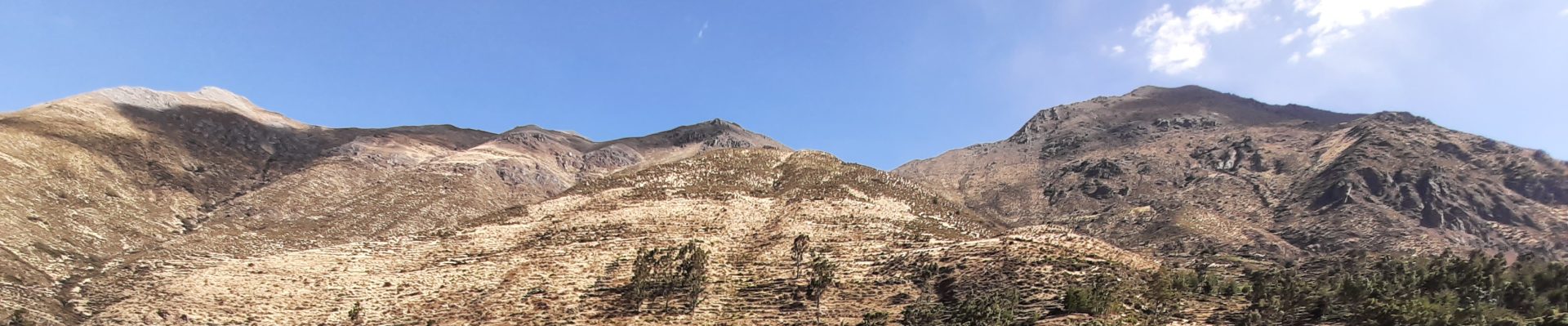
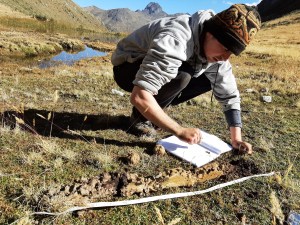
Environmental management of high Andean ecosystems. During the field school in Peru MSc Earth Science students work with locals and NGOs to improve practices (click here to find out more)
The Environmental Management track can be taken in conjunction with the “Science for Sustainability” minor offered by the Faculty of Science, or other free elective courses to broaden your program.
During the course you will do an internship to get direct experience of working outside academia. Organisations hosting internships in recent years have included:
During the concert the Ukrainian Ambassador gave an impressive and moving speech in which he called for continued, and strengthened, support for Ukraine against Russian aggression. Different routes to supporting Ukraine, their scholars and their artists through this difficult time include:
McMichael, C.N.H., Vink, V., Heijink, B.M., Witteveen, N.H., Piperno, D.R., Gosling, W.D. & Bush, M.B. (2023) Ecological legacies of past fire and human activity in a Panamanian forest. Plants, People, Planet5, 281-291. DOI: 10.1002/ppp3.10344
Chris Kiahtipes will be presenting a, African Pollen Database (APD), practical tutorial about working with paleoecological data in R for beginners! Please join us Wed, February 22 at 9am EST. Please email chris.kaihtipes@gmail.com for the zoom link.
Also, if you are interested in joining, please follow the set-up guide below before the start of the workshop in order to make sure you are ready to go and follow along in real-time during the workshop!
At the University of Amsterdam the MSc Earth Science is split into two tracks, one of these is entitled: “Earth System Science”. Earth System Science is a research intensive track focused on understanding the fundamentals of abiotic and biotic interactions across the globe and through time. During this degree you will spend around 6 months studying to pick up specialist knowledge and skills, and around 18 months actively developing yourself – in your key areas of interest – through project work.
The taught part of the Earth System Science track includes courses such as:
The Earth System: Learn how to analyse Earth system function across space and through time.
Analysis & Modelling Lab: Develop skills in data handeling, analysis and modeling relevant to Earth science.
Biogeochemical Cycles in the Earth System: Study how the dynamics of carbon and nitrogen link to societal challenges.
Climate Change: Explore the scientific basis for climate change an its implications for the environment and society.
Environments Through Time: Consider and analyse environmental change on timescale relevant to landscapes, societies and climates.
GIS and Remote Sensing in Ecosystem Dynamics: Learn how to use large remotely sensed datasets to gain insights into geological, geomorphological and soil systems.
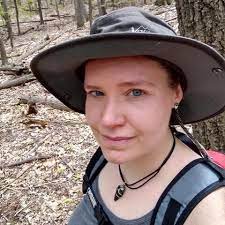
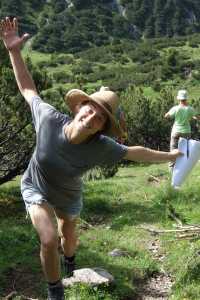
Clare Lee (on one leg, left) during field course in Peru successfully published her literature review which she conducted as part of her MSc in Earth Sciences at the University of Amsterdam.
In addition, free elective courses are possible from across the University of Amsterdam, or at other approved organizations or universities, i.e. it is possible to pick up skills in other specialisms (for example in languages, AI, or programming), or study a course at a university abroad, and have this included within your University of Amsterdam MSc Earth Science degree.
The project part of the Earth System Science track includes two research projects, or one research project and one internship with an external organization (such as a company or NGO). MSc research projects are often closely linked to active research within the Institute for Biodiversity & Ecosystem Dynamics. Some projects and literature reviews conducted by our MSc researchers reach a high enough level to be published in international scientific journals, either on there own or as part of a wider collaboration. Examples of recent papers including MSc researchers (highlighted in bold) are:
Lee, C.M., van Geel, B. & Gosling, W.D. (2022) On the use of spores of coprophilous fungi preserved in sediments to indicate past herbivore presence. Quaternary5, 30. DOI: 10.3390/quat5030030
de Nijs, E.A. & Cammeraat, E.L. (2020) The stability and fate of Soil Organic Carbon during the transport phase of soil erosion. Earth-Science Reviews 201, 103067. DOI: 10.1016/j.earscirev.2019.103067
The African Pollen Database community is hosting a series of workshops including practical data tutorials and discussions to help paleoecologists working in Africa integrate these data into research and teaching.
Our theme for Spring 2023 is “using R to understand African paleoecology”, and the schedule is posted here.
Our first workshop will be February 22 at 9am EST. Chris Kiahtipes will be provided a guided tutorial that can be followed live to help you use R and RMarkdown to develop reproducible research workflows for pollen data. This will be ~1 hour. Please register in advance by emailing Chris (chris.kiahtipes@gmail.com) to receive the zoom link and a guide to setup your workspace ahead of the workshop.
To see our launch meeting from February 8 that includes a tour of the African Pollen Database on the Neotoma Paleoecology Database, watch this video.
The MSc Earth Sciences at the University of Amsterdam has a new look for the start of the next academic year (starting September 2023). Drawing on the international research expertise of our staff it is now possible to tailor your studies within two complementary tracks:
Earth System Science: Focused on fundamental aspects of Earth science, such as biogeochemical cycles, climate dynamics, and past environmental change. Our education follows our research in exploring how abiotic and biotic elements of the Earths system interact through time and across the globe.
Environmental Management: Focused on the interface between Earth science and society, key topics include: management of coastal systems, ecosystem dynamics in urban environments, and the relationship between science policy and ethics. During your internship you will have the opportunity to engage with societal partners to develop skills and projects.
For both tracks education is delivered through lectures, field courses, laboratory practical’s, and data analysis. Furthermore, you will get the chance to develop your own research agenda by conducting a project with one of our scientists, or at an external partner or university. In addition to expert knowledge our graduates have transferable skills in data handeling, numerical analysis, and science communication.
To find out more about our program visit click here to visit the MSc Earth Sciences pages on the University of Amsterdam web site.






 Ecology of the past