Exciting new edition of the Past Global Changes (PAGES) magazine focused on the sustainability of Earth’s biodiversity. Includes articles by Ecology of the Past blog contributors Dr. Encarni Montoya and Dr. Macarena Cardenas.
To find out more check out the full issue (free):
Gillson, L., Gell, P. & von Gunten, L. (2017) Past Global Changes Magazine: Sustaining the Earth’s Biodiversity 25(2): 76-130. DOI: 10.22498/pages.25.2
If you have exciting new research on past ecological change please consider submitting it to Vegetation History & Archaeobotany.
Two articles recently published on-line in the journal Vegetation History & Archaebotany (of which I am an Associate Editor) recently caught my attention.These explore:
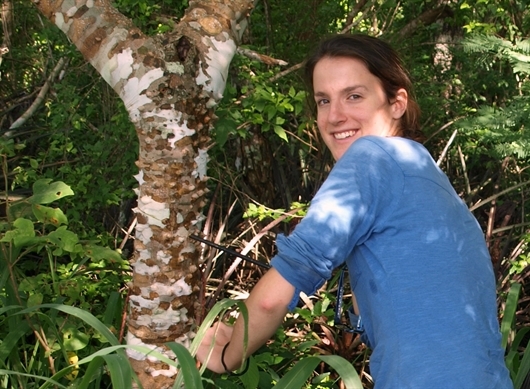
IBEDs Crystal McMichael hard at work sampling sediments in the Andes
Insights into recent field work in Ecuador by a team lead by Crystal McMichael can be found in a recent blog from our collaborators at the Instituto Geofisico, Escuela Politecnica Nacional, Quito (Ecuador).
The images taken by Adele Julier to help her with pollen identifications during her PhD at The Open University (UK) are now available to download. Please note these images are not of reference material but identifications, made by Adele and myself, of the pollen grains found within her pollen traps. The pollen traps were deployed within vegetation study plots in wet evergreen forest, semi-deciduous moist forest, and the forest-savanna transition zone in Ghana. Further publications on this work and a thesis coming soon…
This time you are reading a message from a non-expert in paleoecology. My name is Masha and I will spend the next two years on a very exciting postdoctoral fellowship funded by NWO (Dutch National Science Foundation) under their Rubicon scheme in close collaboration with William Gosling (University of Amsterdam).
Each project was set up to test a particular ecological or biogeographic hypothesis. Investigations included the exploration of the role of humans in modifying ecosystems in Amazon, the nature of the pre-farming landscape in the the Netherlands, and how to chemically identify fossil charcoal. In undertaking their projects individual students had the opportunity to variously develop skills in microscopy, spatial modelling, or analytical chemistry. The high quality of the data produced means that hopefully many of these data sets can be used in future scientific publications. Well done to all!
If you are interested in conducting a similar project (at any academic level) with us please do not hesitate to get in contact. For further details of ongoing research within the Department of Ecosystems & Landscape Dynamics visit our web pages by clicking here.

 Exciting new edition of the Past Global Changes (PAGES) magazine focused on the sustainability of Earth’s biodiversity. Includes articles by Ecology of the Past blog contributors Dr. Encarni Montoya and Dr. Macarena Cardenas.






 Ecology of the past