All applications must be pre-approved by the host institution so if you are interested in applying for a project through The Open University expressions of interest are required by 25th January 2013.
The last two months of 2012 were exceptionally busy!
On the research front
Grants took centre stage for much of my time. First writing for the NERC December 1st deadline was pressured as usual, and second response to reviewers comments on the July submission was interesting.
Paper writing proceeded with reviewer and co-author comments on three manuscripts hopefully desitined for Review of Palaeobotany and Palynology (lead by Hayley), Palaeo3 (lead by Macrarena) and The Holocene (with Joe Williams) respectively.
Two tasks dominated the non-research activity: 1) teaching the Geological Record of Environmental Change (S369) exams assessment and assigment, and 2) as Post Graduate Tutor keeping up with NERC developments for the new Doctoral Training Partnerships.
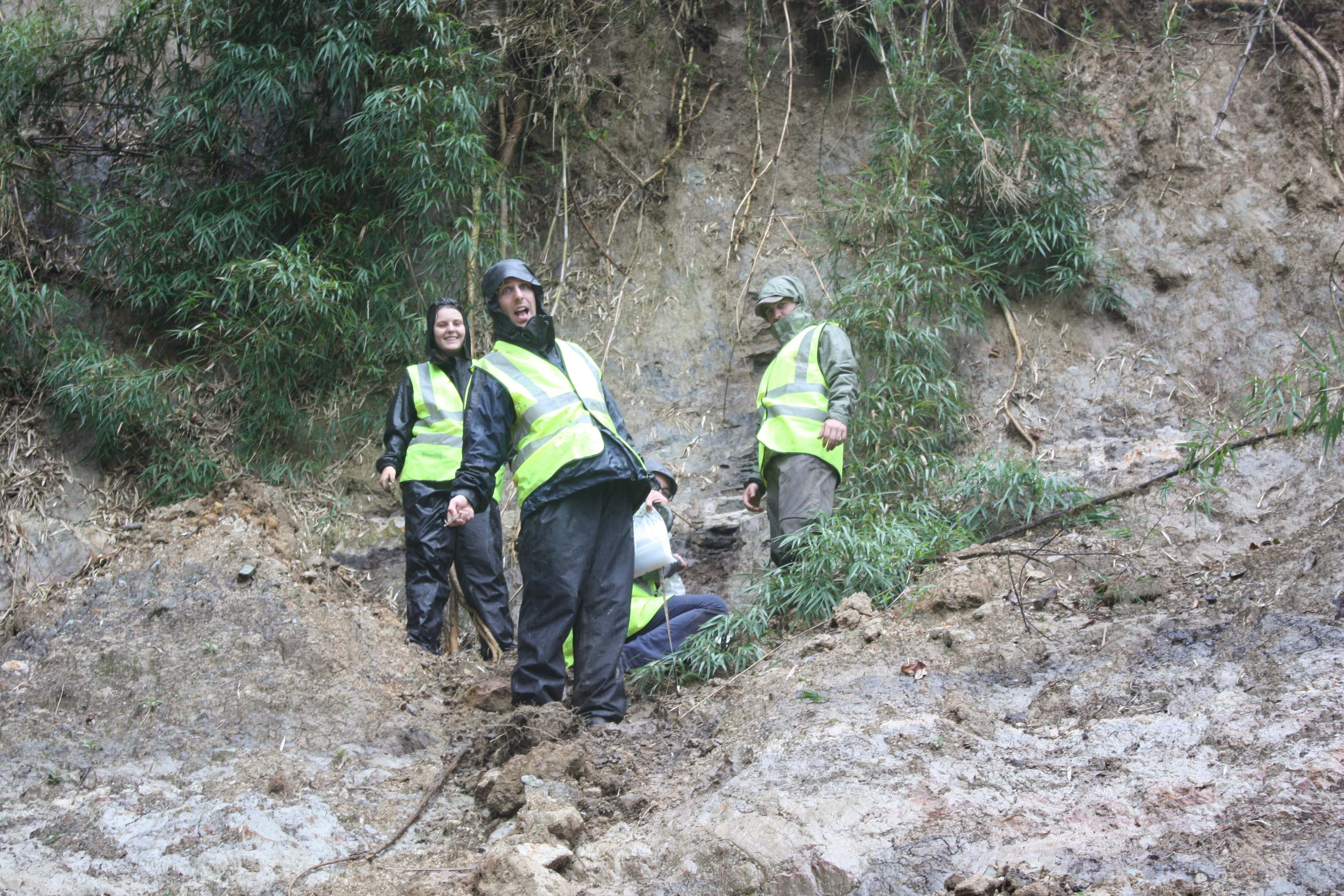
PCRG members on field work in Cayabe-Coca National Park (2012). Left to right: Hayley, Encarni, William and Frazer. Encarni and Frazer have returned to Ecuador Jan-Feb 2013 to collect further sedimentary cores. More on the blog soon…
Finally all that remains is to say “Happy New Year”from the PCRG and on with 2013… 🙂
Prof. H. Hoogiemstra Chair of Palaeoecology & Landscape ecology at IBED
Dutch and Belgian Palynology meeting
University of Amsterdam
13/12/2012
Many thanks to Henry Hooghiemstra for the invitation to present at the recent palynology meeting in Amsterdam hosted by the Institute of Biodiversity and Ecosystems Dynamics (IBED). The program of talks was broad and interesting ranging from the deep time geological history of the Amazon basin (Carina Hoorn) to the use of video game technology in visulizing landscapes (Bodo Schuetze); watch videos of his work, or read the thesis.
View Schuetze’s work on recreating Mauritius in 3D on Vimeo
I contributed some new work on human-landscape interaction in the central Andes, entitled: “Ecosystem service provision sets the pace for pre-Columbian Andean societal development”. It was very exciting to get feedback from such an esteemed audience on this new work. The days talks concluded with the IBED seminar given by Mark Bush (Florida Institute of Technology) which countinued the South American human-environment theme but we moved to the lowlands for “Amazonia in 1491: A paleoecological perspective”. Mark’s talk built on his recent work exmining the extent of human impact on Amazonia (references 1-3 below) which has cautioned against assuming widespread and intensive human impact within Amazonia prior to the arrival of Europeans.
Following the seminars we had drinks at the institute and an excellent meal in Amsterdam. Thanks again to Henry and all those at IBED who hosted a high class and scientifically stimulating meeting.
Two NERC algorithm funded PhD studentships are currently available with the PCRG. The projects are focused on understanding past environmental change in west tropical Africa and Amazonian-Andean Ecuador. Both projects will involve field work and build on on-going research within the lab.
Closing date 31/01/2013
One project will work on samples collected during fieldwork in 2012 near Papallacta (Ecuador).
Further project details and how to apply below… Continue Reading
The PCRG contribution to the meeting was made by Hayley Keen who presented the first paper related to her doctoral research to an exteral audience entitled “Pollen counting for diverse tropical ecosystems”. The paper presented:
A statistical model (developed by co-author Felix Hanke) which simulaltes pollen counting in order to estimate the size of pollen count required to develop a robust ecological insight from the fossil pollen record, and
compared model predictions with empirical data from a diverse tropopical ecosystem (Mera, Ecuador) to assess the reliablity of the model.
It is hoped the application of the model to fossil pollen counting will allow more efficient and effective use of palynologists time. The paper was very well recieved despite the audible intake of breath when Hayley recommened that to characterize pollen richness (diversity) in some settings pollen counts in excess of 2000 grains might be required!
The back end of September and October has been very busy as I have tried to catch up with the teaching, administration and research activity which somewhat accumulated whilst on field work!
Major tasks have been:
1) the marking and coordination for level 3 Geological Record of Environmental Change (S369) module examination,
2) getting used to my new role as Post Graduate Tutor looking after all things related to a doctoral students in the Department of Environment, Earth & Ecosystems, and
3) trying to find time to finish off three manuscripts for submission!
Other members of the lab have also been busy: * Encarni has arrived from Valenti Rull‘s lab at the Botanical Institute in Barcelona as a NERC Fellow and is settling in to life in Milton Keynes, more details soon…
* Lottie is getting into data analysis and writing up of the Lake Bosumtwi pollen an N isotope data,
* Natalie is writing, crunching numbers and waiting for a machine to be fixed…
* Bryan is working on gelling biogeographic data together in GIS
Imagae of a Toarcian foraminifera taken by Alice Kennedy facilitated by the new cable which allows our microscope camera to talk to a computer – hooray!
* Hayley has been preparing for talking at the Linnean Society palynology meeting on 1st November “Understanding pollen and spore diversity”, and helping “steal” a microtome for sectoning her wood macrofossils,
* Frazer has started to plot Andean and Amazonian midge distributions against temperature, and
* Alice has been taking photos…
In the midst of all this fun I was sent this great video which brightened my day. I hope you enjoy it as well…
The four fellowships are advertised in four areas of Earth & Environmental Science; however, applications from exceptional scientists in related fields are also welcome.






 Ecology of the past