During the Mapping Ancient Africa workshop in Rome I conducted short interviews with the scientists involved. The first of these, Alfred Houngnon can be viewed here, below are four more, and more will follow as I get them uploaded. I hope they provide interesting insights into the diverse range of skills and backgrounds our scientists have.
Interview 2: Busisiwe Hlophe (University of the Witwatersrand)
Interview 3: Angela Effion (University of the Witwatersrand)
Interview 4: Bahru Zinaye Asegahegn (University of Cologne)
Interview 5: Michela Leonardi (University of Cambridge)
To find out more about the Mapping Ancient Africa project click here.
The second part of the Mapping Ancient Africa session at the INQUA Rome congress contained eight talks. Busisiwe Hlophe (University of the Witwatersrand) kicked us off by showing us the power of looking at wood anatomy preserved in charcoal microfossils to determine the nature of past vegetation and climate. RahabKinyanjui (National Museums of Kenya) presented phytolith work from archaeological sites revealing a mixed woody and grassy vegetation associated with archaic Homo sapiens in Kenya.
Three talks from the Cape Region in South Africa then followed with Saul Manzano (University of Leon), StellaMoscher (University of Utah), and Asithandile Ntsondwa (Nelson Mandela University) using various palaeo ecological approaches to explore climate, vegetation and fire regime shifts during the Holocene. Adele Julier (University of Portsmouth) then took us a little further north to Namibia to think about the challenges of parameterising modern pollen-vegetation relationships in arid regions. The final southern African talk was given by Gemma Poretti (University of Cape Town) explored a new approache to tracking change in past rainfall patterns using charcoal material.
Every picture tells a story. This one is a snapshot I took of Dan Livingstone’s African palaeolimnology group in June1984, when I spent a few months at Duke University, North Carolina, at Dan’s invitation. I had started work on the pollen analysis of a Holocene core from Cameroon that I’d collected in 1981 and Dan was keen to help me as far as possible. He was making plans for his lake coring projects a few years later in Cameroon (Barombi Mbo).
Back row (L-R) is me (Keith Richards age 24), Margaret Adebisi Sowunmi, Alice Tucker, Lida Burney, George Kling and Dan Livingstone. Front row (L-R) is David Burney, Wendy Watson, Susan Gerbeth-Jones and Patricia G. Palmer.Continue Reading
On Wednesday 19 July 2023 the Mapping Ancient Africa session of the INQUA Rome congress took place. We were delighted to have an full program of speakers despite some late cancellations. The first session featured seven speakers.
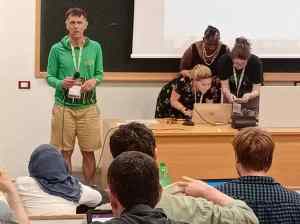
No panic as we set up for session 1…
The first two talks focused on southern Africa. The first talk by Liviu Giosan (Woodshole Oceanographic Institute) focused on new sediment cores extracted from the Okavango – Makgadikgadi region and new efforts to obtain sediment cores that can provide information on the dispersal of hominins. Brian Chase (CNRS) then looks us to the Karoo highlighting recent findings that suggest that this currently arid region was more habitable in the past and that a proliferation of stone tools suggests past peoples utilised the region extensively (Carr et al., 2023).
McMichael, C.N.H., Bush, M.B., Jiménez, J.C. & Gosling, W.D. (2023) Past human-induced ecological legacies as a driver of modern Amazonian resilience. People and Nature. DOI: 10.1002/pan3.10510
We invite you to join us on an incredible journey through the heart of Ecuador, where a group of adventurous students from Florida Institute of Technology embarked on a life-changing experience as part of the Neotropical Archaeoecology summer field course. Buckle up as we delve into the marvels of nature, indigenous cultures, and unforgettable experiences. Let’s dive right in!
Unveiling the Andes
Our adventure began with a breath-taking visit to the Paramo at Cayambe-Coca National Park. Paramos are high altitude (3000-4000 metres) wet grasslands above the tree line and below the snow line within the equatorial Andes. Our tour guides Patricio and Byron gave us information about the local vegetation, focusing on the Polylepis tree (locally known as “paper tree”), which is unique to this sort of habitat. They also told us about some of the fascinating wildlife that can be seen here, such as the Andean Bear (Tremarctos ornatus) and the Andean Puma (Puma concolor).
We then descended through the cloud forest (3,600–3,400 meters) and lower montane rainforest (3,400–2,500 meters). Across these various habitats, we documented changes in hummingbird abundance and recorded their behaviour at four different feeder points: Guango Lodge, La Brisa, San Isidro Lodge, and Cascada el Hollin. The sheer diversity of hummingbird species left us in awe, and we marvelled at their iridescent feathers and incredible agility.
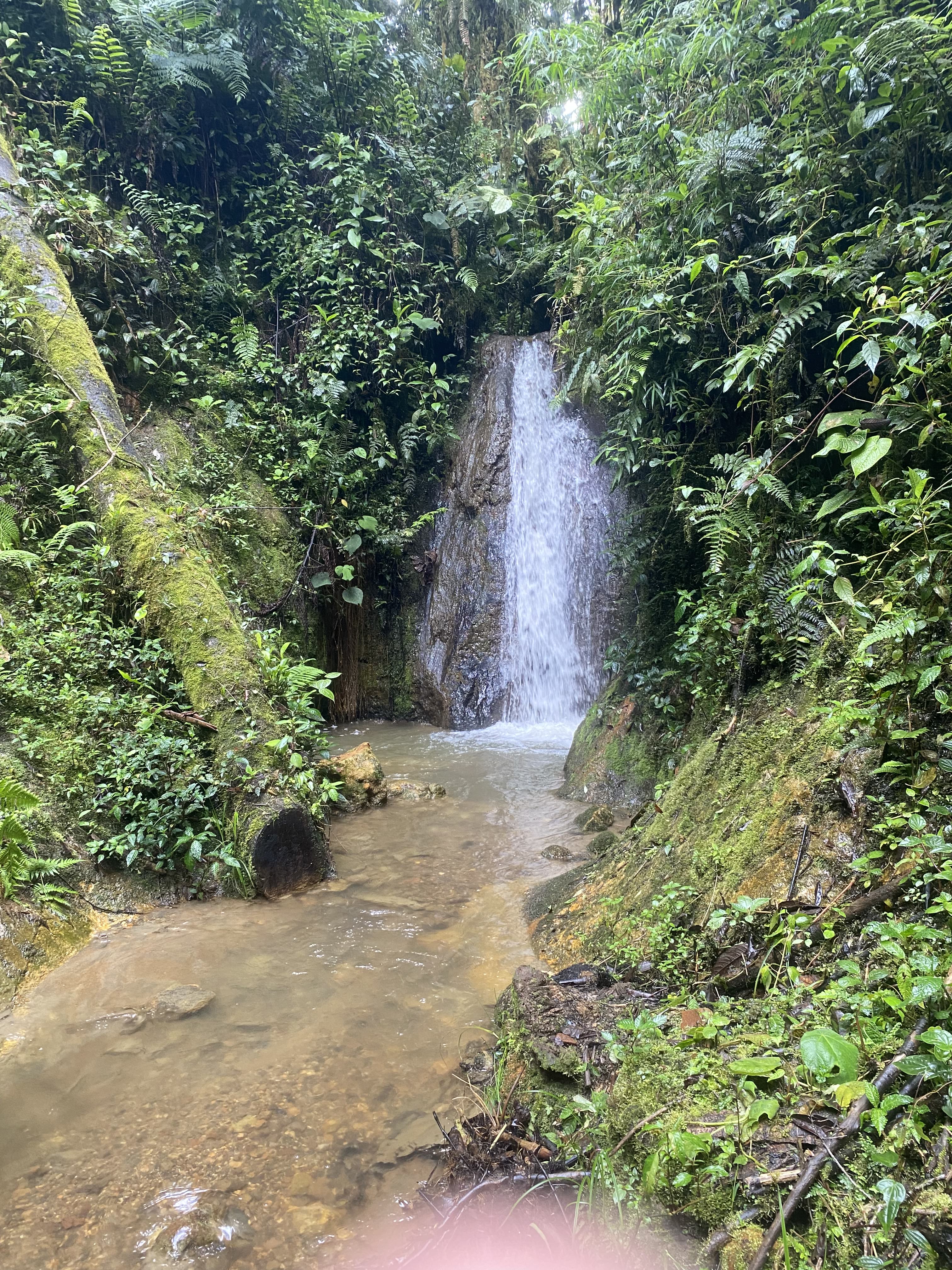
We explored a waterfall near San Isidro Lodge (https://cabanasanisidro.com), and we were able to observe pre-Inca pottery. At the lodge we also saw a diverse array of bird species, which was delightful! The forest’s nightlife brought us close encounters with a group of nocturnal monkeys, and to our surprise, we stumbled upon a very rare mountain tapir. The following morning we saw a small agouti (a small rodent) prowling around the lodge, and ended our adventures in the cloud forest on a high note.
San Isidro waterfall and some of the animal diversity we observed
Gosling, W.D. & McMichael, C.N.H. (2023) The use of micro infrared spectroscopy in reconstructing past ecological and environmental change. Reference Module in Earth Systems and Environmental Sciences (ed. by R. Bradshaw) Elsevier. DOI: 10.1016/B978-0-323-99931-1.00087-8
My name’s Alfred Houngnon, native of Benin Republic in West Africa. I hold an agricultural engineering degree in “Rangeland Management and Conservation” (Abomey-Calavi University). After gaining relevant field experience, I obtained a French Government Bursary to pursue an MSc degree in “Tropical Plant Biodiversity” at Montpellier (France). There, I learned about how to use indicators of past environmental and climatic change to give insights into projected future change.
It was a great scientific experience to participate in-person at the XXI INQUA Congress 2023 in Rome (Italy). This opportunity came under the supervision of William Gosling, and with the support of the Mapping Ancient Africa (MAA) project funded by INQUA’s Palaeoclimate commission (PALCOM). I have been working with Will for a number of years and published a first paper related to this work in 2021; a checklist of vascular plants from a ‘relict’ forest in Benin (Houngnon et al., 2021). A second manuscript is under development and was accepted for poster and oral presentation at INQUA 2023 congress that brought together around 4000 abstracts.
Interview 1: Alfred Houngnon (AGIR)
The bursary from the MAA project allowed me to also attend the MAA Rome workshops held at the Royal Netherlands Institute in Rome (12-13 July 2023). During the workshops, I was trained in two novel approaches to palaeoclimate modeling. The first based on interfacing paleoclimate models through the “pastclim” R package (Michela Leonardi), and the second on reconstructing palaeoclimates on the basis of ancient pollen data using the “CREST” program (Manu Chevalier). The workshops helped me to sharpen the communication of my ideas and in so doing strengthened the manuscript in preparation for submission to an international journal for publication.
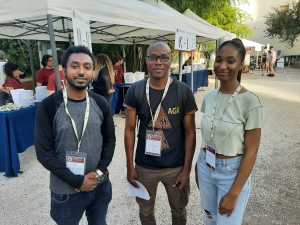
Mapping Ancient Africa participants at the INQUA Rome ice breaker event ready for action! Left to right: Bahru Zinaye Asegahegn, Alfred Houngnon, Busisiwe Hlophe.
The Mapping Ancient Africa (MAA) project has a double session of talks and a poster session at the INQUA congress in Rome 2023. Our session will be on Wednesday 19 July. Unfortunately a number of the originally planned speakers could not make it to Rome due to a combination of not obtaining visas, logistical challenges and ill health. We wish them all well and hope that they will continue to be involved in the project. Further, many thanks to all those who have agreed to step up and give a presentation at a late notice. Below is an updated schedule correct as of Sunday 16 July based on the information contained on the INQUA Rome App; if you are aware of any further problems or changes please let me know ASAP!
Giosan et al. When the desert was a lake: Providing context for Homo sapiens development in the northern Kalahari
Chase et al. Paleolakes and socioecological implications of glacial “greening” of the South African interior
Blinkhorn et al. Evaluating refugia in recent human evolution in Africa
Aureli et al. Homo sapiens behaviour and adaptation in East Africa. New evidence from an open-air site in a modern Ethiopian savannah environment: the GOT10 site
Effiom et al. Late Holocene palaeoecological studies at Lake St Lucia, KwaZulu-Natal
Tallavaara et al. Pan-African Climate and Vegetation over the Quaternary and Implications for Human Distribution
Quick et al. Palaeoenvironments of the Cape Floristic Region: New research & current developments
In person attendees (left to right): William Gosling (University of Amsterdam), Busisiwe Hlophe (University of Witwatersrand), Michela Leonardi (University of Cambridge), Soléne Boisard (University of Montréal), Rahab Kinyanjui (National Museums of Kenya), Trevor Hill (University of KwaZulu-Natal), Mathias Vinnepand (Johannes Gutenberg-University of Mainz), Tom Johnson (University of Massachusetts Amherst), Manu Chevalier (University of Bonn), Brian Chase (CNRS: Montpellier), Stefanie Kaboth-Bahr (Free University of Berlin), Markus Fischer (University of Potsdam), Bahru Zinaye Asegahegn (University of Cologne), Alfred Houngnon (AGIR), and Jemma Finch (University of KwaZulu-Natal); present but not in photo Angela Effion (University of Witswatersrand).
A further nine participants were anticipated to attend the workshop but, due to a combination of the non-issue of visas, logistical difficulties and ill health, they were not able to attend at the last moment. These were: Aliyu Adamu Isa (Ahmadu Bello University), George Biddulph (University of St Andrews), Olugbenga Boboye (University of Ibadan), Husna Mashaka (University of Nairobi), Emma Mbua (National Museums of Kenya), Aissatou Thiam Ndong (University of Cheikh Diop, Dakar), Adisa Ogunfolakan (Leventis Museum of Natural History), Alice Paine (University of Oxford), and Lynne Quick (Nelson Mandela University). Some people were able to attend partly online. Some have now made it to Rome and we hope to catch up at the INQUA Rome congress (Session 64) if not before. We hope that all will continue to be involved with the Mapping Ancient Africa project.








 Ecology of the past