Elliott, S., Maezumi, S.Y., Robinson, M., Burn, M., Gosling, W.D., Mickleburgh, H.L., Walters, S. & Beier, Z.J.M. (2022) The legacy of 1300 years of land use in Jamaica. Journal of Island and Coastal Archaeology. DOI: 10.1080/15564894.2022.2078448
Lee, C.M., van Geel, B. & Gosling, W.D. (2022) On the use of spores of coprophilous fungi preserved in sediments to indicate past herbivore presence. Quaternary 5, 30. DOI: 10.3390/quat5030030
This manuscript was developed from a literature review study by Clare Lee conducted as part of her MSc Earth Sciences degree at the University of Amsterdam under the supervision of Bas van Geel.
On the 19 May the Palynologische Kring (Dutch palynological society) held a hybrid seminar meeting under the theme “Dutch palynologists then and now”.
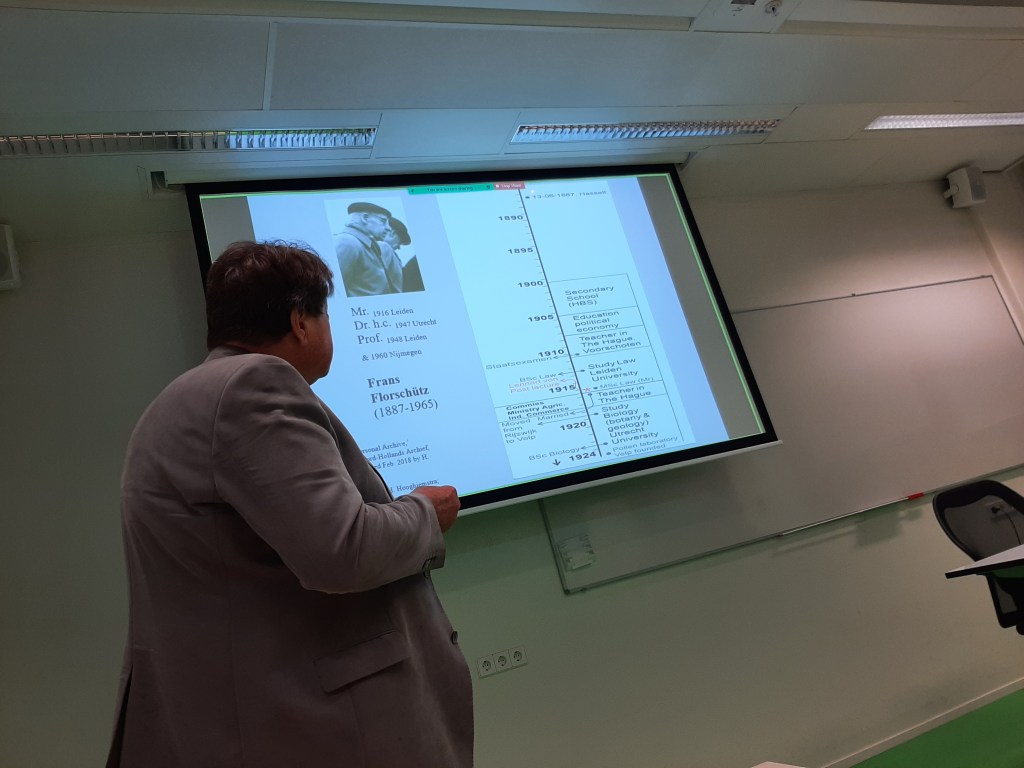
The meeting was opened by Prof. dr. Henry Hooghiemstra (University of Amsterdam) who focused on the “then” and presented a biopic of pioneering Dutch palynologist Frans Florschütz. Florschütz became one of the major figures in establishing palynology within the Netherlands during the 1900s. Originally, he studied political economy and law, but went on to become the Secretary to the Board of Governors of the Agricultural School in Wageningen. From his position in Wageningen Florschütz had a base to develop his interests in palynology and past environmental change. He started work on the seminar work “Nederland in Ijstijd” (The Netherlands in the Ice Age) in 1939 and it was published in 1950. During his career Florschütz also held positions at Utrecht University (obtaining his doctorate), University of Leiden (endowed chair, until 1958) and University of Nijmegen (post retirement). Click here for further information on Frans Florschütz visit.
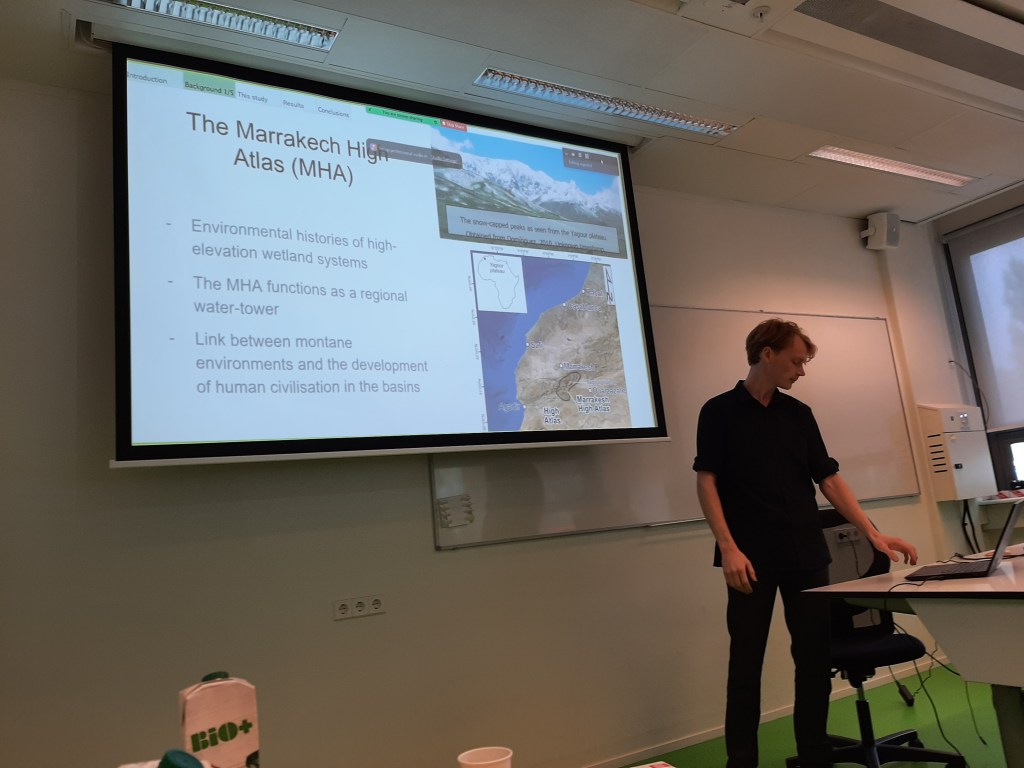
The second part of the meeting focused on the “now” with presentations form three Dutch researchers engaged in research abroad. First up with Eric de Boer (Universidad de Granada, Spain), then Thya van den Berg (University of Hull, UK), and finally Henk Cornelissen (University of Manchester, UK). Eric presented new data on the human and climate impacts on the Iberian Peninsula. Thya presented her work in two parts focused on the new datasets on past environmental change from Yorkshire (UK) and then the development of modelling approached to estimate landscape cover on the basis of pollen datasets. Henk took us to the high atlas of Morocco and showed how pollen and chemical data can be integrated to reveal past human presence and impacts.
The next scheduled event will be in the annual excursion which this year will be to Leiden. For further details and to find out more about the Palynologische Kring visit the web pages here.
Title: “The potentials and pitfalls of linking climate and cultural change, with a focus on the archaeological record“
The seminar will be delivered via Zoom. The link for the seminar can be obtained from the MAA Slack page, or from seminar chair and chaired by Lynne Quick.
On behalf of Manu Chevalier, Anne Dallmeyer, Ulrike Herzschuh, Thomas Hickler, Yoshi Maezumi and Martin Claussen I would like to draw your attention to a special issue of Climate of the Past entitled: “Past vegetation dynamics and their role in past climate changes”. The call for papers for this special issue is now open (closing date: December 2024). See below for full details and how to submit.
I would like to draw your attention to SKOPE (Synthesizing Knowledge of the Past Environments) project run by R. Kyle Bocinsky, Andrew Gillreath-Brown, Keith Kintigh, Ann Kinzig, Timothy A. Kohler, Allen Lee, Bertram Ludaescher, and Timothy McPhillips and funded by National Science Foundation (USA). They have just launched an online tool that allows the exploration of past environmental change data aimed at archaeologists, ecologists, historians, geographers and planners. Check out the details on their web site:
I am pleased to announce the next seminar series from the Palynologische Kring“Dutch Palynologists Then and Now: A brief history or Frans Florschütz, and new research from scientists who have been working abroad”
The meeting will take place on the afternoon of the 19th May at the Institute for Biodiversity & Ecosystem Dynamics (University of Amsterdam); if you are not a member of the society and want to follow the talk online or attend in person please contact me for details.Full program below.
Gosling, W.D., Miller, C.S., Shanahan, T.M., Holden, P.B., Overpeck, J.T. & van Langevelde, F. (2022) A stronger role for long-term moisture change than for CO2 in determining tropical woody vegetation change. Science 376, 653-656. https://doi.org/10.1126/science.abg4618
To access this article FREE through the Science author referral service click here.
For more on the palaeoecological dataset underpinning this research check out the PhD thesis of Charlotte Miller by clicking here or here.
Smeenge, H., Kooijman, A., Brinkkemper, O., Mars, H.d., Mauquoy, D. & van Geel, B. (2022) The origin of alkaline fen in the Mosbeek Valley in the Netherlands is due to human impact rather than a natural development. The Holocene 09596836221088230. DOI: 10.1177/09596836221088230