To start discussion during the Mapping Ancient Africa kick off meeting (October 2021) lead author Stefanie Kaboth-Bahr has recorded an introduction to her recent paper proposing a novel tropical based climate mechanism for driving climatic change across Africa.
Kaboth-Bahr S, Gosling WD, Vogelsang R, Bahr A, Scerri EML, Asrat A, Cohen AS, Düsing W, Foerster V, Lamb HF, et al. 2021. Paleo-ENSO influence on African environments and early modern humans. Proceedings of the National Academy of Sciences 118(23):e2018277118. https://doi.org/10.1073/pnas.2018277118
The first meeting of the, INQUA funded, Mapping Ancient Africa project will take place on the 14 and 15 of October 2021 with face-to-face meetings at four locations (Nairobi, Kenya; Port Elisabeth, South Africa; Potsdam, Germany; Portland, Oregon, USA) being linked up online.
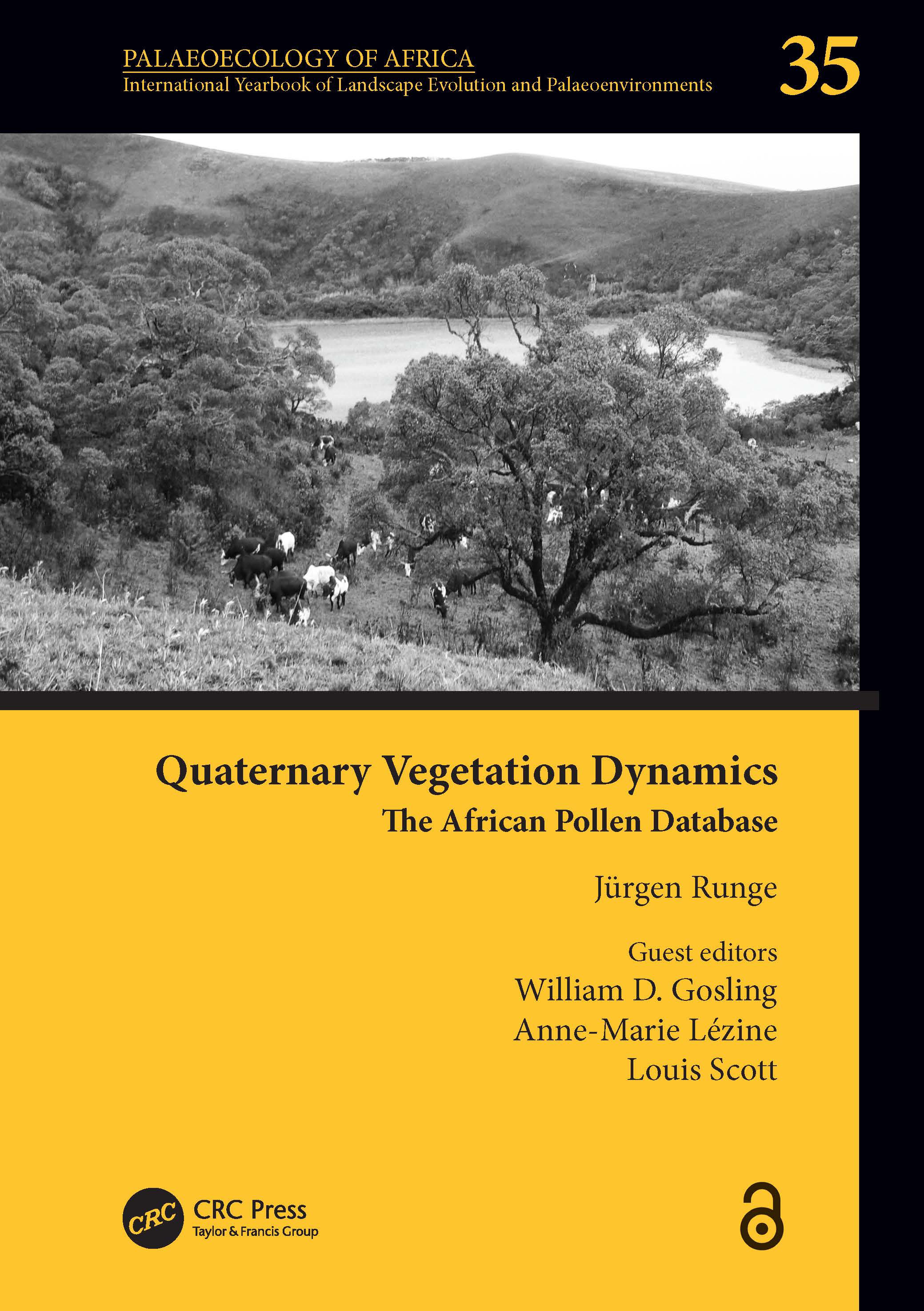
I am pleased to announce that the new, open access, volume of Palaeoecology of Africa (PoA) should be available to download in October. The “Quaternary Vegetation Dynamics” volume comprises 24 chapters, produced by more than 70 authors, and contains extensive review papers, personal perspectives on hot topics, as well as new research and data papers.
To find out more on the volume visit the publishers web site: PoA Vol. 35
Over the next few months I aim to blog about the various specific chapters to showcase some of the key findings. I hope that this book will provide a useful resource to all researchers working on past climate, environmental and vegetation change in Africa, and will provide a springboard for the start of the new “Mapping Ancient Africa” project that will kick off in October.
I am excited to announce that we are looking for an expert in climate systems, with experience of computational modelling, to join our team in the Department of Ecosystem & Landscape Dynamics (ELD) at the University of Amsterdam. ELD is one of four research departments within the Institute for Biodiversity & Ecosystem Dynamics which seeks to unravel how ecosystems function in all their complexity. The successful applicant will deliver climate related education within our BSc Future Planet Studies and MSc Earth Sciences programs, and conduct cutting edge research. We are looking for a collaborative researcher who can establish research links with existing staff members and inspire students.
The British Ecological Society (BES) has just opened a new call for applications to its Outreach, Ecologists in Africa, Small Research Projects, Large Research Projects and Travel & Training grants. To find out how to apply visit: https://www.britishecologicalsociety.org/funding/research-grants/
Maezumi SY, Gosling WD, Kirschner J, Chevalier M, Cornelissen HL, Heinecke T, McMichael CNH. 2021. A modern analogue matching approach to characterize fire temperatures and plant species from charcoal. Palaeogeography, Palaeoclimatology, Palaeoecology 578:110580. https://doi.org/10.1016/j.palaeo.2021.110580
I am pleased to announce the start of a new project “Mapping Ancient Africa” funded by the International Union for Quaternary Research (INQUA) with support from the Palaeoclimate commission (PALCOM) and the Human & Biospheres commission (HABCOM). This project will bring together Quaternary scientists focused on past climates and environments with those working on human evolution and development in Africa. Through the synthesising data and linking these with modelling approaches we hope to bring together a novel group of researchers to explore the climatic and environmental backdrop to hominin development.
Further information on the project can be found on a new “sub-site” within this blog dedicated to the “Mapping Ancient Africa” project. The project is designed to connect researchers working on these topics so if you are interested to be involved please do get in contact. The first meeting will be held in October 2021 online and at four locations: Nairobi (Kenya), Port Elizabeth (South Africa), Potsdam (Germany) and Portland (Oregon, USA) – for further details click here.
We are looking for a researcher with a geosciences background to explore the physical properties of the sediments recovered from Lake Bosumtwi (Ghana). The Lake Bosumtwi sediments we recovered by the International Continental Scientific Drilling Program in 2004 and have been found to span the last c. 1.07 million years (Koerbel et al., 2005). This project will examine the borehole data and relate this ongoing palaeoenvironmental studies at the site (Miller & Gosling, 2014; Miller et al., 2016).
Kaboth-Bahr S, Gosling WD, Vogelsang R, Bahr A, Scerri EML, Asrat A, Cohen AS, Düsing W, Foerster V, Lamb HF, et al. 2021. Paleo-ENSO influence on African environments and early modern humans. Proceedings of the National Academy of Sciences 118(23):e2018277118. https://doi.org/10.1073/pnas.2018277118







 Ecology of the past