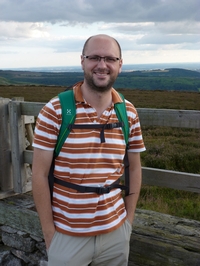
Hi, my name’s Nick and I’m joining the Palaeoenvironmental Change Research Group as a PhD student on a NERC funded project looking at the response of tropical forests to past changes in global climate.
I’m excited to be going off to Ecuador in November (with Encarni and Will) to undertake the sampling of lake sediments around the Estación Biológica Pindo Mirador and the National Park of Cayambe Coca, from which I hope to be able to determine changes in the ecology of the mountainous flora of the Andean regions of Ecuador during the last glacial and current interglacial periods.
I’m thrilled to be starting at the OU and am looking forward to splitting my time trekking through tropical rainforests and staring at microscopic pollen in a lab in Milton Keynes.
To date I have published one scientific paper, I hope to produce many more over the next few years…
Loughlin, N.J.D. & Hillier, R.D. (2010) Early Cambrian Teichichnius-dominated ichnofabrics and palaeoenvironmental analysis of the Caerfal Group, Southwest Wales, UK. Palaeogeography, Palaeoclimatology, Palaeoecology 297(2): 239-251. doi: 10.1016/j.palaeo.2010.07.030
Hello! I’m Adele and I started my PhD about a week ago. It’s been a little intense but I can almost find the lab without a map now, so it is probably time to introduce myself.
I’ll be studying pollen-vegetation relationships in Ghana, as part of the NERC funded project ‘500,000 years of solar irradiance, climate and vegetation changes’. This means I’ll be using pollen traps to figure out how pollen outputs vary between (and sometimes within) different vegetation types in Ghana. I will also be trying my hand at chemotaxonomy and video making. I’m heading out to Ghana (along with Phil Jardine) in just over a week to do my first lot of field work which will involve seeing the plots, collecting existing traps, replacing them with new ones, and setting up some new sites. I’m very excited.
Hayley Keen: “Continual pollen counting, second lot of Argon dating done, and first set of wood macrofossils back and ready for identification!”
Frazer Bird: “At the start of September I began working as a technician as part of Encarni’s project. I am looking at the midges from the core we collected together on our last field trip. Things are going well, although the midges are hard to find in the older sections the preservation in early sequences is great. The resolution of this core looks to be fantastic also so and hopefully we will get some interesting results when we compare all the proxies. Away fromthe lab I presented at INTECOL 2013 in London, The talk seemed to go down well and was noted as highly commended by the judging panel. Great publicity all round for the midges!!!”
Bryan Valencia: Has been on field work in Peru during this time he presented a talk on climate change to the Asociación para la Conservación de la Cuenca Amazónica, and gave interviews to local journalists and two TV stations. He also collected sediments from two locations, and manged to obtain a new US visa. He is now working on the final stages of submitting his thesis.
Phil Jardine: Phil has been busy ordering in microscopes and other equipment for the Lake Bosumtwi project (the first of which arrived today), and setting up the trip to Ghana that he’ll be going on with new PhD student Adele Julier in late October. He’s also been attempting to learn more about geochemistry, which has proved challenging.
Lake Pindo: We have finally the results of 6 samples radiocarbon dated from NRCF through our collaborator Dr Pauline Gulliver, and we have sent 4 more to “range find” the key interval of interests for the FORSENS project. We have started the midges’ analysis although it seems this going to be focused to the upper 4 meters of sediment. We would like to discern possible preservation issues in tropical records for this proxy. Some samples for a preliminary screening looking for diatoms ahve been collected and sent to the new FORSENS collaborator Teresa Vegas-Vilarrúbia. MS samples have been also collected for the first three drives and we hope to run this analysis next month.
Lake Banos: We have started the pollen prep. for the upper section of the record.
Management tasks: We are now ready for the tropical record Lake Marcacocha pollen prep., collaborating with an ongoing project lead by Alex Chepstow-Lusty. On a different topic, I have started the organisation of department seminars, so I would like to highlight if you have any potential speaker, please contact me.
Publications: a co-authorship in a paper published in Perspectives in Plant Ecology, Evolution and Systematics authored by Valentí Rull and his research group in the Botanical Institute of Barcelona is now available on line (click here)
William Gosling: “I have been promoted to Senior Lecturer (hooray),started work on the new level 2 environmental science module, been working on a new paper from the Erazo study site, and had a holiday!”
Rull, V., Montoya, E., Nogué, S., Vegas-Vilarrúbia, T., Safont, E., (online) Ecological palaeoecology in the neotropical Gran Sabana region: Long-term records of vegetation dynamics as a basis for ecological hypothesis testing. Perspectives in Plant Ecology, Evolution and Systematics. doi: 10.1016/j.ppees.2013.07.004
Human modification of the landscape in the Andes (Peru)
Whilst working on intergrating palaeoecological and archaeological data for a recent publication (Gosling & Williams, 2013) I was struck by the range of sources I had to go to to obtain data from the two different disciplines. The paper focuses on the how societies in the high Andes have developed over the last 5000 years and the role, if any, that changes in natural resource (ecosystem service) avaliability might have played in pacing any societal changes. However, when I got the first set of review comments back I was left considering my (academic) resource base, how I accessed this, and how that influenced my ability to conduct research; especially when moving slightly outside the area of my specialism.
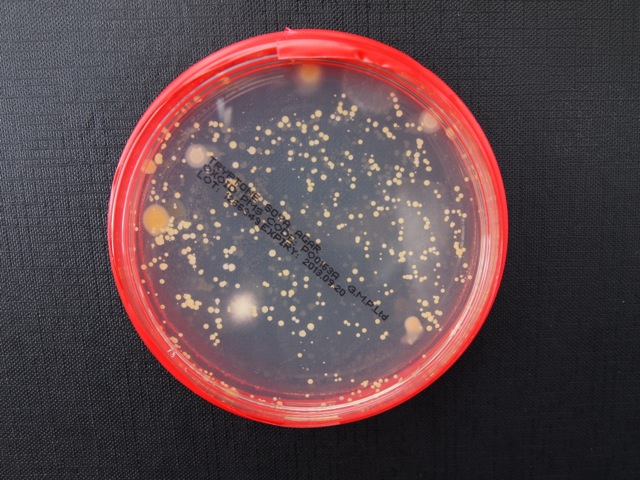
Will’s BES T-shirt logo swabbed at Greenman; for more microbes on festival kit visit the “Hall of shame” on http://www.besfest.org
August was a month for travel with PCRG members heading for Peru (Bryan, and he is still there), Greenman festival (William), INTECOL conference (William and Frazer), and the Royal Geographic Society annual meeting (William, Encarni, Frazer and Hayley). Detailed reports of the UK based travels are already on the blog, and hopefully we will get a post from Bryan on his Peruvian adventure once he is back.
Back in Milton Keynes work progressed with:
Hayley producing a revised full draft of her pollen counting methodology manuscript,
Frazer starting with the first tentative attempts to apply his chironomid training data set to fossil chironomid records,
Phil trialing inverted microscopes and training on the FTIR,
Encarni plotting field work in Ecuador (more travel for November-December),
My name’s Phil Jardine, and I’ve recently joined the Palaeoenvironmental Change Research Group as a post-doc, on the NERC-funded ‘500,000 years of solar irradiance, climate and vegetation changes’. For this project I’ll be analysing the chemistry of pollen grains from a 500,000 year long sediment record from Lake Bosumtwi in Ghana, with the aim of generating a long-term historical record of solar irradiance.
Before coming to the Open University I was based at the University of Birmingham, where I did PhD and post-doc research on North American pollen records from the early Palaeogene (~65 – 45 million years ago). For this work I was particularly interested in the role of climate in driving changes in plant communities, especially during a rapid global warming event 55 million years called the Paleocene-Eocene Thermal Maximum (PETM). Having worked for some time now on pretty old material, I’m looking forward to researching something a bit more recent – if you can call the last 500,000 years recent – and going out to Ghana and looking at real, live, tropical plants.
If you would like to get in touch about the Lake Bosumtwi project, or something else pollen related, please feel free to get in touch.
Palaeo-people at the RGS-IBG meeting plotting future papers and grants. Left-right: Encarni Montoya, Joe Williams, Hayley Keen and Frazer Bird.
RGS – IBG Annul International Conference 2013
27th – 30th August, London
Yesterday (29th August) four members of the Palaeoenvironmental Change Research Group (PCRG) went down to London for the third day of the Royal Geographical Society with IBG (RGS – IBG) international conference for a day of informative talks. Two of the morning sessions were of particular interest to us with the sessions entitled ‘Human – environment interactions in the Neotropics: historical impact to current challenges’organised by John Carson, Lizzy Rushton and Sarah Metcalfe.
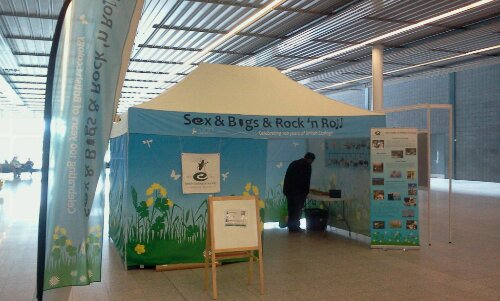
Sex & Bugs & Rock n Roll at INTECOL: The BES sponsored tour of music festivals (http://www.besfest.org) landed at INTECOL. David Price from Science made Simple (http://www.sciencemadesimple.co.uk/) arrived on the Wednesday day afternoon to show what can be achived with professional science busking.
As a palaeoecologist when I came back to the UK from my post doc in Florida I started to get involved with the British Ecological Society (BES) so I could meet neoecologists. Eight years later I am still involved in the society and delighted that the theme of the society’s centenary celebration meeting focuses on change through time: Into the next 100 years. With 11 plenary lectures, dozens of parallel session, hundreds of posters and other activities including Pecha Kucha talks, workshops, field trips and trade stalls I will restrict my post to my thinking about the theme of timescales and the broader messages I got from the meeting.
Last week I attended the annual meeting of the British Ecological Society Macroecology Special Interest Group (or BES Macroecology SIG for something a bit more manageable) at the University of Sheffield. Macroecology deals with ecological patterns and processes that occur over large spatial and temporal scales, and so is a natural fit for a lot of palaeoecological data.
The organisers deliberately moved away from the standard conference format of back-to-back talks, and instead built in lots of time for discussions around several themes (‘provacations’) that addressed the current status of macroecology and possible future directions for it. Several areas for progress were identified here, including finding more efficient ways of generating, curating and accessing large (global scale) datasets, increasing dialogue between numerical modellers and empirical ecologists, and more statistical and computational training for undergraduate ecologists and biologists.
Sessions of presentations were also formulated to encourage discussion and debate, with either rapid, five-minute presentations or longer methodological talks forming the starting point for further discourse. I struggled enormously with the five-minute time limit during my talk (conference talks are often built around a 15 minute slot) but hopefully interested a few people in the uses of 60 million year old pollen for addressing macroecological questions.
A workshop on ‘Spatial analysis in R’ followed the two-day meeting. This was taught by Barry Rowlingson, and was co-organised by the Macroecology and Computational Ecology SIGs. Barry started by introducing the programme R and then went on to demonstrate its uses for handling, mapping and analysing spatial data. This type of analysis was largely new to me, and this workshop was a brilliant introduction to what R can do with geographical data.
To join these British Ecological Society SIGs and find out about other groups visit the BES SIG pages by clicking here.



 Ecology of the past