This time you are reading a message from a non-expert in paleoecology. My name is Masha and I will spend the next two years on a very exciting postdoctoral fellowship funded by NWO (Dutch National Science Foundation) under their Rubicon scheme in close collaboration with William Gosling (University of Amsterdam).
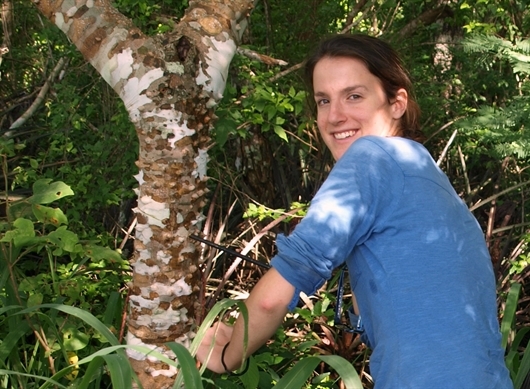
Hi all! My name is Seringe (Dutch for lilac flower), and unsurprisingly I am a biology student. I completed my BSc Biology at the VU University, specializing in ecology. Being fascinated by tropical rainforest since I was a kid, I attended a Tropical Ecology course at the University of Amsterdam (UvA), resulting in a research project with Crystal McMichael from the Palaeoecology & Landscape Ecology group on the late-Holocene fire history of western Amazonia. Besides performing this palaeoecological project, focusing on the aspect of ancient human activity, I followed courses of Latin America Studies to broaden my perspectives on the current socio-environmental complexity and conservation status of the area. This year, I have gotten the amazing opportunity to join Crystal McMichael on a fieldwork expedition to the Ecuadorian Amazon!
Seringe Huisman in the field…
The fieldwork will be part of my Master’s thesis, elaborating on the regional patterns of vegetation composition changes in relation to human disturbance. I will be taking sediment cores from two lakes in the Sangay region of Ecuador, perform charcoal and phytolith analysis to reconstruct fire and vegetation assemblages over the late Holocene and compare the results to previously established records across western Amazonia. While I am currently attending the MSc Biological Sciences Limnology & Oceanography Master’s track at UvA, I could not help but directing my first project into Paleoecology again! My field trip is largely made possible by obtaining €1150 of grants through the Treub-Maatschappij and the Amsterdam University Fund, for which I am very grateful.
I am super excited to be heading to Ecuador soon, and will be back in a month with field stories, mosquito bites and hopefully some suitable sediments!
Eric Grimm: A high-resolution record of hydrologic variability, vegetation, and fire from the Northern Great Plains, North America
Suzette Flantua: Assembling the biogeographic history of the Northern Andes – A multi-proxy approach
Carina Hoorn: The Amazon at sea: Onset and stages of the Amazon River from a marine record, with special reference to Neogene plant turnover in the drainage basin
Keith Richards: Why did the Arctic seal, Phoca hispida, become land-locked in the Caspian Sea 2.6 million years ago? : Palynology and foraminifera explain how
The meeting will be followed by the IBED seminar given by Prof. Jonathan Overpeck, click here for more details.
Salamanca Villegas, S., van Soelen, E.E., Teunissen van Manen, M.L., Flantua, S.G.A., Santos, R.V., Roddaz, M., Dantas, E.L., van Loon, E., Sinninghe Damsté, J.S., Kim, J. & Hoorn, C. (2016) Amazon forest dynamics under changing abiotic conditions in the early Miocene (Colombian Amazonia). Journal of Biogeography online. DOI: 10.1111/jbi.12769
This is my first time attending the European Conference of Tropical Ecology and my second visit to Germany. The conference attracted c. 350 delegates; big enough to have plenty of interesting science, and yet small enough to find everyone you wanted to. The keynote speakers chosen to head the days provided some exciting insights into various new developments across the tropics, including: the importance of biogeography (Richard Corlett), metabolism and carbon cycles (Yadvinder Malhi), diversity and resilience (Lourens Poorter), tropical peatlands (Sue Page), agricultural landscapes (Ravi Prabhu), and mutualism of figs and fig wasps (Martine Hossaert-McKay).
From the many other interesting talks five in particular grabbed my attention, these were:
Miller, C.S. (2014) 520,000 years of environmental change in West Africa. PhD Thesis, Department of Environment, Earth & Ecosystems, The Open University.
McMichael, C., Piperno, D., Neves, E., Bush, M., Almeida, F. & Mongelo, G. (2015) Phytolith assemblages along a gradient of ancient human disturbance in western Amazonia. Frontiers in Ecology and Evolution 3.DOI: 10.3389/fevo.2015.00141
Mackenzie, G., Boa, A.N., Taboada, A.D., Atkin, S.L. & Sathyapalan, T. (2015) Sporopollenin, the least known yet toughest natural biopolymer. Frontiers in Materials 2. DOI: 10.3389/fmats.2015.00066
Nelson, B.W., Ferreira, C.A.C., da Silva, M.F. & Kawasaki, M.L. (1990) Endemism centers, refugia and botanial collection density in Brazilian Amazonia. Nature 345, 714-716. DOI: 10.1038/345714a0
Souto, C.P., Kitzberger, T., Arbetman, M.P. & Premoli, A.C. (2015) How do cold-sensitive species endure ice ages? Phylogeographic and paleodistribution models of postglacial range expansion of the mesothermic drought-tolerant conifer Austrocedrus chilensis. New Phytologist 208, 960-972. DOI: 10.1111/nph.13508 COMMENT: Variation in genetic diversity used to infer the location of glacial refugia.
Open access online:
Flantua, S.G.A., Hooghiemstra, H., Grimm, E.C., Behling, H., Bush, M.B., González-Arango, C., Gosling, W.D., Ledru, M., Lozano-García, S., Maldonado, A., Prieto, A.R., Rull, V. & Van Boxel, J.H. Updated site compilation of the Latin American Pollen Database. Review of Palaeobotany and Palynology 223, 104-115. DOI: 10.1016/j.revpalbo.2015.09.008
 Dear Ecology of the past blog readers,



 Ecology of the past