Preparing my lecture for the new Scientific Methods in Archaeology course for VU Amsterdam and University of Amsterdam students studying a minor in Geoarchaeology. The focus will be on detecting human activity in the past, to illustrate this I will include Easter Island/Rapa Nui as a case study. We will focus on how palaeoecological evidence can be used to gain insights into past human activity. Whilst putting this together I discovered these nice documentaries looking at humans and their environmental impacts on Easter Island/Rapa Nui which I wanted to share, they show how much effort people would have had to put into altering their landscape:
For further information see also:
Rull, V., Cañellas-Boltà, N., Saez, A., Margalef, O., Bao, R., Pla-Rabes, S., Valero-Garcés, B. & Giralt, S. (2013) Challenging Easter Island’s collapse: The need for interdisciplinary synergies. Frontiers in Ecology and Evolution 1, DOI: 10.3389/fevo.2013.00003
Title: When was the South Pacific colonised? A lake sediment approach to understanding climate:human drivers of ecosystem change on remote Pacific Islands
Zoe and William just after the graduation ceremony (UvA)
Two students (Zoe van Kemenade and Tessa Driessen) have recently completed projects looking at past environmental change on Samoa working in the Research Group of Palaeoecology & Landscape Ecology at the University of Amsterdam (UvA). Zoe’s project, part of her BSc Future Planet Studies (major Earth Sciences) at UvA, was entitled “A multi‐proxy analysis on the effect of climate and human activity on the environment of Samoa during the Holocene” and investigated charcoal, macro-fossils, and algae. Tessa’s project, “Biodiversity, fire and human dynamics on Samoa over the last 9200 years”, was completed as an internship during her MSc in Environmental Biology at Utrecht University (UU) that was co-supervised by Rike Wagner-Cremer. Tessa focused on the fossil pollen record to reconstruct past vegetation change. Both projects were conducted in cooperation with Jon Hassel and David Sear (both University of Southampton) who provided access to the Samoan sediments; for more on the Southampton Pacific Islands projects check out their blog Palaeoenvironmental Laboratory at the University of Southampton.
The results from both projects, and work by the University of Southampton team, will be presented at this years GTO conference (European conference of tropical ecology) in Gottingen next week.
William giving his personal view on the work of Tessa at her gradation ceremony (UU)
Posted on behalf of Thomas Giesecke:
EUROPEAN POLLEN DATABASE
Meeting and training workshops
1-3/06/2016
Aix-en-Provence, France
We offer exciting keynote lectures, an extensive poster session to showcase your research, and two days of training with experts in software, databases, and modelling.
We want your opinion on how to develop the European Pollen Database (EPD) to make it a better resource for research, education, and data storage.
NO registration fee
Workshop topics include:
Plotting and archiving palaeoecological data, using Tilia and Neotoma
Charcoal analysis software and database
How to use modern surface samples for ‘analogue’ reconstructions of the past
Hi I’m Tessa and really excited to introduce myself here!
I’m an Environmental Biology Master student from Utrecht University (UU) doing a research internship in Amsterdam with William Gosling and Rike Wagner of the UU. Most people would describe me as a typical biologist because I like identifying plants and know some birds by their name. Personally I disagree because I lack the beard and hardly wear woollen socks. Besides looking at birds and plants I’m also interested in biodiversity and palaeoecology, and I will try to combine these interests in my research project on a sediment core from Samoa. I will be working on lake sediment cores from Samoa and hope fossil record can give me an overview of the natural history of the island (past c. 10,000 years); and an insight into what impact human colonisation had on the biodiversity. To explore the islands natural history I will be looking at pollen, charcoal and non pollen palynomorphs.
The sediment core on which I will be working has already been recovered and currently resides in beautiful Southampton (UK). So I’m spared of a 30 hour trip to tropical Samoa and the opportunity to return with some Samoan tattoo’s and a tan… So thanks to David Sear and his team at the University of Southampton with whom I will be collaborating for this project.
I have a long standing interest in tropical islands. Before commencing this research internship I did my first masters internship at WWF Indonesia. For my WWF internship I spent three months in the tropics collecting baseline ecological data on timber companies located in a new reserve in Sumatra. Furthermore, during my bachelor degree, I did a research internship at Naturalis Biodiversity Center investigating the “Correlation between higher altitudes and endemic plant species” in the Malayan archipelago. Our results turned out much better then we hoped for and fingers crossed our article will be accepted soon!
In three weeks I will be starting in the lab in Amsterdam and hopefully in a few months will be able to post an update about my results here.
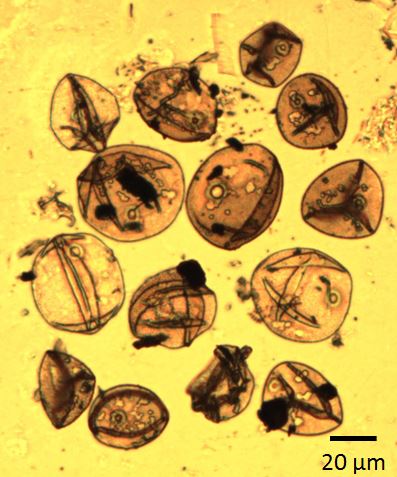
Grass pollen from Lake Bosumwti picked for individual chemical analysis
Abstract submission is now open for the XIX International Union for Quaternary Research (INQUA) Congress. “Ecology of the past” researchers will be there and are hosting a special session, entitled Organisms and environments: Frontiers in palaeoecological technique development, at which we hope to bring together a wide range of palaeoecologists working on novel proxy development. Members of the “Ecology of the past” group will be showcasing recent findings on the environmental significance of pollen chemistry change through time; linked to the 500,000 years of solar irradiance, climate and vegetation change in tropical West Africa project (Fraser et al., 2014). Please take a look at our session and consider submitting YOUR abstract today!
For information on abstract submission click here. Closing date for abstract submission 20 December 2014.
For further information on our session click here, or “Continue reading” below…
I am delighted to be organizing a focus session at the first AfQUA meeting. The session seeks to bring together ecologists and palaeoecologists working in Africa. If you are interested in getting involved please contact me (William Gosling) directly. For further information on the conference visit the AfQUA website or twitter feed.
Focus session 1: African ecology in context
The African continent spans over 80 degrees of latitude, nearly 6000 m of altitude and around 30 million km2 consequently it contains a vast array of unique ecosystems. Many of the African ecosystems are under direct pressure from human activity and are threatened by on-going and projected climate change. However, management and conservation of the modern African ecosystems is hampered by a paucity of data on their natural history. Studies of observations of ecosystems spanning >30 years are rare so we are heavily reliant on examination of the fossil record to place modern ecology in a long-term (>50 year) context. Information on past ecosystems can be extracted through the examination of a range of biological indicators (e.g. pollen, carbon isotopes, charcoal) found within marine and lake sediments. However, interpretation of the sediments and the proxies they contain with the ecosystems observed today is challenging because of timescale and interpretation issues. The aim of this session is to bring together modern ecologists and paleo-ecologists working in Africa to present the state-of-the-art understanding of ecosystems past and present, and explore how we can improve understanding of timescales and proxy interpretation to place these threatened ecosystems in context.






 Ecology of the past