Introducing Nina Witteveen

April 6, 2018
WDG

My name is Nina Witteveen and I’m doing a research project for my master (Biological Science) with Crystal McMichael and William Gosling. I’m analyzing phytoliths to reconstruct the vegetation changes of Campo Libre (Napo, Ecuador) of the past 30,000 years. It is so exciting to count phytoliths of such an old age!

Simon Scholz is currently doing a charcoal analysis and two years ago, Maaike Zwier performed a physical analysis in the sediment. With all these results combined, I will investigate how climate changes and human influence have changed the vegetation of Campo Libre. Hopefully this research will give more insight into the effect of a changing climate on this biodiversity hotspot!

I’ve completed my thesis for the Biology bachelor at the UvA under the supervision of Crystal and Will. Together with other students we performed phytoliths, pollen and charcoal analysis from sediment of Well-Aaijen (Limburg, the Netherlands). More specifically, I’ve looked at the vegetational changes during the transition from hunter-gatherers to farmers through pollen and phytolith analysis. I’m very happy to be working with Crystal and Will again, this time in a more tropical setting!

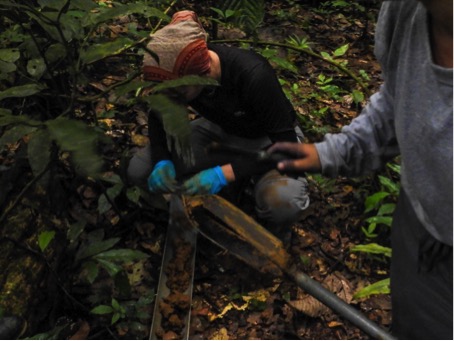
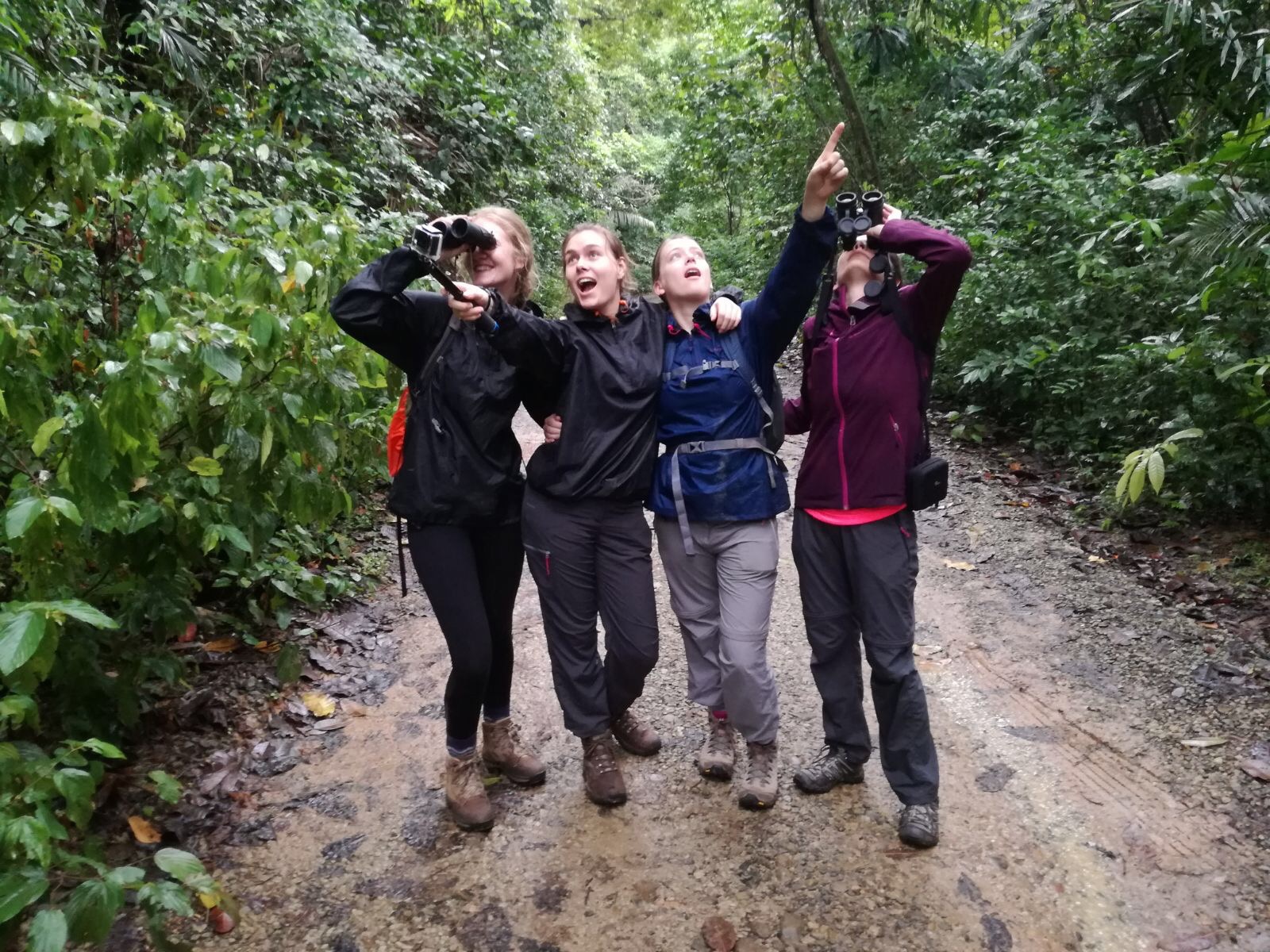
In January of this year, I travelled to Panama with Veerle Vink, Britte Heijink and Crystal McMichael. It was a great experience! Surrounded by Howler Monkeys, we made our way through streams and Geonoma palms to collect soil surface samples for future phytolith analysis. Definitely a highlight of my fieldwork so far! I am now back in the microscope lab, and always up for a (paleo)chat 🙂
 

Polylepis woodland dynamics during the last 20,000 years

March 23, 2018
WDG

Valencia, B.G., Bush, M.B., Coe, A.L., Elizabeth, O. & Gosling, W.D. (2018) Polylepis woodland dynamics during the last 20,000 years. Journal of Biogeography online. DOI: 10.1111/jbi.13209

Introducing Britte Heijink

March 2, 2018
WDG

Veerle and I trying to protect ourselves from the mosquitos.

Veerle and I trying to protect ourselves from the mosquitos.

Hi all!

My name is Britte Heijink and I’m doing my MSc Biological Science thesis research project with Crystal McMichael and William Gosling. I travelled with Veerle Vink and Crystal to the Colombian part of Amazonia to collect samples for my project. At Amacayacu National Park, we collected soil cores from different locations in the plot. Now that we’re back in Amsterdam, I’m analysing the soils to reconstruct the fire and vegetation history from the plot using charcoal and phytoliths. I am specifically looking to see if humans have been present in the system and how they potentially affected the vegetation at Amacayacu.

 Here I’m Sampling pieces of soil cored by Louisa and checking for large pieces of charcoal

Here I’m Sampling pieces of soil cored by Louisa and checking for large pieces of charcoal

I’ve completed my bachelor thesis for Bèta-Gamma (Liberal Arts and Sciences) under the supervision of Crystal and Will here at the UvA. I’m really excited to work with them again, and already looking forward to our meetings at the Oerknal 😉  I will be finished by the end of September, and then possibly return for a literature study.

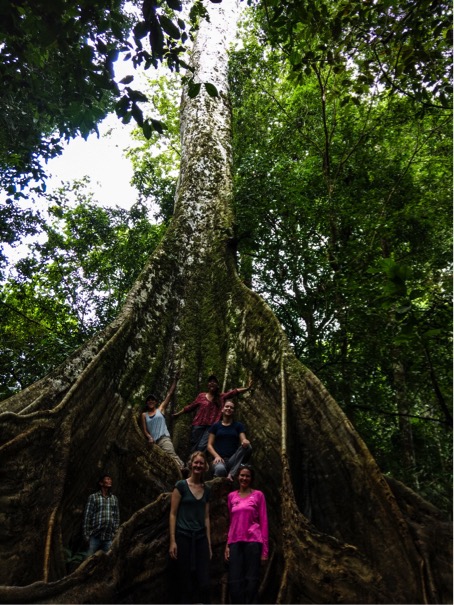
One of the most wonderful experiences in my academic career so far has been the fieldwork to Panama and Colombia with Crystal, Veerle, and Nina. It was a lot of hard work, and 90% of our time was spent covered in mud, sweat, and insect repellant, but the experience of working in a tropical rainforest was completely worth it! Veerle and I will write another blog about our fieldwork soon. Come see us in the microscope lab if you want to hear our dangerous and amazing stories before that!

Cheers,

Britte

Our last day in the Amazon was spend with some of the local students, Louisa Fernando Gomez Correa and Mariana Gutierrez Munera.

Our last day in the Amazon was spend with some of the local students, Louisa Fernando Gomez Correa and Mariana Gutierrez Munera.

The impact of people on islands

January 19, 2018
WDG

Since being appointed as an Associate Editor of Vegetation History & Archaeobotany last year I have the pleasure of working on a number of exciting and interesting manuscripts from the tropics. I am particularly delighted that the first of these (Astudillo, 2018) has now been published. I particularly liked this manuscript because of: (i) the close relationship that was shown between the historical and fossil records, and (ii) the clear signal shown from working on a island system. This linkage is something I have been thinking about in my own research on Mauritius recently (Gosling et al., 2017) and is, I believe, particularly valuable to do because it demonstrates the validity of techniques to track human activity when applied in contexts without historical documentation. The impact of people on the Galapagos is shown by Astudillo (2018) from investigation of multiple proxies (charcoal, phytoliths and macrofossils) to build up a comprehensive picture of human impacts on one of the most famous places for biodiversity on Earth. Hopefully this study is just the start of investigations into past human impacts on the Galapagos islands, and I hope that you enjoy reading the manuscript!

Continue Reading

Off to the tropics!!

December 26, 2017
cmcmicha

On Jan 1, 2018 I (Crystal McMichael) get to ring in the New Year in the best way possible by heading off to the tropics to do fieldwork! And this time I get to take two students with me. Britte Heijink and Veerle Vink are both in the Biological Sciences MSc program (Ecology and Evolution track), and they are going to work on research projects that are associated with a recent grant that I was awarded through the Smithsonian Tropical Research Institute CTFS-ForestGEO Research Grants Program.

Continue Reading

Job: Post-doctoral researcher in Palaeoecology

November 30, 2017
cmcmicha

Job: Post-doctoral researcher in Neotropical Palaeoecology
Location: Institute for Biodiversity & Ecosystem Dynamics, University of Amsterdam
Duration: 3 years
Deadline for applications: 15 January 2018

We are seeking to recruit a Neotropical palaeoecologist to join the recently funded “The past peoples of Amazonia: Assessing ecological legacies” project (PI Dr. Crystal McMichael, funding NWO, based within the Department of Ecosystem & Landscape Dynamics). The project aims to reconstruct cultural histories from lake sediments in northwestern Amazonia, and link past human activities with modern ecological observations. The project involves analyzing microfossils (including pollen, phytoliths, and charcoal), and the development of a transfer function that estimates past human impacts in tropical forest systems.

We are particularly looking for a candidate with  expertise and experience, in:

  • Fieldwork in remote areas.
  • Neotropical pollen.
  • Quantitative analysis, including familiarity with R and Geographical Information Systems.
  • Academic publication.

For more details and how to apply click here.

Evidence of early cultivation around the globe

October 24, 2017
WDG

Two recent articles published in the journal Vegetation History & Archaeobotany, which caught my attention as an Associate Editor, explore early cultivation in Argentina and Czech Republic:

  • Lopez (2017) examine macro-botanical remains from 16 archaeological sites in Argentina and concludes that the transition from foraging to cultivation commenced around 1000 years ago.
  • Dreslerová et al. (2017) looked an charred macrofossil remains from 84 archaeological sites in the Czech Republic to think about how early farmers selected the crops they grew.

Continue Reading

The ACER pollen and charcoal database: a global resource to document vegetation and fire response to abrupt climate changes during the last glacial period

October 11, 2017
WDG

Goni, M.F.S., Desprat, S., Daniau, A., Bassinot, F.C., Polanco-Martinez, J.M., Harrison, S.P., Allen, J.R.M., Anderson, R.S., Behling, H., Bonnefille, R., Burjachs, F., Carrion, J.S., Cheddadi, R., Clark, J.S., Combourieu-Nebout, N., Mustaphi, C.J.C., Debusk, G.H., Dupont, L.M., Finch, J.M., Fletcher, W.J., Giardini, M., Gonzalez, C., Gosling, W.D., Grigg, L.D., Grimm, E.C., Hayashi, R., Helmens, K., Heusser, L.E., Hill, T., Hope, G., Huntley, B., Igarashi, Y., Irino, T., Jacobs, B., Jimenez-Moreno, G., Kawai, S., Kershaw, A.P., Kumon, F., Lawson, I.T., Ledru, M., Lezine, A., Liew, P.M., Magri, D., Marchant, R., Margari, V., Mayle, F.E., McKenzie, G.M., Moss, P., Mueller, S., Mueller, U.C., Naughton, F., Newnham, R.M., Oba, T., Perez-Obiol, R., Pini, R., Ravazzi, C., Roucoux, K.H., Rucina, S.M., Scott, L., Takahara, H., Tzedakis, P.C., Urrego, D.H., van Geel, B., Valencia, B.G., Vandergoes, M.J., Vincens, A., Whitlock, C.L., Willard, D.A. & Yamamoto, M. (2017) The ACER pollen and charcoal database: a global resource to document vegetation and fire response to abrupt climate changes during the last glacial period. Earth System Science Data 9, 679-695. DOI: 10.5194/essd-9-679-2017

Fields and feasts

July 28, 2017
WDG

If you have exciting new research on past ecological change similar to this please consider submitting it for consideration to be published in Vegetation History & Archaeobotany.

If you have exciting new research on past ecological change please consider submitting it to Vegetation History & Archaeobotany.

Two articles recently published on-line in the journal Vegetation History & Archaebotany (of which I am an Associate Editor) recently caught my attention.These explore:

For more detailed thoughts on these papers read on…

Continue Reading

Records of past animals and human ecosystem manipulation

February 28, 2017
WDG

vhaHaving recently become an Associate Editor for Vegetation History & Archaeobotany I have decided that I will try and highlight a couple  papers from the journal each months which have caught my attention. My first selections are:

  • A study which demonstrated the close relationship between the fossil fungal spore record and historical accounts (Orbay-Cerrato et al., 2017).
  • An investigation of a human modification of ecosystems on the sub-tropical Pacific island of New Caledonia using fossil wood charcoal remains (Dotte-Sarout, 2017)

For more detailed thoughts on these papers read on…

Continue Reading

Blog at WordPress.com.