Gosling, W. D., de Wolf, I. K., Witteveen, N. H., de Zwaan, S. B., Van Teulingen, C., Föllmi, D., Thissen, W., Vink, V. B., Woutersen, A., Philip, A. L., van Herk, M. J., Nascimento, M. N., Prins, M. A., & McMichael, C. N. H. (2025). Herbivory and vegetation openness in a pre-farming European landscape. Plant Ecology & Diversity, 1–22. https://doi.org/10.1080/17550874.2025.2576566
This manuscript has been developed over many years through the contributions of many MSc and BSc students based at the University of Amsterdam.
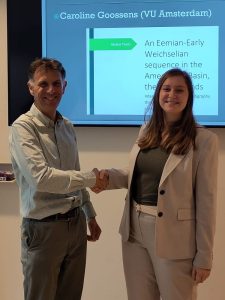
On Friday 24 May 2024 the Palynologische Kring (Dutch palynological society) held a seminar series and laboratory workshop at the Institute for Biodiversity & Ecosystem Dynamics (University of Amsterdam). During the afternoon we had the annual meeting of the society, the presentation of our MSc Thesis prize, four seminars and two laboratory demonstrations. The MSc thesis prize “Florschütz Award” was won by Caroline Goossens (VU Amsterdam) for her thesis entitle: “An Eemian-Early Weichselian sequence in the Amersfoort Basin, the Netherlands”; the project was supervised by Natalie Van der Putten, Cees Kasse and Jeroen Schokker. We hope that Caroline will present her thesis at a future Palynologishe Kring meeting.
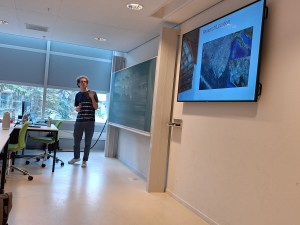
Teye Aukes presenting on the diatoms of ancient Rome
The talk series was kicked off by Nina Witteveen (University of Amsterdam) who presented part of her PhD thesis (currently awaiting defense), entitled: “Long-term forest recovery in Amazonia insights from phytolith analysis”. Nina discussed the impact of past peoples on the vegetation of Suriname based on her work identifying phytoliths in soil samples collected at varying distances from an archaeological site. The second talk was given my Amanda Henry (Leiden University) who demonstrated how the analysis of starch grains extracted from archaeological context can provide insights in to past diets. She used these evidences to suggest that early humans and Neanderthals had a similar diversity of plants in their diets. The third talk was given by University of Amsterdam MSc researcher Teye Aukes and focused upon his identification of diatoms from an swampy lagoon environment near Ostia (Italy). He drew conclusions from these data about the antiquity of salt production in ancient Rome. The final talk was given online by Welmoed Out (Moesgaard Museum) who presented a detailed analysis of inter- and intra-analyst variability in phytolith morphometric analysis.
After the seminars we moved upstairs to the microscope laboratory where Nina Witteveen and Ana Smuk (University of Groningen) showed off phytoliths from their study site in South America and the Netherlands.
Some of the Palynologische Kring members enjoying some refreshment after the event.
Using phytolith analysis to detect palm enrichment in AmazoniaNina Witteveen (University of Amsterdam)
Starch grains as indicators of plant food consumption in Neanderthals and Early Modern HumansAmanda Henry (University of Leiden)
Paleoenvironmental history of an archaeological lagoon in Central Italy: Insights from diatom analysisMajoi Nacimiento, Teye Aukes & Jan Sevink (University of Amsterdam)
15:45-17:30 – Laboratory activities
Advances in topical phytolith identificationNina Witteveen (University of Amsterdam)
Finding Suitable Grounds – combining the on/off site approach through phytolith investigation in FlevolandAna Smuk (Rijksuniversiteit Groningen)
The Science in Archaeology 2 course, run as part of the minor in “Archaeology Today” by the Amsterdam Centre for Ancient Studies and Archaeology (ACASA), is currently underway. This year I have again contributed to this course with a weeks worth of activity related to detecting past human impacts. During this week we have focused on what sorts of evidence contained within the sedimentary record can be used to track human actions. We focused in particular on the manipulation of fire regimes and the the abundance of animals in landscapes (i.e. extinctions vs. introductions of domestic species). To illustrate how past human activities can be detected in landscapes I tapped into some recent publications I have been involved with (eastern Andean flank, Samoa and Mauritius) and the students selected papers in line with their own focus to discuss. Here is what they came up with…
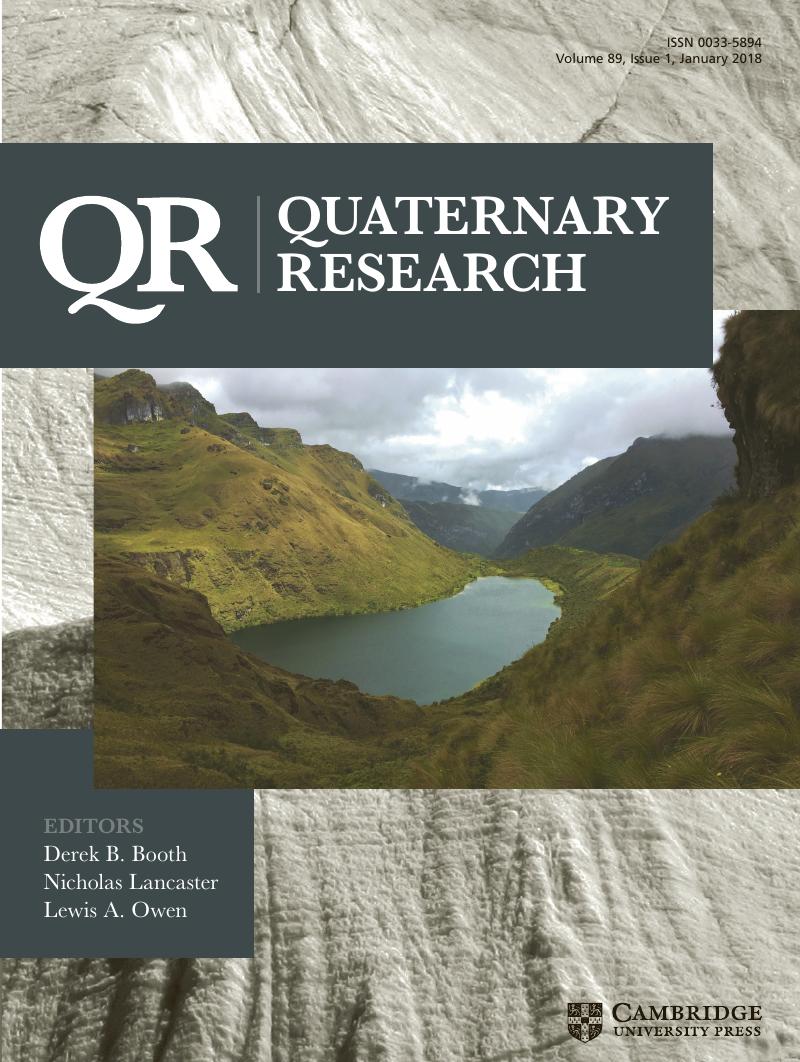
Mark Bush and I are proud to announce that a tribute to Prof. Daniel Livingston and Prof. Paul Colinvaux has recently been published in Quaternary Research. Dan and Paul were both pioneers of tropical pal(a)eoecology and both died in the spring of 2016 . To mark their passing Mark and I have guest edited ten new papers on palaeoecology drawn from researchers, and regions, of the tropics in which Dan and Paul worked (Bush & Gosling, 2018). We would like to thank Quaternary Research Senior Editor Derek Booth for giving us this opportunity and assisting greatly in the process of compiling the manuscripts. We would also like to thank all to contributing authors for their hard work and dedication to the project. We hope that you will enjoy reading the manuscripts and find them a fitting tribute to the life and work of these two great researchers.
Extracting data from tropical pollen records can be difficult, and time consuming, because of the high floristic diversity. Ecology of the past contributor and PhD researcher Bryan Valencia has developed a method for turning your computer into a tally counter. Bryan’s method allows the easy recording of diverse assemblages, and saves time on data entry. The tally counter can be used to count whatever you like…



 Ecology of the past