The images taken by Adele Julier to help her with pollen identifications during her PhD at The Open University (UK) are now available to download. Please note these images are not of reference material but identifications, made by Adele and myself, of the pollen grains found within her pollen traps. The pollen traps were deployed within vegetation study plots in wet evergreen forest, semi-deciduous moist forest, and the forest-savanna transition zone in Ghana. Further publications on this work and a thesis coming soon…
Shanahan, T.M., Hughen, K.A., McKay, N.P., Overpeck, J.T., Scholz, C.A., Gosling, W.D., Miller, C.S., Peck, J.A., King, J.W. & Heil, C.W. (2016) CO2 and fire influence tropical ecosystem stability in response to climate change. Scientific Reports 6, 29587. DOI: 10.1038/srep29587
Journal articles
Clement, C.R., Denevan, W.M., Heckenberger, M.J., Junqueira, A.B., Neves, E.G., Teixeira, W.G. & Woods, W.I. (2015) The domestication of Amazonia before European conquest. Proceedings of the Royal Society of London B: Biological Sciences 282. DOI: 10.1098/rspb.2015.0813
Oliver, T.H., Heard, M.S., Isaac, N.J.B., Roy, D.B., Procter, D., Eigenbrod, F., Freckleton, R., Hector, A., Orme, C.D., Petchey, O.L., Proenca, V., Raffaelli, D., Suttle, K.B., Mace, G.M., Martin-Lopez, B., Woodcock, B.A. & Bullock, J.M. Biodiversity and Resilience of Ecosystem Functions. Trends in Ecology & Evolution. DOI: 10.1016/j.tree.2015.08.009
Watkins, C. (2015) Oliver Rackham OBE FBA 1939–2015. Landscape History 36, 5-8. DOI: 10.1080/01433768.2015.1044280
COMMENT: One of the books that inspired me to enter this field of research was Rackham’s Trees and woodlands in the British landscape; published the year I was born…
Bush, M.B. (1995) Neotropical plant reproductive strategies and fossil pollen representation. American Naturalist 145, 594-609. Stable URL: http://www.jstor.org/stable/2462970
Cárdenas, M.L., Gosling, W.D., Sherlock, S.C., Poole, I., Pennington, R.T. & Mothes, P. (2011) The response of vegetation on the Andean flank in western Amazonia to Pleistocene climate change. Science 331, 1055-1058. DOI: 10.1126/science.1197947
Logan, A.L. & D’Andrea, A.C. (2012) Oil palm, arboriculture, and changing subsistence practices during Kintampo times (3600–3200 BP, Ghana). Quaternary International 249, 63-71. DOI: 10.1016/j.quaint.2010.12.004
The second day of our fieldwork saw us; transfer from Accra to Fumesua where FORIG is located (approximately 20 km south of Kumasi); meet up with FORIGs deputy director Dr Stephen Adu-Bredu to discuss fieldwork and outreach plans; and settle in to FORIG for the next two weeks.
The next two days will involve building pollen traps ready for deployment next and finalising the detailed day-to-day plan of work.
The latest round of fieldwork in Ghana is underway. Adele and myself are travelling out to collect pollen traps deployed last year as part of Adeles PhD research. We will be revisiting the sites in Ankasa, Bobiri and Kogyae that Adele and Phil visited last year. This time we are also accompanied by Lottie who will be delivering workshops on outreach activity engagement and the palaeoecology represented in the sediment record of Lake Bosumtwi.
Flying into land at Accra in the twilight we passed over a storm cell, with some fantastic convective clouds illuminated by flashes of lightning within. Once out of the airport, we were taken through the hustle and bustle of Accra streets, alive with evening activity. Finally reaching our destination for the night, the FORIG guesthouse. All three members of our party readily made for bed to get a good nights sleep before tomorrows journey to Kumasi.
Grass pollen from Lake Bosumwti picked for individual chemical analysis
Abstract submission is now open for the XIX International Union for Quaternary Research (INQUA) Congress. “Ecology of the past” researchers will be there and are hosting a special session, entitled Organisms and environments: Frontiers in palaeoecological technique development, at which we hope to bring together a wide range of palaeoecologists working on novel proxy development. Members of the “Ecology of the past” group will be showcasing recent findings on the environmental significance of pollen chemistry change through time; linked to the 500,000 years of solar irradiance, climate and vegetation change in tropical West Africa project (Fraser et al., 2014). Please take a look at our session and consider submitting YOUR abstract today!
For information on abstract submission click here. Closing date for abstract submission 20 December 2014.
For further information on our session click here, or “Continue reading” below…
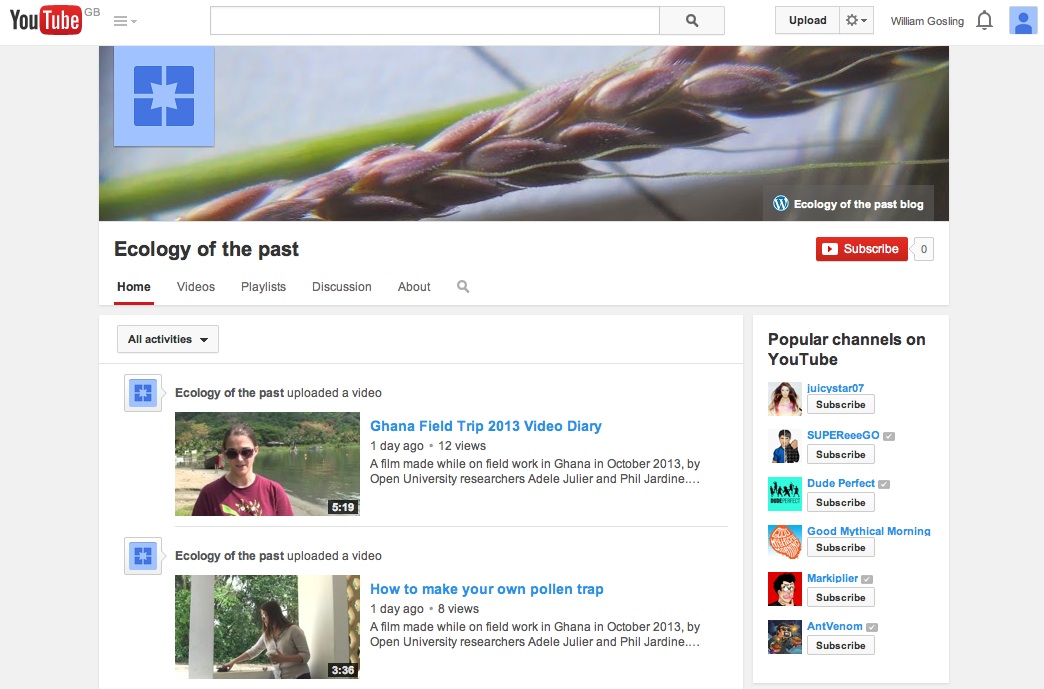
With the redesign and refocusing of the blog underway, I’m delighted to announce the launch of our very own “Ecology of the past”YouTube channel. Initially this will host videos produced as part of the Lake Bosumtwi pollen chemistry project, which includes a strong emphasis on impact and outreach activities. The videos are being targeted to a secondary school/sixth form audience, and will demonstrate both how we are doing the research and who we are as academics, highlighting the different roles and career pathways within the team. As time goes on this channel will be a platform for videos from other members of the research group, again showing who we are, what we do and how we do it.
For now, here are the first two videos: a diary of the field trip to Ghana that Adele and I went on last Autumn, and an accompanying piece showing how you too can make your own pollen trap. Enjoy!
Tardigrade egg found in Ghanaian pollen trap by Adele
Here is a summary of what other people have been up to:
Lottie Miller: submission and approval of thesis corrections (hooray), working on British Ecological Society grant application.
Hayley Keen: is finishing up lab work (macro charcoal – done, XRF – done, wood macrofossils – thin sectioned, awaiting identification, pollen – just 4 more samples!); and dealing with minor review revisions to first submitted paper (hooray).
Frazer Bird: finished the data collection for two Ecuadorian lakes (Banos and Pindo) and will hopefully begin to write up this data soon; attended the NERC stats course (very useful; would advise everyone to try and get on it).
Nick Loughlin: has split and logged the sediment cores recovered from Lake Huila (Ecuador) during recent fieldwork, and begun preparing the samples for pollen.
Adele Julier: has been preparing pollen trap samples from Ghana and learning tropical pollen.
Emily Sear: has mostly been on holiday and we are still waiting for the post card! She has also been working at getting results that make sense from the MS2.
Phil Jardine: has been oxidising spores to see what it does to the chemistry, generating FTIR data with the oxidised samples and starting the numerical analysis, and editing film footage from the 2013 Ghana trip.
Encarni Montoya: has been doing pollen lab and analysing pollen from Baños, and comparing the midges trends from Pindo and Baños with Frazer.
Wes Fraser: Reported back to Royal Society on finding from research grant – paper containing exciting results to follow in next couple of months.
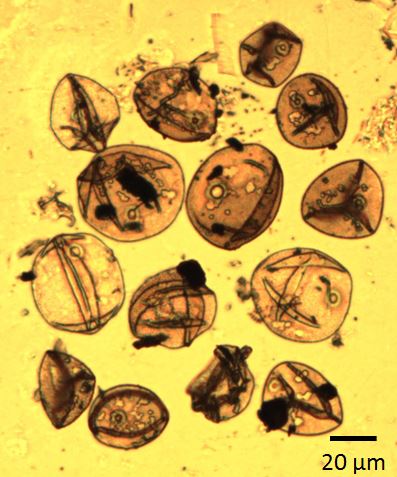
Some pollen from Adele’s pollen traps in Ghana
We have also had 4 papers published with 2014 dates on them:
Cárdenas, M.L., Gosling, W.D., Pennington, R.T., Poole, I., Sherlock, S.C. & Mothes, P. (2014) Forests of the tropical eastern Andean flank during the middle Pleistocene. Palaeogeography, Palaeoclimatology, Palaeoecology, 393: 76-89. doi: 10.1016/j.palaeo.2013.10.009
Fraser, W.T., Watson, J.S., Sephton, M.A., Lomax, B.H., Harrington, G., Gosling, W.D. & Self, S. (2014) Changes in spore chemistry and appearance with increasing maturity. Review of Palaeobotany and Palynology, 201, 41-46. doi:10.1016/j.revpalbo.2013.11.001
Sayer, E.J., Featherstone, H.C. & Gosling, W.D. (2014) Sex & Bugs & Rock n Roll: getting creative about public engagement. Trends in Ecology & Evolution, 29, 65-67. doi: 10.1016/j.tree.2013.12.008
The latter half of 2013 seems to have been incredibly busy and I have not managed to get my monthly update posts completed since October. Rather than a rapid series of backdates here is a quick summary of what I think the main activities through this period have been!
Thesis defence: Congratulations to both Lottie and Natalie for sucessfully defending their PhD theses! Exeptional effort and hard work from both of you. Well done.
Publications: Four articles have gone through the final stages and been published in top journals. Well done to Lottie, Maca, Wes for leading three of those publications covering Lake Bosumtwi, Erazo and pollen/spore chemistry respectively. Personally I am delighted that the revised tropical pollen atlas is now online and open access. The final stages of publication of the atlas with Review of Palaeobotany and Palynology were hard work but great to see it online and avaliable. Thanks to Lottie and Dan Livingstone for their invaluable contributions.
Grant: We have been awarded further 14C dates from NERC radiocarbon facility to improve the chronology on Laguna Khomer Kotcha Upper so that the timing of temperature osscilations revealed by new chironomid analysis (by Frazer Bird) can be related to the last global degalciation (c. 18,000 years ago) and the Younger Dryas cooling event (c. 12,800 – 11,500 years ago). This research builds on that of former PCRG PhD student and current research collaborator Joe Williams (Williams et al., 2011; Williams et al., 2012).
Teaching: I have been working primarily on the Geological record of environmental change (S369) presentation, and writing the landforms section for the new level 2 environmental science module.
Fieldwork: Trips to Ghana (Adele and Phil) and Ecuador (Nick, Encarni and Will) have been super successful; AND all the samples have made it back! See posts elsewhere on the blog for details of field work fun.
I am sure other stuff has happened… more in the New Year… and maybe some more pictures when I can get back on my newly “optimized” (killed) office computer 🙂





 Ecology of the past