Environments Through Time – weeks 2 & 3

November 19, 2017
WDG

Britte reconfiguring the chronology for Lake Pata

Britte reconfiguring the chronology for Lake Pata

The second and third weeks of the Environments Through Time course at the University of Amsterdam has focused on obtaining practical experience of developing chronologies, analyzing multi-variate data-sets, and conducting time series analysis. The focus of the course has been on Quaternary environmental change, however, the skills learnt can be applied to almost any time-scale so long as you have time control points you want to tie together, and multiple things you can track changing through that time.

Over the two week period the students worked on a previously published paper that they had selected that contains: (i) chronological information (at least 3 control points), and (ii) multiple variables that change through the time series (at least 9 variables). In week two they deconstructed the chronologies and generated their own revised versions. For example students have (re-)calibrated radiocarbon dates, made different decisions on dates to include/exclude, and used different approaches to constructing the age vs. depth model, e.g. contrasting linear point-to-point vs. Bayesian methodologies. In week three they have taken the data-set(s) associated with their paper and re-evaluated it in light of the revised chronologies using cluster analysis, ordination techniques, and wavelets.

The joy of wavletes

The joy of wavletes

Through this exercise students have gained experience of how to critically assess scientific literature and gained an appreciation of where re-analysis of data-sets can (and cannot) make a difference. Personally I have be delighted with the high level of engagement and enthusiasm for the material and have been excited to have a chance to delve into literature that I would not otherwise be aware of.

For more information on this course see: Environments Through Time – week 1
 

Environments Through Time – week 1
November 3, 2017
WDG

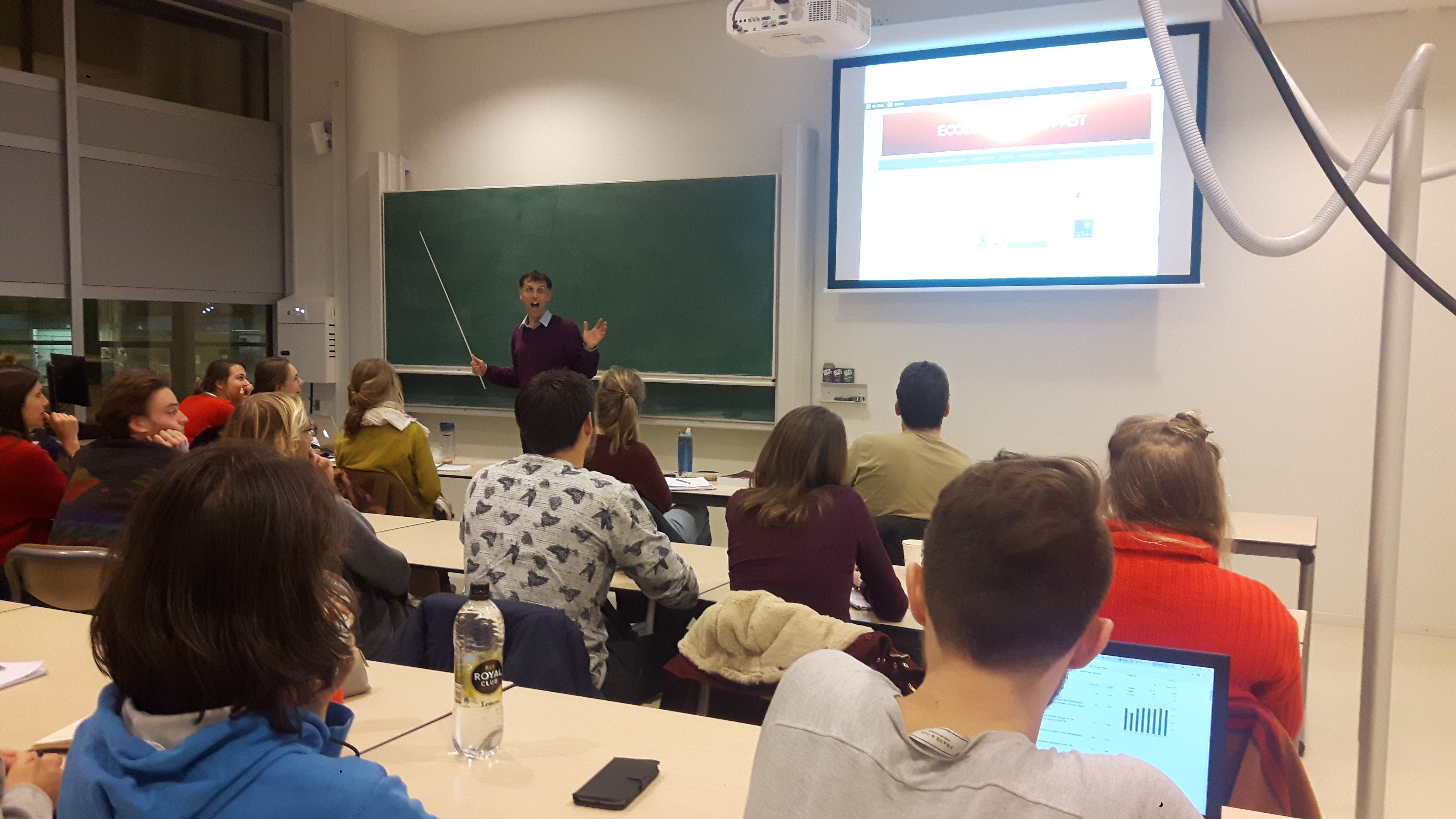
Me teaching human impacts on environmental change...

Me teaching human impacts on environmental change…

The first, ever, week of the Environments Through Time course at the University of Amsterdam has just finished. The course sits within the MSc Biological Sciences (Ecology & Evolution) and MSc Earth Sciences (Geo-ecosystem Dynamics) but is also avaliable to other masters students. In the first week we have thought about four main topics:

  1. Scales of change (ecological, geological, and human).
  2. Humans as drivers of environmental change.
  3. Extra-terrestrial forcing of environmental change.
  4. Earth system feedbacks.

The week was completed with each student giving a three (3) minute presentation of their favourite paper. The papers presented ranged from the extinction of giant sharks, through forest-savannah transitions, to how climate change thwarted Ghengis Kahn. Next week we continue by disecting how chronologies are constructed.

This slideshow requires JavaScript.

The Enviornments Through Time course is taught by: William Gosling, Crystal McMichael, and Milan Teunissen van Manen.

Continue Reading

UvA Open day – 3D visualization of the ice ages in the Andes

October 27, 2017
WDG

Researchers in the Institute for Biodiversity and Ecosystem Dynamics (IBED) at the University of Amsterdam have been studying the páramos and Andean ecosystems for over 50 years. These highly diverse ecosystems are currently restricted to mountain-tops (resembling an archipelago of islands in the sky), but in the past dominated large surface areas throughout the Northern Andes. Climate change determined the degree of páramo fragmentation and connectivity in the past, and site-specific results have been integrated into a GIS-environment (visualization) for southern Colombia and the entire Northern Andes by IBED researchers Suzette Flantua and Henry Hooghiemstra.

Watch the ‘Time machine: Ice ages in the Andes’ video and see its presentation at the recent IBED Open Day:

Continue Reading

Field work in Ecuador

July 27, 2017
WDG

IBEDs Crystal McMichael hard at work sampling sediments in the Andes

IBEDs Crystal McMichael hard at work sampling sediments in the Andes

Insights into recent field work in Ecuador by a team lead by Crystal McMichael can be found in a recent blog from our collaborators at the Instituto Geofisico, Escuela Politecnica Nacional, Quito (Ecuador).

Trabajo colaborativo entre Volcanólogos y Palenólogos potenciará el conocimiento sobre el Paleoclima en el Valle de Latacunga en los últimos 20 mil años by Patricia Mothes

MSc Biological Sciences University of Amsterdam

December 8, 2016
WDG

UvAThe MSc Biological Sciences at the University of Amsterdam is open to international students (taught in English) and offers four ‘tracks’ so you can specialize to your particular interest:

In addition as part of this MSc degree you will conduct research projects and have opportunities for internships. For further information to click here or watch our recent webinar with the program coordinator Joost Duivenvoorden.

Job: Full Professor Earth Surface Science

December 5, 2016
WDG

ibedlogo-lowJob: Full Professor Earth Surface Science
Location: Institute for Biodiversity & Ecosystem Dynamics, University of Amsterdam
Closing data: 04/01/2017

The Institute for Biodiversity & Ecosystem Dynamics (IBED) at the University of Amsterdam currently has a vacancy for a Full Professor in Earth Surface Science. IBED is seeking to appoint a world leading scientist whose research and teaching skills compliment those that already exist within the Research Group of Earth Surface Science (ESS). Key themes within the ESS group are: biotic and abiotic interactions, biogeochemistry, geomorphology, and soil chemistry, biodiveristy and management. The work of the ESS group is closely related to other research groups within IBED, and in particular, the Palaeoecology & Landscape ecology (P&L) group which I lead.

For full details click here.

Tropical forests in the Anthropocene

November 8, 2016
WDG

Yadvinder MalhiSeminar
Institute for Biodiversity & Ecosystem Dynamics
University of Amsterdam

Tropical forests in the Anthropocene
by Prof. Yadvinder Malhi (University of Oxford)

16:00-17:00, 24 November 2016
Science Park, Amsterdam
If you want to attend please click here for full details.

ABSTRACT: Continue Reading

Tropical palynology meeting

July 8, 2016
WDG

PalykringThe Palynologische Kring (Palynological Association)
Tropical palynology meeting
14 July 2016

Hosted by: Palaeoecology & Landscape Ecology, Institute for Biodiversity & Ecosystem Dynamics, University of Amsterdam
Located: Science Park 904
Organised: Carina Hoorn (if you want to attend please contact Carina for further details)


Speakers

  • 14.00-14.30 Suzette Flantua (University of Amsterdam) – Thriving palynological research in Latin America: What has been done and what’s next.
  • 14.30-15.00 Dunia Urrego (University of Exeter, UK)- Tropical and subtropical vegetation dynamics over orbital and millennial timescale
  • 15.00-15.30 Coffee break
  • 15.30-16.00 William Gosling (University of Amsterdam) – Long-term solar and ultraviolet-B irradience detected using sporopollenin chemistry
  • 16.00-16.30 Kim Hagemans (Utrecht University) – High Andean vegetation responses to changes in palaeo-ENSO

Caspian Sea mini symposium

March 9, 2016
WDG

Research Group of Palaeoecology & Landscape Ecology
Institute for Biodiversity & Ecosystem Dynamics
University of Amsterdam

Date: 01/04/2016
Time: 15:00-18:00
Location: Amsterdam Science Park 904 
Registration: Contact Prof. dr. Henry Hooghiemstra or Dr. Carina Hoorn to book your place and receive location details

15:00-15:30
Frank Wesselingh & the PRIDE team
How high can you get? Mountain uplift driving diversification in Pontocaspian lakes before humans bring down the unique aquatic biota?

15:30-16:00
Christiaan van Baak
Mediterranean-Paratethys connectivity during the late Miocene to recent

– 16:00-16:15 tea/coffee break –

16:15-17:15
Keith Richards
Studies in Caspian palynology: Vegetation, climate and sea level change

17:15-18:00
Questions and discussion

Blog at WordPress.com.