Scales of change (ecological, geological, and human).
Humans as drivers of environmental change.
Extra-terrestrial forcing of environmental change.
Earth system feedbacks.
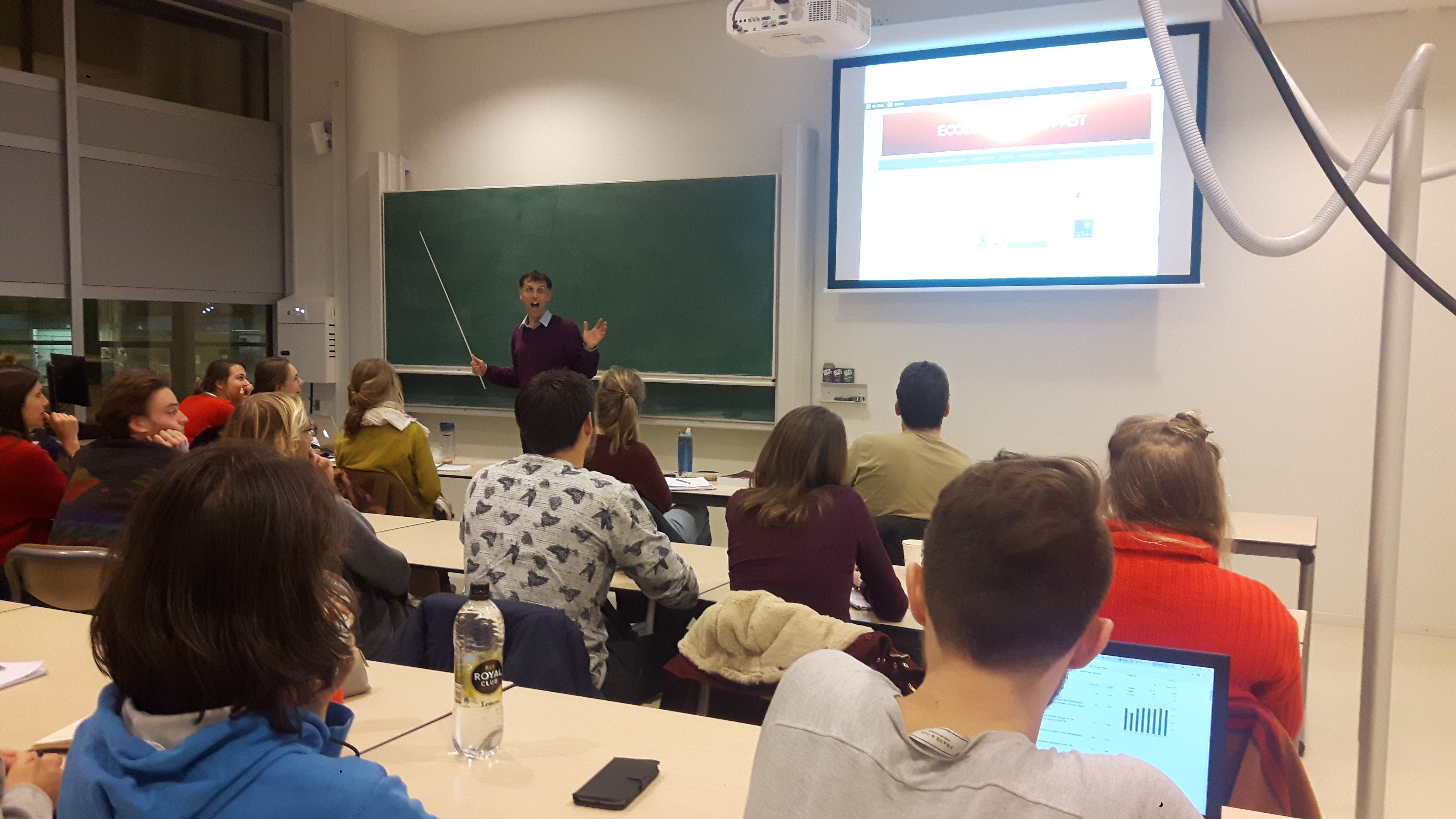
The week was completed with each student giving a three (3) minute presentation of their favourite paper. The papers presented ranged from the extinction of giant sharks, through forest-savannah transitions, to how climate change thwarted Ghengis Kahn. Next week we continue by disecting how chronologies are constructed.
Zoe and William just after the graduation ceremony (UvA)
Two students (Zoe van Kemenade and Tessa Driessen) have recently completed projects looking at past environmental change on Samoa working in the Research Group of Palaeoecology & Landscape Ecology at the University of Amsterdam (UvA). Zoe’s project, part of her BSc Future Planet Studies (major Earth Sciences) at UvA, was entitled “A multi‐proxy analysis on the effect of climate and human activity on the environment of Samoa during the Holocene” and investigated charcoal, macro-fossils, and algae. Tessa’s project, “Biodiversity, fire and human dynamics on Samoa over the last 9200 years”, was completed as an internship during her MSc in Environmental Biology at Utrecht University (UU) that was co-supervised by Rike Wagner-Cremer. Tessa focused on the fossil pollen record to reconstruct past vegetation change. Both projects were conducted in cooperation with Jon Hassel and David Sear (both University of Southampton) who provided access to the Samoan sediments; for more on the Southampton Pacific Islands projects check out their blog Palaeoenvironmental Laboratory at the University of Southampton.
The results from both projects, and work by the University of Southampton team, will be presented at this years GTO conference (European conference of tropical ecology) in Gottingen next week.
William giving his personal view on the work of Tessa at her gradation ceremony (UU)
My undergraduate studies were interdisciplinary in nature: I did a BSc Beta-Gamma (Institute for Interdisciplinary Studies (IIS), UvA) where students are taught to collaborate between different disciplines. Ecology has always been an interest of mine, so I was quick to specialize in that field. In my final year of my bachelor I came in contact with paleoecology and did not hesitate to make sure my first master’s project (MSc Biological Science, IBED, UvA) would be with the P&L research group (IBED) – a worked on a project on tropical rainforest dynamics in Miocene Amazonia. After that I got the chance to test my skills outside research institutes: during the Tesla consultancy Minor (IIS) I got firsthand practical experience in developing urban green areas from start to finish for the municipality of Amsterdam. The focus of that project was to increase the ecologic, educational, scientific, and social value of the natural areas on Amsterdam Science Park. It was great to see my scientific background put to good use outside the research community. The project is still active today.
After a short period of working in education and sustainability consultancy I seized the opportunity to, once more, join the P&L research group – this time as a Ph.D. student under the watchful eyes of William Gosling and Boris Jansen. My project revolves around characterizing biomarker and modern pollen-rain signals across the altitude of the Ecuadorian Andes vegetation. A great opportunity at the frontier of tropical research!
If the first week is any indication, I foresee to a lot of collaboration, hard work, exploration and adventure in the coming years!
It’s very nice to be invited to write something for this blog, let me introduce myself a little bit.
I am a MSc Earth Sciences student at the University of Amsterdam. Currently I am working on my master thesis at Naturalis Biodiversity Center, under supervision of Niels Raes, Willem Renema and William Gosling. We are looking at species migration between Australia and Asia during the Miocene, and we compare it to migration between N and S America at the dawn of the Great American Biotic Interchange. To do so I’m analysing data on fossil occurrences in Australia and Southeast Asia. Hopefully this research will lead to interesting new insights.
Before starting my MSc Earth Sciences I did a bachelor in Biology at Leiden University. I decided to do a master’s in Earth Sciences because it offered a broader perspective of the natural world and its processes.
I like analysing and sorting out data like I’m currently doing for my thesis with fossil occurrence data. It also played a major role in my internship at TNO – Caribbean Branche Office, where I was involved in starting a database containing information on Aruba’s subsurface. During my internship I also experienced the “Green Aruba” conference and was involved in organising a geological excursion for some of the attendants. I am very interested in environmental issues and solutions, such as the transition to renewable energy. New technologies spike my interest a lot and I like being aware of innovations in a whole lot of fields.
Hopefully I will have my thesis ready within a couple of months, and can give an update about some of the findings.
Hello! I’m Adele and I started my PhD about a week ago. It’s been a little intense but I can almost find the lab without a map now, so it is probably time to introduce myself.
I’ll be studying pollen-vegetation relationships in Ghana, as part of the NERC funded project ‘500,000 years of solar irradiance, climate and vegetation changes’. This means I’ll be using pollen traps to figure out how pollen outputs vary between (and sometimes within) different vegetation types in Ghana. I will also be trying my hand at chemotaxonomy and video making. I’m heading out to Ghana (along with Phil Jardine) in just over a week to do my first lot of field work which will involve seeing the plots, collecting existing traps, replacing them with new ones, and setting up some new sites. I’m very excited.





 Ecology of the past