Time for topical ecology

March 14, 2025
WDG

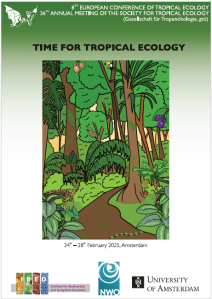
8th European Conference of Tropical Ecology

36th Annual Meeting of the Society for Tropical Ecology

24-28 February 2025, Amsterdam

The 8th European Conference of Tropical Ecology took place in Amsterdam (The Netherlands) from 24 to 28 February 2025. This meeting was organized for the Society for Tropical Ecology. The event was hosted by the Institute for Biodiversity & Ecosystem Dynamics (University of Amsterdam), held at Hotel Casa, and the main sponsor was the NWO (Dutch Science Foundation).

During the conference around 250 scientists delivered 150 oral and 69 poster presentations. The science spanned the full breadth of tropical ecology, ranging from interactions of coral dwelling crabs, through carbon cycling dynamics in forests, to the governance of hunting activity. The six keynote speakers were paired under three topics “Human legacies in the tropics”, “Tropical ecosystem dynamics”, and “Protecting tropical ecosystems”. Within each topic we invited a senior scientist and a ‘rising star’ to provide their perspective on a particularly hot-button issue. If you want to find out more about what was presented all the abstracts are now published, open access, in the Society for Tropical Ecology’s journal Ecotropica.

Abstract booklet

Open access:
Gosling, W.D. & McMichael, C.N.H., eds. (2025) Time for tropical ecology: Abstracts of the 8th European Conference of Tropical Ecology, Amsterdam, The Netherlands; 24.-28.2.2025. The Society for Tropical Ecology, Ecotropica, 26 (1-2): 1-222. https://doi.org/10.30427/ECOTROP202501
European Conference of Tropical Ecology: Registration Open

November 14, 2024
WDG

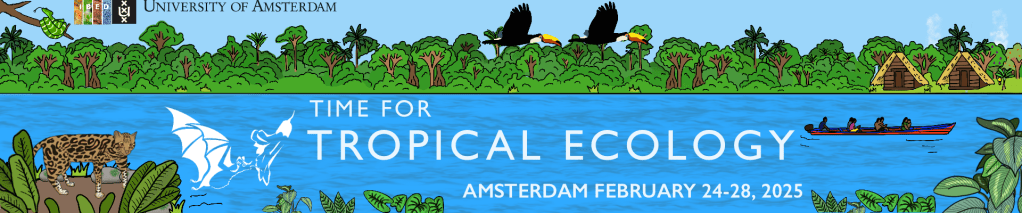
We are excited that more than 250 abstracts have been submitted for the 8th European Conference of Tropical Ecology “Time for Tropical Ecology” in Amsterdam. Furthermore, we are delighted to announce the NWO (the Dutch Science Foundation) as the main sponsors of the event. The conference is being organised by the Institute for Biodiversity & Ecosystem Dynamics (University of Amsterdam) on behalf of the European Society of Tropical Ecology. The conference will take place in February 2025 at a central location in the city (Hotel Casa).

We have an exciting program emerging including keynotes from three ‘rising star’ and three ‘senior’ scientists, a conference dinner (House of Watt), and a photo competition with prizes! Throughout the program we hope to create a vibrant atmosphere for the discussion of cutting edge research into the tropical regions of planet Earth.

You can be a part of this event by registering now. Early bird rate is valid until: 18 December 2024

Mapping Ancient Africa: Collaboration opportunity

July 26, 2024
WDG

COLLABORATION OPPORTUNITY: The TIP-TOP project, funded through the Dutch Research Council (NWO) and awarded to Rick Hennekam at the NIOZ Royal Netherlands Institute for Sea Research (NIOZ), is running from 2024-2029 and aims to use sediments accumulated in front of North African rivers to study environmental tipping points in North Africa. Specifically, the project focuses on available sediments from the Nile River delta, a now-dormant river system in Libya, as well as material from in front of the Senegal and Gambia rivers that will be acquired during a cruise early 2025. A multidisciplinary group of scientists is collaborating within this project, including scientists from NIOZ, GFZ Potsdam, ETH Zürich, Wageningen University, and the Utrecht University, using especially (in)organic and palynological proxies. Yet, we are keen to start new collaborations, especially with scientists based in northwest Africa. Potentially we could aim for the INQUA Fellowship Program For International Mobility (deadline 15 of September, 2024) for someone to gain international experience at one of the involved institutes for the duration of 3–6 months. If you are interested to link up with Rick please join the seminar to speak with him, or contact him directly. Note that participation in the 2025 expedition to the coasts of Gambia, Senegal, and Mauritania can be discussed too, but available places are very limited.

This video was recorded after the 19th online Mapping Ancient Africa seminar given by Solène Boisard, to watch her seminar on the past climate of north-western Africa and others in the series click here. To find out more about the Mapping Ancient Africa project click here.

INQUAlogo

PhD Scholarship program for migrants in the Netherlands

April 5, 2024
WDG

The Dutch science foundation (NWO) currently has a call for proposals to support migrants to the Netherlands to undertake a PhD project.

Applicants must have:

  • a Dutch passport (or residency status),
  • a masters level degree from a university in the Kingdom of the Netherlands, and
  • have been born in specific regions outsides the Netherlands (or be the child of someone born outside the Netherlands)

For full details click here visit the NWO Mozaiek 2.0 call web page.

If you think you might fulfill all the criteria for application, and are interested in conducting a PhD on a “ecology of the past” related theme at the University of Amsterdam, please do not hesitate to get in contact. I am then happy to check eligibility and discuss if your skill set and interests would be appropriate to apply for a PhD scholarship with us. I would be delighted if we would be able to support an applicant to this scheme.

Deadline for applications: 21 May 2024 (but please get in contact as soon as possible so that we can make the relevant eligibility checks and discuss ideas).

Contact: William D. Gosling

Keep on pollen sniffing

May 5, 2020
WDG

By Cas Verbeek (University of Amsterdam)

Luckily, in spite of these trying times, we are allowed to continue our research in Amsterdam and on the Veluwe to determine the effects of air pollution on airborne pollen grains. Unfortunately for us (but generally perhaps one of the few silver linings of this situation), the COVID-19 lockdown has largely eliminated our main variable of interest; air pollution.

With traffic in the city at a minimum, any chemical differences might not be as pronounced between the city and rural areas. However, this may actually provide us with a unique opportunity to get a baseline of the pollen chemistry in Amsterdam with relatively little pollution. This baseline may also be of interest to projects working on urban air quality and greenifying urban spaces, such as the projects in the Amsterdam Knowledge Mile Park, which is included amongst our sampling locations.

This slideshow requires JavaScript.

For more about our project on pollen and pollution in the Netherlands see other posts:

Pollen in the Netherlands

April 21, 2020
WDG

By Letty de Weger (Leiden University Medical Centrum)

In the coming weeks lots of pollen can be collected. Due to the nice, sunny weather birch trees are in full flower and release their pollen into the air.  This is of course not so good news for the individuals sensitized to the pollen of birch because they can suffer from hay fever symptoms.

Next to birch also the ash trees are flowering. The black buds of the ash branches have bursted, releasing the purple anthers (first figure). Among those anthers you can see some that release their yellow pollen  (second figure).

For more about our project on pollen and pollution in the Netherlands see other posts:

Urban vs. rural pollen in the Netherlands

February 26, 2020
WDG

Urban vs. rural pollen chemistry project design

Figure 1: (a) Illustrative images of sample locations in Amsterdam and the Hoge Veluwe. (b) The newly developed ‘pollen sniffer’ collects airborne pollen from the environment. (c) The FTIR can chemically characterise individual pollen grains.

Does environmental pollution enhance the allergenic nature of pollen? This is the question that drives my NWO Idea Generator grant that has just started. This project links up the pollen chemistry expertise in my group within the Department of Ecosystem & Landscape Dynamics (University of Amsterdam) and the work of Letty de Weger into human health and pollen (Leiden University Medical Centrum). Over the 2020 flowering season we will be monitoring pollen in Amsterdam (urban) and in the Hoge Veluwe (rural) in the space in which people have allergic reactions to see if there is any chemical difference between the pollen in urban and rural settings.

We are delighted that Cas Verbeek has joined the team as a Research Assistant; taking time out from his MSc Biological Sciences degree (University of Amsterdam). Cas is already busy in the field and lab fine tuning our collection and analysis protocols.

Find out more from:

Job: Post-doctoral researcher in Palaeoecology

November 30, 2017
cmcmicha

Job: Post-doctoral researcher in Neotropical Palaeoecology
Location: Institute for Biodiversity & Ecosystem Dynamics, University of Amsterdam
Duration: 3 years
Deadline for applications: 15 January 2018

We are seeking to recruit a Neotropical palaeoecologist to join the recently funded “The past peoples of Amazonia: Assessing ecological legacies” project (PI Dr. Crystal McMichael, funding NWO, based within the Department of Ecosystem & Landscape Dynamics). The project aims to reconstruct cultural histories from lake sediments in northwestern Amazonia, and link past human activities with modern ecological observations. The project involves analyzing microfossils (including pollen, phytoliths, and charcoal), and the development of a transfer function that estimates past human impacts in tropical forest systems.

We are particularly looking for a candidate with  expertise and experience, in:

  • Fieldwork in remote areas.
  • Neotropical pollen.
  • Quantitative analysis, including familiarity with R and Geographical Information Systems.
  • Academic publication.

For more details and how to apply click here.

Rubicon project to link fossil pollen with plant traits

July 20, 2017
WDG

Dear Ecology of the past blog readers,

This time you are reading a message from a non-expert in paleoecology. My name is Masha and I will spend the next two years on a very exciting postdoctoral fellowship funded by NWO (Dutch National Science Foundation) under their Rubicon scheme in close collaboration with William Gosling (University of Amsterdam).

Continue Reading

Blog at WordPress.com.