Centenary (1916-2016) of Pollen Analysis and the Legacy of Lennart von Post
February 15, 2016

February 15, 2016
November 17, 2015
Posted on behalf of Barry Lomax
Linnean Society Palynology Specialist Group meeting
 Tuesday 24 November 2015
Provisional program
10:30 – 11:00 Barry Thomas (Aberystwyth University). Ecological interpretations of Asturian and Cantabrian lycophyte microspore floras of the Variscan Foreland and the Appalachian Province of the Central Coalfields of the U.S.A
11:00 – 11:30 Adele Julier (Open University). Can FTIR spectroscopy be used to identify grass pollen?
Morning Coffee 11:30-12:00
12:00 – 12:30 Katrina Bakker (York University). Spore particles: new materials applications.
Lunch 12:30-14:00
14:00 – 14:30 Viktória Baranyi1 (Oslo Universiy). Morphology and wall-ultrastructure of Froelichsporites traversei, an enigmatic sporomorph from the Late Triassic in North America.
14:30 – 15:00 Hannah Banks (Royal Botanic Gardens Kew). Functional and phylogenetically useful structures in Caesalpinioid legume pollen.
15:00 – 15:30 Sam Slater (Sheffield University). A quantitative analysis of Middle Jurassic vegetation dynamics based on dispersed spore/pollen assemblages from the Ravenscar Group, North Yorkshire, UK.
Afternoon tea 15:30 – 16:00
16:00 – 16:30 Alex Askew (Sheffield University). A palynological investigation of the Middle Devonian of northern Spain: hunting for the Kačák event.
16:30 – 17:00 Phil Jardine (Open University). A new use for old pollen: reconstructing past solar irradiance using pollen chemistry.
Wine reception
To register please contact Barry Lomax (Group secretary)
September 30, 2015
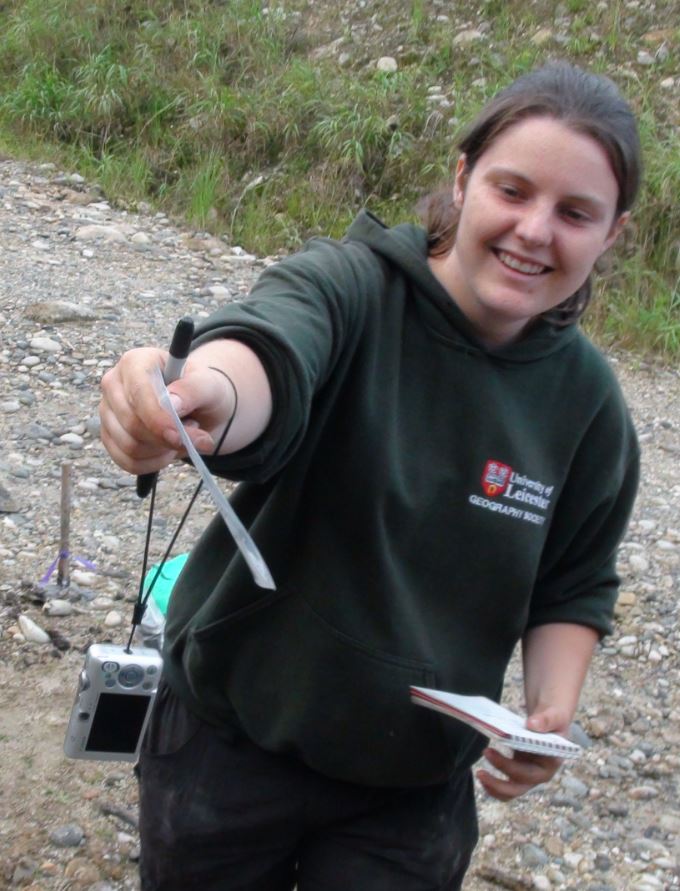
Hayley Keen getting excited about sediments during fieldwork in Ecuador (2012). Photo: J. Malley
Keen, H.F. (2015) Past environmental change on the eastern Andean flank, Ecuador. PhD Thesis, Department of Environment, Earth & Ecosystems, The Open University.
Abstract
The eastern Andean flank of Ecuador (EAF) contains some of the world’s most biodiverse ecosystems. Andean montane forests are threatened due to anthropogenic pressures and both current and projected climate change. This thesis examines the palaeoecological history of two stratigraphic sequences (Mera Tigre West [MTW] and Mera Tigre East [MTE]) obtained from the Ecuadorian modern lower montane forest. The sediments preserved were analysed using eight analytical techniques, allowing an insight into the ecosystem’s potential response to projected changes derived from their past responses. Palaeoecological studies on the EAF are rare, and those that do exist are debated relating to: i) the inference of robust ecological data from pollen records in floristically diverse locations, and ii) the past source area of sediments preserved in fluvially exposed sequences, potentially leading to contamination with older material.
A statistical sub-sampling tool was developed (debate i), capable of producing statistically robust count sizes for each pollen sample; MTW and MTE count sizes ranged from 196-982 showing the diversity within sequences. The depositional environment of MTE was analysed, investigating sediment provenance throughout (debate ii). Results found that large scale volcanic events were critical in the preservation of the sediments, whereas fluvial influence caused a regional sediment source area in the upper stratigraphy, impacting on the palynological interpretation of MTE. Pollen records demonstrated the presence of a diverse vegetation community with no modern analogue at MTE (abundant taxa (>15 %): Hedyosmum, Wettinia, Ilex) and upper montane forest at MTW (Alnus, Hedyosmum, Podocarpus). Fire was not the main driver for the vegetation reassortment at either site (MTW correlation coefficient: -0.37, MTE: 0.16). The two sites have demonstrated the EAF plays host to floristically dynamic ecosystems, susceptible to drivers of change (fire and landscape) and should be considered when predicting the montane forests’ future response to environmental change.
Supervisors: Dr. William D. Gosling (The Open University/University of Amsterdam), Dr. Encarni Montoya and Dr. Sarah Sherlock (both The Open University).
Examiners: Dr. Dunia Urrego (University of Exeter), and Prof. David Gowing (The Open University).
Chair: Dr. Mark Brandon (The Open University).
To borrow a copy from The Open University Library click here.
Publications (so far): Continue Reading
Bogota, G., Hoorn, C., Star, W., Langelaan, R., Banks, H., Galeano, G., Bernal,R. (2015) Pollen morphology of Sabinaria magnifica (Cryosophileae, Coryphoideae, Arecaceae). Phytotaxa 207, online.
Published open access:
Jardine, P.E., Fraser, W.T., Lomax, B.H. & Gosling, W.D. (2015) The impact of oxidation on spore and pollen chemistry. Journal of Micropalaeontology, online.
January 4, 2015

William shortly after first Dutch haircut
2014 has seen more people visit this blog and more “clicks” through to articles than in any previous year (see Annual Report 2014). So thanks for reading! I hope that the information provided is useful. For me 2014 has been a big year of change; with the largest work related change being taking up my new post at the University of Amsterdam in September.
2015 promises to be an exciting year with a number of key projects generating exciting findings (including chironomid climate for the Neotropics, Andean flank evolution, and ‘deep time’ palynomorphs) , the start of the XPERT network, and new proposals and collaborations being developed here in the Netherlands (including new proposal to work in Europe!).
Any comments, thoughts or contributions on the blog welcome.
William
November 6, 2014
The Palynology Specialist Group Meeting
13th November 2014
Burlington House, Piccadilly, London W1J 0BF, UK
Program
Phillip Jardine 10:30 – 10:55
Recovering sporopollenin chemical information from processed palynological samples
Luke Mander 10:55 – 11:20
On the taxonomic resolution of pollen and spore records of Earth’s vegetation.
Hugh Dickinson 11:20 – 11:45
Asymmetry in pollen mitosis 1; how does it work and is it important
Mark Grosvenor 11:45 – 12:10
Human-landscape interactions during the Mesolithic-Neolithic Transition in Cumbria
Guy Harrington 12:10 – 12:35
The fate of pollen in soils in the Paleocene-Eocene Thermal Maximum (PETM): The terrestrial response to global warming
– Lunch (not provided) at various locations around Burlington House –
Barry Lomax 14:00 — 14:25
Episodic perturbations of end Permian atmosphere recorded in plant spore chemistry
Matthew Pound 14:25 – 14:50
Global vegetation record indicates no atmospheric pCO2 decline at the Eocene-Oligocene transition
Peter Mark 14:50 – 15:15
The effect of heat stress on wheat pollen development: a multi-faceted approach to a better understanding of a potentially serious issue
Sam Salter 15:15 – 1540
Micro vs. Mega: A quantitative comparison of dispersed spores/pollen and plant megafossil assemblages from a Middle Jurassic plant bed from Yorkshire, UK.
– Tea in Linnean Society Library –
Carina Hoorn 16:00 — 16:25
Evidence of past marine conditions in Amazonia
Wes Fraser 16:25 – 16:50
Towards a unified cross-taxa sporopollenin composition
September 8, 2014
Hayley Keen’s video “Past environmental change in the Amazon basin” has been shortlisted for the American Geophysical Union (AGU) student video prize. Please watch and like Hayley’s video; top “Liked” videos will win entry to the AGU 2014 Fall meeting.
View all the videos on the AGU YouTube channel.
Published open access:
Keen, H.F., Gosling, W.D., Hanke, F., Miller, C.S., Montoya, E., Valencia, B.G. & Williams, J.J. (2014) A statistical sub-sampling tool for extracting vegetation community and diversity information from pollen assemblage data. Palaeogeography, Palaeoclimatology, Palaeoecology, 408, 48-59.
December 20, 2013
Gosling, W.D., Miller, C.S. & Livingstone, D.A. (2013) Atlas of the tropical West African pollen flora. Review of Palaeobotany and Palynology, 199, 1-135
Gosling, W.D. & Williams, J.J. (2013) Ecosystem service provision sets the pace for pre-Hispanic societal development in the central Andes. The Holocene, 23, 1619-1624
Miller, C.S., Leroy, S.a.G., Izon, G., Lahijani, H.a.K., Marret, F., Cundy, A.B. & Teasdale, P.A. (2013) Palynology: A tool to identify abrupt events? An example from Chabahar Bay, southern Iran. Marine Geology, 337, 195-201
Roucoux, K.H., Lawson, I.T., Jones, T.D., Baker, T.R., Coronado, E.N.H., Gosling, W.D. & Lähteenoja, O. (2013) Vegetation development in an Amazonian peatland. Palaeogeography, Palaeoclimatology, Palaeoecology, 374, 242-255
Rull, V., Montoya, E., Nogué, S., Vegas-Vilarrúbia, T. & Safont, E. (2013) Ecological palaeoecology in the neotropical Gran Sabana region: Long-term records of vegetation dynamics as a basis for ecological hypothesis testing. Perspectives in Plant Ecology, Evolution and Systematics, 15, 338-359

 Ecology of the past