Gosling, W. D., de Wolf, I. K., Witteveen, N. H., de Zwaan, S. B., Van Teulingen, C., Föllmi, D., Thissen, W., Vink, V. B., Woutersen, A., Philip, A. L., van Herk, M. J., Nascimento, M. N., Prins, M. A., & McMichael, C. N. H. (2025). Herbivory and vegetation openness in a pre-farming European landscape. Plant Ecology & Diversity, 1–22. https://doi.org/10.1080/17550874.2025.2576566
This manuscript has been developed over many years through the contributions of many MSc and BSc students based at the University of Amsterdam.
Mapping Ancient Africa Quaternary International special issue article #8
Open access:
Neumann, F. H., Finch, J., Hahn, A., Miller, C. S., Scott, L., Schefuß, E., Dupont, L., Cawthra, H. C., & Engelbrecht, F. (2025). Vegetation and climate dynamics in a 16,600-year marine sequence offshore Mozambique in Delagoa Bight, south-eastern Africa. Quaternary International, 747, 109956. DOI: 10.1016/j.quaint.2025.109956
To find the complete list of articles in the Mapping Ancient Africa special issue of Quaternary International click here.
Mapping Ancient Africa Quaternary International special issue article #7
Open access:
Gosling, W.D., Chevalier, M., Fischer, M.L., Holewijn, M., Finch, J., Gil-Romera, G., Hill, T., Houngnon, A., Leonardi, M., Manica, A., & Kaboth-Bahr, S. (2025). A multi-model approach to the spatial and temporal characterization of the African Humid Period. Quaternary International744, 109933. https://doi.org/10.1016/j.quaint.2025.109933
Gosling, W.D., Chevalier, M., Lothar Fischer, M., Holewijn, M., Finch, J. M., Gil-Romera, G., Hill, T. R., Houngnon, A., Leonardi, M., Manica, A., & Kaboth-Bahr, S. (2025). Code from: A multi-model approach to the spatial and temporal characterization of the African Humid Period. Figshare. https://doi.org/10.6084/M9.FIGSHARE.29608400.V1
To find the complete list of articles in the Mapping Ancient Africa special issue of Quaternary International click here.
I was delighted to be invited to give a seminar as part of the Max Planck Institute for Geoanthropology “Human Palaeo-systems Research Group” series. In case you missed it the seminar is will soon be available to watch online (click here).
To see the full list of seminars in the series click here.
Chevalier, M., Gosling, W.D., Hooghiemstra, H., Cartapanis, O., Chase, B.M. & Kaboth-Bahr, S. (2025) Eccentricity-driven glacial climate variability and its influence on speciation in the tropical Andes. Quaternary Science Advances 100278. DOI: 10.1016/j.qsa.2025.100278
The next seminar series of the Palynologische Kring (Dutch palynological society) will take place on 24 January 2025, at the Auditorium of TNO Utrecht. If you would like to attend please register by emailing the society (link).
PROGRAMME
13.00-13.15 Arrival
13.15-13.45 Irene Waajen (TNO): Re-evaluation of Early Weichselian pollen zones with new insights from the North Sea.
A postdoctoral position in palynology and sedimentary DNA analysis, focused on understanding the environmental history of the Malagasy landscapes and populations over the last millennia, is now available working with Laurent Bremond (University of Montpellier, France). Funding is from the French National Research Agency (ANR) with support from CNRS.
Ivory, S.J., MacDougal, E., Mason, A., Pereboom, E., Garelick, S., Ficken, K., Wooller, M.J., Nakileza, B. & Russell, J. (2024) Highland forest dynamics across equatorial East Africa during the end of the African humid period. Quaternary International. DOI: 10.1016/j.quaint.2024.10.007
Wei, C., Li, M., Mao, L., Mander, L., Jardine, P.E., Gosling, W.D. & Hoorn, C. (2024) A 23-million-year record of morphological evolution within Neotropical grass pollen. New Phytologist. DOI: 10.1111/nph.20214
This paper is the latest to come from the PhD thesis of Caixia Wei who defended at the University of Amsterdam earlier in 2024. To find out more about Caixia’s work click here.
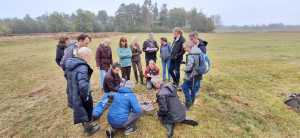
During the seminar afternoon (17 October) we heard four talks. The first from Harm Smeenge and Ariët Kieskamp (both Bosgroep) introduced the sites we were to visit on the excursion the next day. This focused on the landscape ecology and ecological history of the bogs on the eastern slopes of the Veluwe. The second talk, by Roy van Beek (Wageningen University & Research), focused on the Celtic field systems around the Veluwe. He explained the latest archaeological and archaeobotaincal work investigating the age and origins of these field systems. The third presentation was by Jasper Candel (Wageningen University & Research) and focused on the geomorphological features from glacial activity in the Veluwe region and how this has effected the development of mire ecosystems. I (William Gosling) gave the final talk, presenting the outputs of the research theses of Sanna Wessel, Chiara Raino and Roos Dik who all completed projects at the University of Amsterdam and worked together to investigate how different mega-herbivore populations in the Dutch landscape were represented by the dung fungal spores preserved in the soil.




 Ecology of the past