Wei, C., Jardine, P.E., Mao, L., Mander, L., Li, M., Gosling, W.D. & Hoorn, C. (2023) Grass pollen surface ornamentation is diverse across the phylogeny: Evidence from northern South America and the global literature. Journal of Systematics and Evolution. DOI: 10.1111/jse.13021
de Wolf, I.K., Donders, T.H., Hoek, W.Z., Gouw-Bouman, M. & Giesecke, T. (2023) Unlocking the wealth of Dutch pollen data for future research and education. Vegetation History and Archaeobotany.DOI: 10.1007/s00334-023-00951-z
The pollen and phytolith identification quiz! Is that an Asteraceae phytolith I see…???
The University of Amsterdam “Palaeoecology” course commenced this week with lectures getting students up to speed with the fundamental principles and approaches to the subject, and laboratory practicals training students in the identification of micro- and macro-fossils. Once students have gained a basic understanding of pollen and phytolith identification – and demonstrated this by passing the ‘dreaded’ identification quiz – it is time to commence the group project work.
This year the students are trying to identify from which study site their ‘mystery slides’ come from on the basis of the micro-fossil assemblages (pollen and phytoliths) that they contain. The study sites all come from the area around Hilversum (Netherlands) and (could) include: heathland, pine forest, mix-deciduous forest, and birch woodlands. In addition, just to make it more interesting, one group has samples taken from the medieval palaeosol that is found locally.
Next week is field work week and the students will then need to parameterise the vegetation around the Hilversum area in such a way that they: (i) get a representative sample the variation across the landscape, and (ii) can compare the vegetation data with their micro-fossil data. Then, following the number crunching in the third week of the course, we will find out if the different groups can identify the correct study site from which there samples came…
The Palaeoecology course at the University of Amsterdam is part of the BSc Biology program, it is also frequently taken by students on the BSc Future Planet Studies degree. We also welcome students from other programs, such as BSc Béta-Gamma, and international exchange students.
Every picture tells a story. This one is a snapshot I took of Dan Livingstone’s African palaeolimnology group in June1984, when I spent a few months at Duke University, North Carolina, at Dan’s invitation. I had started work on the pollen analysis of a Holocene core from Cameroon that I’d collected in 1981 and Dan was keen to help me as far as possible. He was making plans for his lake coring projects a few years later in Cameroon (Barombi Mbo).
Back row (L-R) is me (Keith Richards age 24), Margaret Adebisi Sowunmi, Alice Tucker, Lida Burney, George Kling and Dan Livingstone. Front row (L-R) is David Burney, Wendy Watson, Susan Gerbeth-Jones and Patricia G. Palmer.Continue Reading
Gosling, W.D. & McMichael, C.N.H. (2023) The use of micro infrared spectroscopy in reconstructing past ecological and environmental change. Reference Module in Earth Systems and Environmental Sciences (ed. by R. Bradshaw) Elsevier. DOI: 10.1016/B978-0-323-99931-1.00087-8
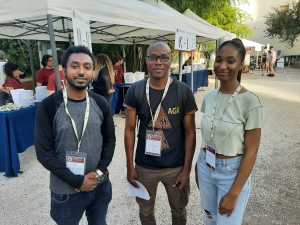
Mapping Ancient Africa participants at the INQUA Rome ice breaker event ready for action! Left to right: Bahru Zinaye Asegahegn, Alfred Houngnon, Busisiwe Hlophe.
The Mapping Ancient Africa (MAA) project has a double session of talks and a poster session at the INQUA congress in Rome 2023. Our session will be on Wednesday 19 July. Unfortunately a number of the originally planned speakers could not make it to Rome due to a combination of not obtaining visas, logistical challenges and ill health. We wish them all well and hope that they will continue to be involved in the project. Further, many thanks to all those who have agreed to step up and give a presentation at a late notice. Below is an updated schedule correct as of Sunday 16 July based on the information contained on the INQUA Rome App; if you are aware of any further problems or changes please let me know ASAP!
Giosan et al. When the desert was a lake: Providing context for Homo sapiens development in the northern Kalahari
Chase et al. Paleolakes and socioecological implications of glacial “greening” of the South African interior
Blinkhorn et al. Evaluating refugia in recent human evolution in Africa
Aureli et al. Homo sapiens behaviour and adaptation in East Africa. New evidence from an open-air site in a modern Ethiopian savannah environment: the GOT10 site
Effiom et al. Late Holocene palaeoecological studies at Lake St Lucia, KwaZulu-Natal
Tallavaara et al. Pan-African Climate and Vegetation over the Quaternary and Implications for Human Distribution
Quick et al. Palaeoenvironments of the Cape Floristic Region: New research & current developments
Henry Hooghiemstra (University of Amsterdam) began working on “long” continental pollen records during his PhD (Hooghiemstra, 1984). After a long and distinguished career working around the Henry has just published a retrospective discussing the challenges, benefits, and prospects for investing in this aspect of palaeoecological research (Hooghiemstra, 2023).
References
Hooghiemstra, H. (2023) Making a Long Continental Pollen Record, a Fabulous and Bizarre Enterprise: A 50-year Retrospective. Palynology 47, 1-4. DOI: 10.1080/01916122.2023.2191257
Hooghiemstra, H. (1984) Vegetational and climatic history of the high plain of Bogota, Colombia: A continuous record of the last 3.5 million Years Gantner Verlag, Vaduz.
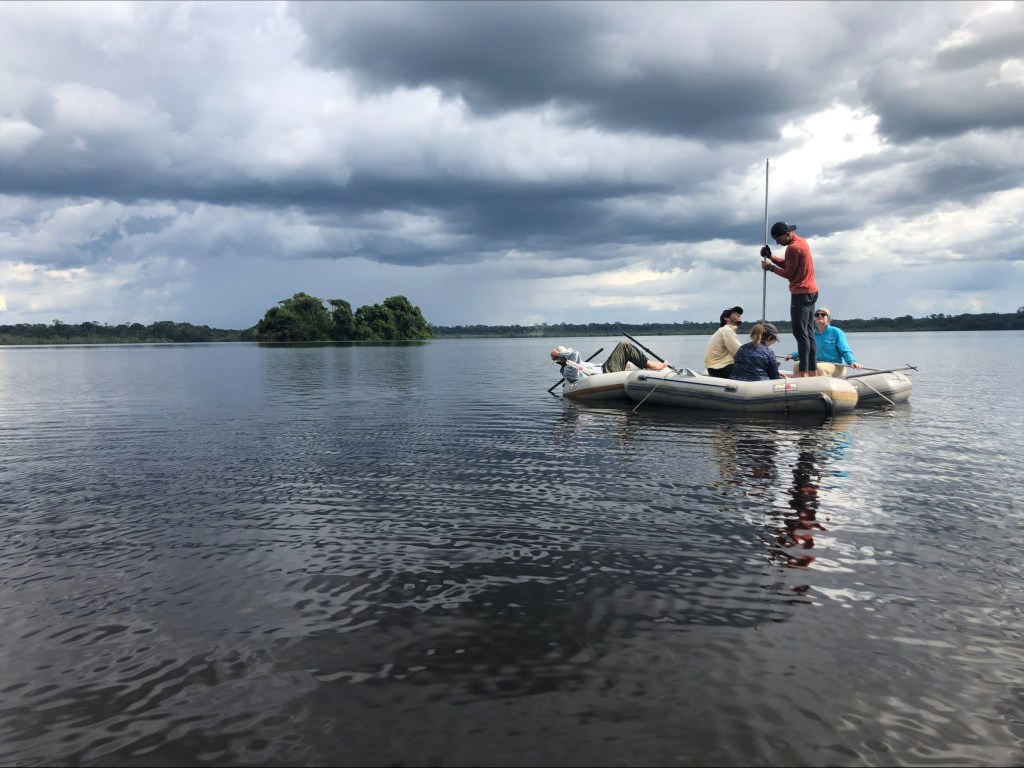
Fieldwork in Ecuador, Lake CubeCoring lake Zancudo Cocha (Ecuador)
Ansis Blaus is a Latvian postdoctoral research associate exploring patterns of climatic and anthropogenic change in the Neotropical Paleoecology Research Group led by Mark Bush at Florida Institute of Technology. He earned his Ph.D. in Earth Sciences from Tallinn University of Technology, Estonia. Supervised by Dr. Triin Reitalu he worked on modern pollen-plant relationships and palaeoecological reconstructions of peatlands and calcareous spring fens with an emphasis on biodiversity and plant functional trait reconstructions.
Currently, at Florida Tech, Ansis works on pollen data and other proxies from the sediment cores collected in the tropical Amazon. He investigates the tropical forest changes in relation to the global climate from a historical perspective, particularly during the Last Glacial Period and the Last Interglacial ca. 130 thousand years ago. His work will shed light on the history of dynamics and climate tipping points in the Amazonian rainforest. This research is particularly important in the face of the current global climate crisis and could help to anticipate the tropical forest response to the changing climate in the future.
Another objective of Ansis’s work is to study the pollen signature of human disturbance in the Amazon Basin as a means to model and interpret human presence and activities in the past and to understand human-nature interactions in tropical forest ecosystems in different spatial and temporal scales. For that, he is collaborating with the University of Amsterdam, Institute for Biodiversity and Ecosystem Dynamics, and working on a project aiming to quantify tropical pollen assemblages led by Crystal McMichael.
Ansis is fascinated by the potential revelations that come with the intersection of neoecology and paleoecology and human interactions. His interest in paleoecology, biodiversity, and various natural processes comes through the sense of pursuing a higher purpose for society and the well-being of our planet, and from the concern that humans have altered tropical forests and most other ecosystems in the world to the level of a negative rebound effect. Ansis believes that we must study and understand these ecosystems from different perspectives to decrease the current damage, predict future scenarios and to develop conservation strategies for both nature and human well-being.
van der Sande, M.T., Bush, M.B., Åkesson, C.M., Berrio, J.C., Correia Metrio, A., Flantua, S.G.A., Hooghiemstra, H., Maezumi, S.Y., McMichael, C.N.H., Montoya, E., Mosblech, N.A.S., de Novaes Nascimento, M., Peña-Claros, M., Poorter, L., Raczka, M.F. & Gosling, W.D. (2023) Warming, drought, and disturbances lead to shifts in functional composition: A millennial-scale analysis for Amazonian and Andean sites. Global Change Biology. DOI: 10.1111/gcb.16818






 Ecology of the past