If you missed our tour of the new African Pollen Database website and discussion of how to incorporate paleoecological data into research and teaching, please the recording here.
Also stay tuned for more details about upcoming workshops and data tutorials!
Chris Kiahtipes will be presenting a, African Pollen Database (APD), practical tutorial about working with paleoecological data in R for beginners! Please join us Wed, February 22 at 9am EST. Please email chris.kaihtipes@gmail.com for the zoom link.
Also, if you are interested in joining, please follow the set-up guide below before the start of the workshop in order to make sure you are ready to go and follow along in real-time during the workshop!
The African Pollen Database community is hosting a series of workshops including practical data tutorials and discussions to help paleoecologists working in Africa integrate these data into research and teaching.
Our theme for Spring 2023 is “using R to understand African paleoecology”, and the schedule is posted here.
Our first workshop will be February 22 at 9am EST. Chris Kiahtipes will be provided a guided tutorial that can be followed live to help you use R and RMarkdown to develop reproducible research workflows for pollen data. This will be ~1 hour. Please register in advance by emailing Chris (chris.kiahtipes@gmail.com) to receive the zoom link and a guide to setup your workspace ahead of the workshop.
To see our launch meeting from February 8 that includes a tour of the African Pollen Database on the Neotoma Paleoecology Database, watch this video.
Interested in African paleoecology? Want to incorporate African pollen data into your research or teaching?
The African Pollen Database (APD) has been updated, and the Neotoma Paleoecology Database now contains over 200 APD records. Many community members filled out a recent survey to help us format of our meetings in order to start focusing on helping people use APD data for research and teaching!
This Wednesday, February 8 at 9am EST, we will announce our finalized schedule for the next few months during a short meeting and provide a short (10 minute) walkthrough of the African Pollen Database on the Neotoma Paleoecology Database. Join us live for this short meeting at 9am EST time or check out the recording afterwards, which we will post here.
Recent research into the chemistry of ancient pollen grains has revealed a pulse of elevated UV radiation may have played a role in the end Permian mass extinction event (250 million years ago). To find out more:
Original article: Liu, F., Peng, H., John, E.A.M., Lomax, B.H., Bomfleur, B., Kent, M.S., Fraser, W.T. & Jardine, P.E. (2023) Dying in the Sun: Direct evidence for elevated UV-B radiation at the end-Permian mass extinction. Science Advances9, eabo6102. DOI: 10.1126/sciadv.abo6102
Interested in African paleoecology? Want to incorporate African pollen data into your research or teaching?
If you read nothing else, please take this survey before January 25!
The African Pollen Database (APD) has been relaunched, and the Neotoma Paleoecology Database now contains over 200 APD records. Data stewards working with APD and Neotoma have been meeting regularly for the last two years to upload data, but we are now changing the format of our meetings in order to start focusing on helping people use APD data for research and teaching!
We are developing a schedule of practical tutorials on APD data workflows in R, using Rneotoma, and a few other topics to take place over next few months (see this video for general info).
This is open to anyone interested in African paleoecology (students, researchers, teachers, etc)! If you or your students might be interested in taking part in one or all of these, please take this very brief survey by January 25 to let us know. Also if you have other students or researchers you think should get this email, let Sarah Ivory (sji15@psu.edu) or Chris Kiahtipes (chris.kiahtipes@gmail.com) know.
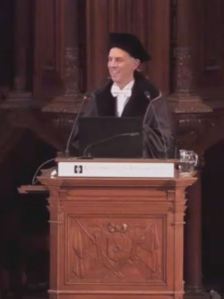
William Gosling giving his oratie “The Ecology of the Past” at the Aula (University of Amsterdam), 22 December 2022.
On the 22 December I gave my oratie (inaugural lecture), entitled “The Ecology of the Past”, related to my appointment as Professor of Palaeoecology & Biogeography at the University of Amsterdam. I really enjoyed the opportunity to mark this personal milestone with some many colleagues, friends and family. In case you missed the event you can watch it online via the universities portal by clicking here (or on the photo).
Note: (1) to flip between seeing the slides and the video feed just click on the screen, (2) running time of lecture until 50 minutes.
The seventh Mapping Ancient Africa online seminar took place on Thursday 15 December 2022. The seminar was delivered by Chantal Kabonyi (University of Bukavu) and chaired by Manu Chevalier (University of Bonn). The presentation was delivered in French with English slides.
Les trois derniers millénaires d’histoire environnementale autour du lac Kivu: De la dorsale congolaise à la dorsale congo-Nil
[The last three millennia of environmental history around Lake Kivu: From the Congolese ridge to the Congo-Nile ridge]
Chevalier, M. (2022) crestr: an R package to perform probabilistic climate reconstructions from palaeoecological datasets. Climate of the Past18, 821-844. DOI: 10.5194/cp-18-821-2022
Wei, C., Jardine, P.E., Gosling, W.D. & Hoorn, C. (2023) Is Poaceae pollen size a useful proxy in palaeoecological studies? New insights from a Poaceae pollen morphological study in the Amazon. Review of Palaeobotany and Palynology 308, 104790. DOI: 10.1016/j.revpalbo.2022.104790








 Ecology of the past