Title: “The potentials and pitfalls of linking climate and cultural change, with a focus on the archaeological record“
The seminar will be delivered via Zoom. The link for the seminar can be obtained from the MAA Slack page, or from seminar chair and chaired by Lynne Quick.
The fifth Mapping Ancient African project took place on Monday 11 April 2022 and focused on the African Pollen Database and past vegetation change in Africa.
The seminar was delivered by Sarah Ivory (Penn State University), Rahab Kinyanjui (National Museums of Kenya), and Lynne Quick (Nelson Mandela University). The seminar covers the principles behind and the working of the African Pollen Database (why make data openly available?) and the latest advances in eastern and southern Africa.
For more about the African Pollen Database check out:
The fourth of a seminars in the Mapping Ancient African project took place on Tuesday 1 March 2022 and was given by Minchao Wu (Uppsala University). You can watch the seminar now on the Ecology of the Past YouTube channel. Seminar details can be found here.
The fourth in Mapping Ancient Africa (MAA) online seminar series will take place on Tuesday 1 March at 17:00 CET. This seminar will focus on African climatology and climate modelling.
The seminar will be delivered via Zoom. The link for the seminar can be obtained from the MAA Slack page, or from seminar chair and chaired by MAA hub coordinator Stefanie Kaboth-Bahr.
For further information on seminars in this series visit the MAA schedule page.
The new edition (December 2021) of the International Union for Quaternary Research (INQUA) newsletter “Quaternary Perspectives” is now available for download open access. Among the many interesting reports on Quaternary science contained within it is an update on the progress made by the Mapping Ancient Africa project written by the INQUA Palaeoclimate Commission chair Prof. Tom Johnson (thanks Tom!).
The recently published volume of the Palaeoecology of Africa series contains a number of different types of papers: research articles, reviews, perspectives and data papers. One of the key reasons I was motivated to become involved in the project was to help mobilise palaeoecological data from Africa towards open access datasets (African Pollen Database, Neotoma). To hopefully get greater recognition to the great work done over the years and to help facilitate synthetic work that will provide a greater understanding of spatial variance in past climate change. Ultimately, four short data papers were included in the volume: an enhanced c. 16,000 year pollen record from the Bale Mountains in Ethiopia (Gil-Romera et al. 2021), two pollen and charcoal record from the southern Cape Coast in South Africa, c. 3200 and 650 years long respectively (du Plessis et al. 2021a; du Plessis et al. 2021b), and a c. 700 year long record from Madagascar (Razanatsoa et al. 2021). The records provide new insights in to landscape scale environmental change driven by both humans and climate. To find out more check out the open access articles and the data at:
I am delighted to announce the publication of the new volume in the Palaeoecology of Africa series. I had the privilege to guest edit this with Anne-Marie Lézine and Louis Scott. The final version is now available OPEN ACCESS online.
Gosling, W.D., Lézine, A.-M. & Scott, L., eds. (2021) Quaternary Vegetation Dynamics: The African Pollen Database. Series editor: Runge, J. Palaeoecology of Africa: Volume 35. CRC Press. ISBN: 9780367755089 DOI: 10.1201/9781003162766
The first meeting of the, INQUA funded, Mapping Ancient Africa project will take place on the 14 and 15 of October 2021 with face-to-face meetings at four locations (Nairobi, Kenya; Port Elisabeth, South Africa; Potsdam, Germany; Portland, Oregon, USA) being linked up online.
I am pleased to announce the start of a new project “Mapping Ancient Africa” funded by the International Union for Quaternary Research (INQUA) with support from the Palaeoclimate commission (PALCOM) and the Human & Biospheres commission (HABCOM). This project will bring together Quaternary scientists focused on past climates and environments with those working on human evolution and development in Africa. Through the synthesising data and linking these with modelling approaches we hope to bring together a novel group of researchers to explore the climatic and environmental backdrop to hominin development.
Further information on the project can be found on a new “sub-site” within this blog dedicated to the “Mapping Ancient Africa” project. The project is designed to connect researchers working on these topics so if you are interested to be involved please do get in contact. The first meeting will be held in October 2021 online and at four locations: Nairobi (Kenya), Port Elizabeth (South Africa), Potsdam (Germany) and Portland (Oregon, USA) – for further details click here.
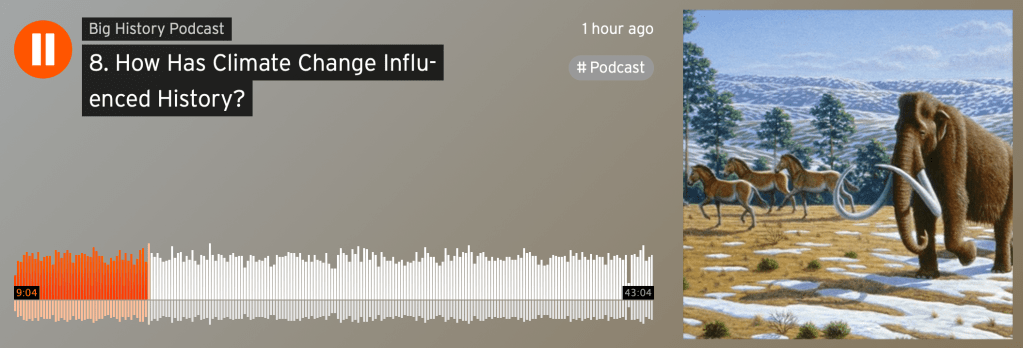
As part of the (on-line) bachelor level “Big History” course from the Institute for Interdisciplinary Studies at the University of Amsterdam I recently recorded a podcast with Henry Hooghiemstra. Under the banner of “How Has Climate Change Influenced History?” among other things we discussed: (i) the principles of how we can obtain information on past climatic and environmental change, (ii) how global climate changed between cold (glacial states) and warm (interglacial states) during the last 2.6 million years (Quaternary), and (iii) past human impacts and influences on environmental and climatic change.






 Ecology of the past