The call for sessions for the next edition of the Society for Tropical Ecology’s, European Conference of Tropical Ecology is open until 8 July 2025. The meeting will be held in Passau (Germany) and will cover all aspects of tropical ecological research. To make sure that your interests are well represented submit a session idea now by visiting the conference web site: https://gtoe2026-passau.de/
Ecology of the Past blog contributor Nina Witteveen was awarded the Hugo de Vries prize on 13 June 2025 at the Botanic Gardens in Nijmegen. The Hugo de Vries prize is awarded by the KNbv (Royal Dutch Botanical Society) and the Stichting Hugo de Vries fonds (Hugo de Vries foundation) for the best PhD thesis in Botany defended at a Dutch University. This years prize was awarded to Nina for her thesis“Long-term Forest Recovery in Amazonia: Insights from Phytolith Analysis” (University of Amsterdam) which was completed under the supervision of Crystal McMichael.
I was delighted to be invited to give a seminar as part of the Max Planck Institute for Geoanthropology “Human Palaeo-systems Research Group” series. In case you missed it the seminar is will soon be available to watch online (click here).
To see the full list of seminars in the series click here.
The aim of this thesis was to provide insight into past human activities in Amazonia, and the long-term forest recovery that followed, using phytolith analysis. The first part of this thesis focused on improving phytolith analysis as a proxy for vegetation changes in Amazonia. The morphological variation of 24 Amazonian palm phytoliths were assessed (Chapter 2) to improve the taxonomic resolution of palm phytolith identification, and results indicate the potential to differentiate Euterpe, Bactris, Oenocarpus, Attalea, Iriartea deltoidea, and Socratea exorrhiza. Chapter 3 demonstrated that phytolith assemblages (from terrestrial soil cores) varied across a gradient of (modern) human disturbance in Surinamese rainforests. In Chapters 4-6, we developed beta regression and GLM models to predict forest cover and biomass changes within 200 m and 1 km of Amazonian lakes, respectively, using grass phytoliths. Applying these innovations in Chapters 5-6 demonstrated that past human activities were on localized scales in Suriname and temporally heterogenous in Ecuador. Palm enrichment of Attalea, Oenocarpus and Astrocaryum occurred within 0 km, 1 km, and 8 km of an archaeological site in Suriname (Chapter 5). In Ecuador, forest cover and biomass ranged between 48-84% and 77-247 Mg/ha, respectively, and the largest decreases (between 1000-1255 CE) were paired with fires (Chapter 6). Overall, the type, intensity, timing, and frequency of disturbances are important factors influencing long-term forest recovery and ecological legacies in Amazonia.
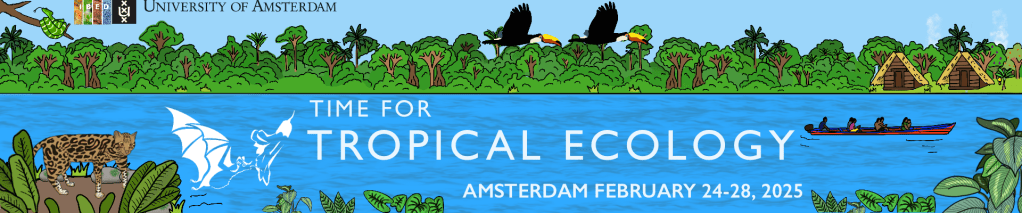
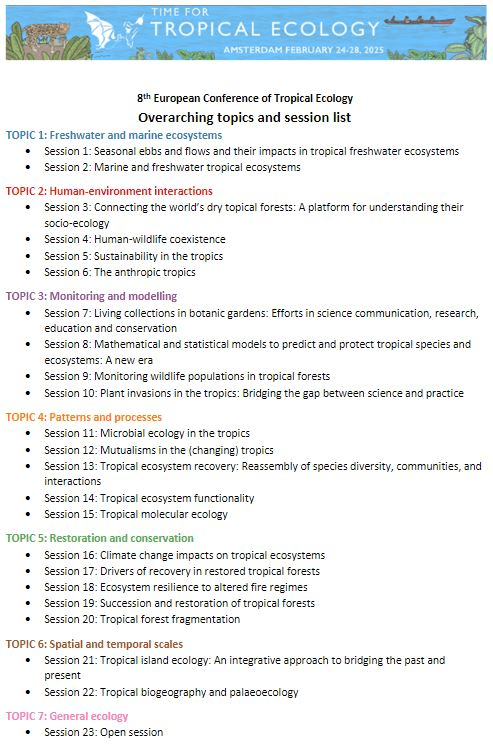
The European Conference of Tropical Ecology will take place in Amsterdam between 24 and 28 February 2025. The event will be centered around thematic oral and poster sessions. There are twenty-three different thematic sessions organized into seven broad topics:
The European Conference of Tropical Ecology will take place in Amsterdam between 24 and 28 February 2025. The call for session ideas is currently open (deadline 19 August). So please visit the conference web pages to find out more and submit your idea that will help shape the program and make this conference a success.
To find out how to submit your session idea click here.
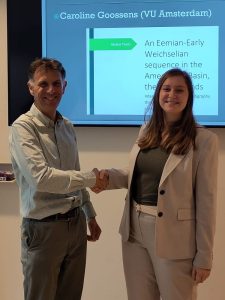
On Friday 24 May 2024 the Palynologische Kring (Dutch palynological society) held a seminar series and laboratory workshop at the Institute for Biodiversity & Ecosystem Dynamics (University of Amsterdam). During the afternoon we had the annual meeting of the society, the presentation of our MSc Thesis prize, four seminars and two laboratory demonstrations. The MSc thesis prize “Florschütz Award” was won by Caroline Goossens (VU Amsterdam) for her thesis entitle: “An Eemian-Early Weichselian sequence in the Amersfoort Basin, the Netherlands”; the project was supervised by Natalie Van der Putten, Cees Kasse and Jeroen Schokker. We hope that Caroline will present her thesis at a future Palynologishe Kring meeting.
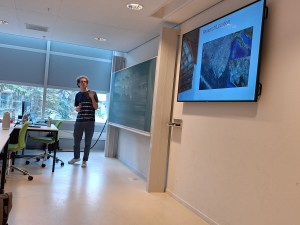
Teye Aukes presenting on the diatoms of ancient Rome
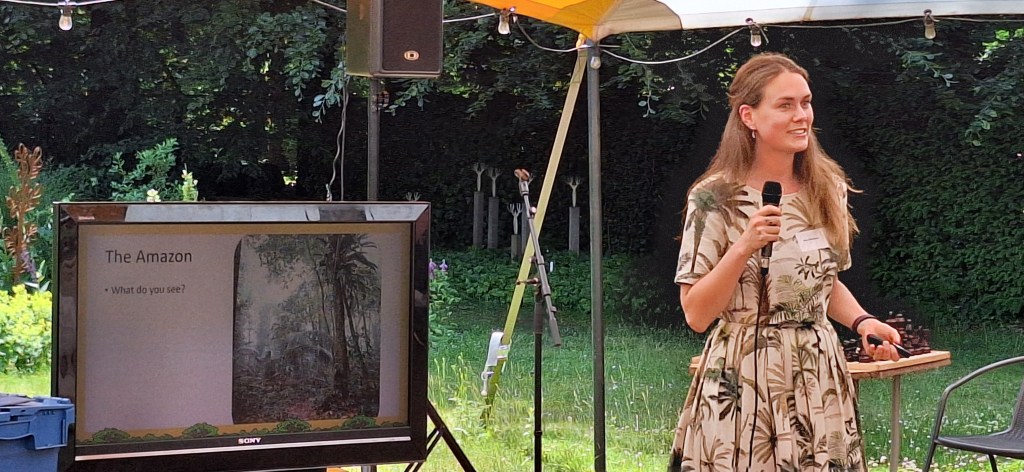
The talk series was kicked off by Nina Witteveen (University of Amsterdam) who presented part of her PhD thesis (currently awaiting defense), entitled: “Long-term forest recovery in Amazonia insights from phytolith analysis”. Nina discussed the impact of past peoples on the vegetation of Suriname based on her work identifying phytoliths in soil samples collected at varying distances from an archaeological site. The second talk was given my Amanda Henry (Leiden University) who demonstrated how the analysis of starch grains extracted from archaeological context can provide insights in to past diets. She used these evidences to suggest that early humans and Neanderthals had a similar diversity of plants in their diets. The third talk was given by University of Amsterdam MSc researcher Teye Aukes and focused upon his identification of diatoms from an swampy lagoon environment near Ostia (Italy). He drew conclusions from these data about the antiquity of salt production in ancient Rome. The final talk was given online by Welmoed Out (Moesgaard Museum) who presented a detailed analysis of inter- and intra-analyst variability in phytolith morphometric analysis.
After the seminars we moved upstairs to the microscope laboratory where Nina Witteveen and Ana Smuk (University of Groningen) showed off phytoliths from their study site in South America and the Netherlands.
Some of the Palynologische Kring members enjoying some refreshment after the event.
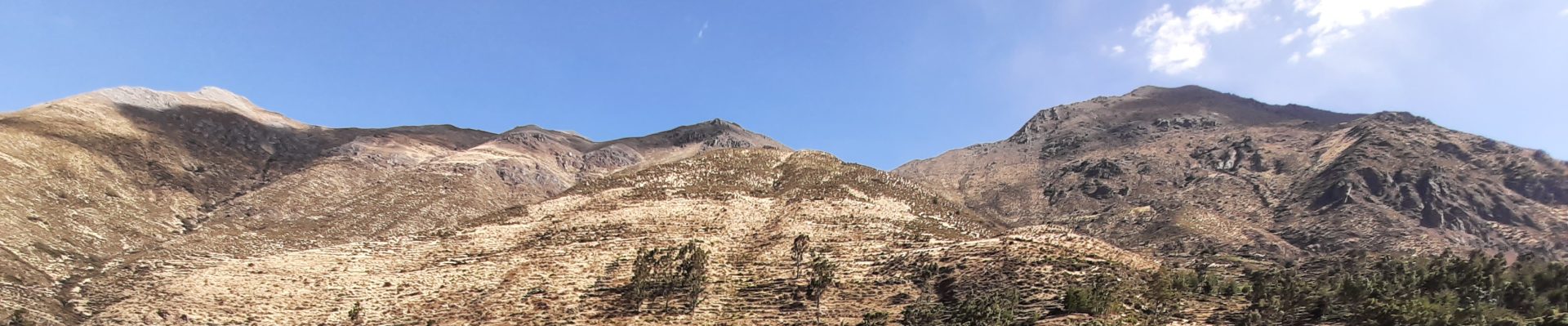
The high tropical Andes harbours vital ecosystems that sustain biodiversity, carbon storage, and environmental service provision for millions of people. They are identified as one of the most vulnerable terrestrial ecosystems to global environmental changes, particularly to climate change and land use conversion. Despite their vulnerability and the importance of global biodiversity conservation and Andean societies, they are among the least studied ecosystems in the world. In this thesis, I studied the patterns of summit plant community’s across the tropical section of the Andes. Further, I studied what environmental factors influence plant community composition, species diversity, and thermal niche traits in high tropical alpine ecosystems. Based on the thermal niche traits, I assessed the potential vulnerability of species and communities to climate warming, considering the effect of the climate variability hypothesis on the species niche breadths. Further, I synthesised the current state of knowledge and assessed the current and projected landscape changes in the high Andes due to the combined effect of glacier retreat and climate warming. I reviewed documented glacier changes and landscape evolution over past decades to millennia and assessed projected future glacier shrinkage until 2100 for two case studies in the Andes of Ecuador and Peru. I also evaluated the capacity of high Andean ecosystems to recover from land use changes using the aptitude to store and take up carbon together with plant diversity. Lastly, I carried out an applied research analysis aimed at informing conservation policy formulation in continental Ecuador through defining critical areas for biodiversity conservation.
McMichael, C.N.H., Vink, V., Heijink, B.M., Witteveen, N.H., Piperno, D.R., Gosling, W.D. & Bush, M.B. (2023) Ecological legacies of past fire and human activity in a Panamanian forest. Plants, People, Planet5, 281-291. DOI: 10.1002/ppp3.10344










 Ecology of the past