During the seminar afternoon (17 October) we heard four talks. The first from Harm Smeenge and Ariët Kieskamp (both Bosgroep) introduced the sites we were to visit on the excursion the next day. This focused on the landscape ecology and ecological history of the bogs on the eastern slopes of the Veluwe. The second talk, by Roy van Beek (Wageningen University & Research), focused on the Celtic field systems around the Veluwe. He explained the latest archaeological and archaeobotaincal work investigating the age and origins of these field systems. The third presentation was by Jasper Candel (Wageningen University & Research) and focused on the geomorphological features from glacial activity in the Veluwe region and how this has effected the development of mire ecosystems. I (William Gosling) gave the final talk, presenting the outputs of the research theses of Sanna Wessel, Chiara Raino and Roos Dik who all completed projects at the University of Amsterdam and worked together to investigate how different mega-herbivore populations in the Dutch landscape were represented by the dung fungal spores preserved in the soil.
INQUA fellow Alfred Hougnon continues his research into past environmental change in the Dahomey Gap (Benin). In the fourth video documenting his progress a short background to the project, and insights into field work, are given. Field work took place near the Ewe-Adakplame forest in the south east of Benin and involved the recovery of sediments using a Russian corer. The video also shows how interactions and engagement with the local community was developed during the research expedition.
To find out more above Alfreds project read posts on:
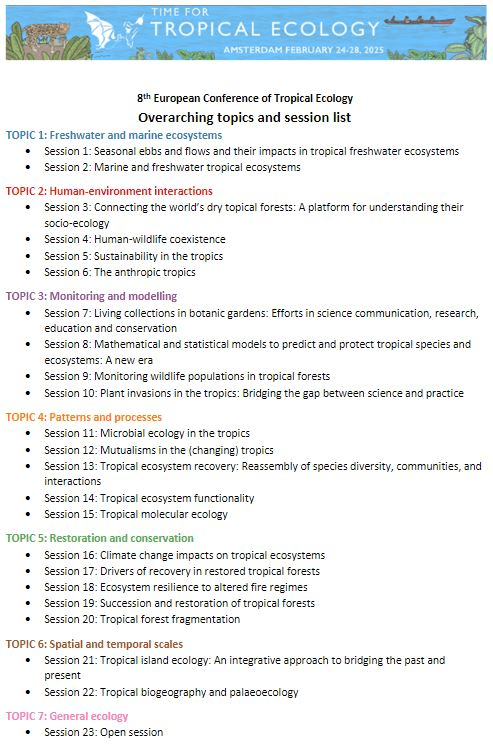
The European Conference of Tropical Ecology will take place in Amsterdam between 24 and 28 February 2025. The event will be centered around thematic oral and poster sessions. There are twenty-three different thematic sessions organized into seven broad topics:
13.00-13.30: Ontvangst met koffie / Arrival with coffee
13.30-14.00: Harm Smeenge & Ariet Kieskamp (Bosgroepen): Landscape ecological/historical ecological characteristics of bogs in the eastern slopes of the Veluwe
14.00-14.30: Roy van Beek (WUR): Archeological, archeobotanical and morphological aspects of the Celtic Field complex of Vaassen (Veluwe)
14.30-15.00: Koffiepauze / Coffee break
15.00-15.30 Jasper Candel (WUR): Geophysical research in the push moraine of the Veluwe and relation with peat development in valley mires
15.30-16.00: William Gosling (UvA): On the use of spores of coprophilous fungi in characterizing herbivory past and present in Dutch landscapes
Voor mensen die slecht ter been zijn, is er beperkte mogelijkheid om met eigen auto deel te nemen aan de excursie (max. 2 auto’s kunnen parkeren bij de excursiepunten). / For people with walking or cycling difficulties there is a limited opportunity to come in a car on the trip (maximum 2 cars can park at the excursion points).
For further information and costs please email Nelleke van Asch (secretary of the Palynologische Kring). Contact details can be found at: https://www.palynologischekring.nl/contact/
During the Mapping Ancient Africa writing workshop in Kenya (3-6 June 2024) Stefanie Kaboth-Bahr conducted a series of short interviews with the scientists attending. Below you can find part 2 (of 2) of the interviews with the participants in the workshop. Watch the videos to find out their scientific stories and top tips for academic writing. Watch all the Mapping Ancient Africa videos on the Mapping Ancient Africa YouTube Playlist.
The participants (part 2 of 2)
Ruth Kiely (University of Amsterdam, Netherlands)
Husna Mashaka (Arizona State University, USA & National Museums of Kenya, Kenya)
During the Mapping Ancient Africa writing workshop in Kenya (3-6 June 2024) Stefanie Kaboth-Bahr conducted a series of short interviews with the scientists attending. During the interviews she asked the participants and instructors to describe their scientific background, what had motivated them to take part in the writing workshop, and what they thought the most important thing they had gained from it. You can now meet the first four of these scientists now by watching the videos below, or catch up with all the latest videos on the Mapping Ancient Africa YouTube Playlist.
The participants (part 1 of 2)
Olugbenga Boboye (University of Ibadan, Nigeria)
Angela Effiom (University of the Witwatersrand, South Africa)
The European Conference of Tropical Ecology will take place in Amsterdam between 24 and 28 February 2025. The call for session ideas is currently open (deadline 19 August). So please visit the conference web pages to find out more and submit your idea that will help shape the program and make this conference a success.
To find out how to submit your session idea click here.





 Ecology of the past