Menu

  • Home
  • About this blog
  • Who we are
  • On film
  • Palaeo research
    • Student research projects
  • Mapping Ancient Africa
    • Background and goals
    • Regional hubs
    • Participants
    • Schedule
    • Past events
    • Literature

Ecology of the past

Job: Physical-chemical research technician with management skills

October 5, 2017
WDG

Vacancy: Physical-chemical research technician with management skills (salary scale 10)
Institute for Biodiversity & Ecosystem Dynamics
University of Amsterdam
Closing date: 22 October 2017

This position will link strongly with the IBED Department of Ecosystem & Landscape Dynamics which aims to improve our understanding of the functioning and dynamics of abiotic and biotic components of (geo-)ecosystems across landscapes through time. To achieve this aim we make use of a wide range of state-of-the-art research facilities provided by IBED (for more information on facilities click here).

For full details of the vacancy and how to apply click here, or visit Academic Transfer.


Categories: News, William Gosling • Permalink

The modern pollen-vegetation relationships of a tropical forest-savannah mosaic landscape, Ghana, West Africa

August 22, 2017
WDG

Julier, A.C.M., Jardine, P.E., Adu-Bredu, S., Coe, A.L., Duah-Gyamfi, A., Fraser, W.T., Lomax, B.H., Malhi, Y., Moore, S., Owusu-Afriyie, K. & Gosling, W.D. (2017) The modern pollen-vegetation relationships of a tropical forest-savannah mosaic landscape, Ghana, West Africa. Palynology online. DOI: 10.1080/01916122.2017.1356392

Categories: Adele Julier, Journal articles, Phil Jardine, Publications, Wesley Fraser, William Gosling • Tags: Bosumtwi, Ghana, palaeoecology, Poaceae, pollen, savannah, transitions • Permalink

Pollen art…

July 29, 2017
WDG

Pollen grains created with glue, salt and paint on card.

Day 1 of my summer holiday raining = art with the kids.

Categories: Online resources, William Gosling • Tags: art, glue, holiday, kinds, paint, painting, palynology, pollen, rain, salt • Permalink

Fields and feasts

July 28, 2017
WDG

If you have exciting new research on past ecological change similar to this please consider submitting it for consideration to be published in Vegetation History & Archaeobotany.

If you have exciting new research on past ecological change please consider submitting it to Vegetation History & Archaeobotany.

Two articles recently published on-line in the journal Vegetation History & Archaebotany (of which I am an Associate Editor) recently caught my attention.These explore:

  • agricultural practices of people living in the Netherlands c. 3000-2000 years ago  (Arnoldussen & van der Linden, 2017), and
  • what it was the ancient Maya feasted upon (Cagnato, 2017)!

For more detailed thoughts on these papers read on…

Continue Reading

Categories: Reading, William Gosling • Tags: ancient agriculture, animals, archaeobotany, Bronze Age, Celtic fields, charcoal, Chultun, Climate change, drums, feast, geochemistry, Guatemala, La Corona, macrobotanical, Maya, Netherlands, north-west Europe, pit, plants, pollen, Raarakker, raised bed agriculture, ritual, Roman period, Vegetation History & Archaeobotany, whistles • Permalink

Field work in Ecuador

July 27, 2017
WDG

IBEDs Crystal McMichael hard at work sampling sediments in the Andes

IBEDs Crystal McMichael hard at work sampling sediments in the Andes

Insights into recent field work in Ecuador by a team lead by Crystal McMichael can be found in a recent blog from our collaborators at the Instituto Geofisico, Escuela Politecnica Nacional, Quito (Ecuador).

Trabajo colaborativo entre Volcanólogos y Palenólogos potenciará el conocimiento sobre el Paleoclima en el Valle de Latacunga en los últimos 20 mil años by Patricia Mothes

Categories: Field work, News, Reports, William Gosling • Tags: comunidad, ecosystem, Ecuador, Escuela Politecnica Nacional, IBED, IGEPN, Institute for Biodiversity & Ecosystem Dynamics, Instituto Geofisico, Landscape, palaeoecology, palenología, sediments, University of Amsterdam, UvA • Permalink

Images of modern pollen from Ghana

July 26, 2017
WDG

The images taken by Adele Julier to help her with pollen identifications during her PhD at The Open University (UK) are now available to download. Please note these images are not of reference material but identifications, made by Adele and myself, of the pollen grains found within her pollen traps. The pollen traps were deployed within vegetation study plots in wet evergreen forest, semi-deciduous moist forest, and the forest-savanna transition zone in Ghana. Further publications on this work and a thesis coming soon…

Julier, A.C.M. & Gosling, W.D. (2017) Modern pollen types, Ghana (v.2). Figshare. doi: 10.6084/m9.figshare.5240956.v2

Example of pollen images collated by Adele

Categories: Adele Julier, Data archive, Publications, William Gosling • Tags: Ankasa, Bobiri, forest-savanna transition, forest-savannah transition, Ghana, images, Kogyae, modern pollen rain, moist semi-deciduous forest, palynology, pollen, Pollen trap, tropics, wet evergreen forest • Permalink

Connecting Two Realms

July 25, 2017
WDG

Article from: Archaeology a publication of the Archaeological Institute of America

Archaeologists rethink the early civilizations of the Amazon
By ROGER ATWOOD
Monday, June 12, 2017

Categories: News, William Gosling • Tags: Amazon, archaeology, Archeaologists, civilization, Peru, pre-Columbian • Permalink

Success for BSc project students

July 18, 2017
WDG

BSc students on the Palaeoecology course prior to undertaking a research project with us.

Many BSc students undertook our “Palaeoecology” course prior to choosing to do a research project with us.

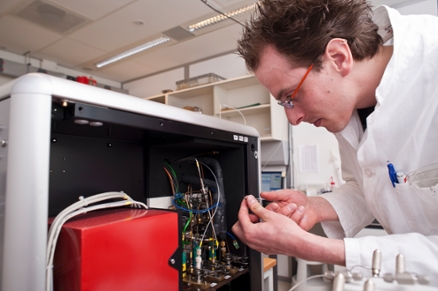
This year 15 (fifteen!) bachelors students completed their research projects in palaeoecology based within the Department of Ecosystem & Landscape Dynamics at the University of Amsterdam. The students had a variety of backgrounds with the majority coming from the BSc Biology and the BSc Future Planet Studies programs.

Each project was set up to test a particular ecological or biogeographic hypothesis. Investigations included the exploration of the role of humans in modifying ecosystems in Amazon, the nature of the pre-farming landscape in the the Netherlands, and how to chemically identify fossil charcoal. In undertaking their projects individual students had the opportunity to variously develop skills in microscopy, spatial modelling, or analytical chemistry. The high quality of the data produced means that hopefully many of these data sets can be used in future scientific publications. Well done to all!

If you are interested in conducting a similar project (at any academic level) with us please do not hesitate to get in contact. For further details of ongoing research within the Department of Ecosystems & Landscape Dynamics visit our web pages by clicking here.

Categories: Reports, Teaching, William Gosling • Tags: Amazonian, analytical chemistry, Andean, Andes, Bachelor, biogeography, BSc, ecology, Ecosystem & Landscape Dynamics, geographical information systems, GIS, Institute for Biodiversity & Ecosystem Dynamics, modelling, Netherlands, palaeoecology, paleoecology, project, research, students, Thesis, University of Amsterdam • Permalink

Pollen diagrams in colour!

July 6, 2017
WDG

I discovered what I think is the first colour pollen diagram this week. Published in 1948 and still looks beautiful.

Selling, O.H. (1948) On the late Quaternary history of the Hawaiian vegetation. PhD thesis, University of Stockholm, Honolulu, Hawaii.

Selling (1948) cover
Selling (1948) colour pollen diragram

Images of the copy held at the University of Amsterdam library.

Categories: Comments, Reading, William Gosling • Tags: 1948, colour, fossil pollen, Hawaiian, palynology, PhD thesis, pollen, pollen diagram, Selling, tropics, University of Stockholm, vegetation • Permalink

Exploring ancient cesspits in Deventer (Netherlands)

June 26, 2017
WDG

Jippe Kreuning

University of Amsterdam MSc Biological Sciences student Jippe Kreuning investigated the contents of cesspits in the Dutch city of Deventer for his research project. Jippe investigated fossil pollen, seeds and other biological remains to discover what people in the ancient city were eating. In doing so Jippe gained new insights into ancient trade routes.

To find out more about Jippe’s project watch his video courtesy of FOLIA YouTube channel (in Dutch)

Jippe Kreunings zoektocht naar versteende poep

Categories: Online resources, William Gosling • Tags: archaeology, cesspit, Deventer, macrofossils, MSc Biological Sciences, palaeoecology, pollen, seeds, trade routes, University of Amsterdam • Permalink

← Older posts
Newer posts →
Blog at WordPress.com.
Ecology of the past
Blog at WordPress.com.
  • Subscribe Subscribed
    • Ecology of the past
    • Join 171 other subscribers
    • Already have a WordPress.com account? Log in now.
    • Ecology of the past
    • Subscribe Subscribed
    • Sign up
    • Log in
    • Report this content
    • View site in Reader
    • Manage subscriptions
    • Collapse this bar

Loading Comments...