Come study with us! New and improved Ecology & Evolution masters track within the MSc Biological Sciences at the University of Amsterdam
To find out more click here.
November 24, 2017
Come study with us! New and improved Ecology & Evolution masters track within the MSc Biological Sciences at the University of Amsterdam
To find out more click here.
November 21, 2017
 Job: Post-doctoral researcher
Location: Institute for Biodiversity & Ecosystems Dyanamics, University of Amsterdam
Duration: 3 years
Deadline for applications: 10 December 2017
Focus on Global Ecology, including: global biodiversity patterns and ecosystem functioning, human impacts on biodiversity, biogeography of species interactions, and/or global changes in ecosystems, biodiversity and ecosystem services.
For more details and how to apply click here.
November 19, 2017

Britte reconfiguring the chronology for Lake Pata
The second and third weeks of the Environments Through Time course at the University of Amsterdam has focused on obtaining practical experience of developing chronologies, analyzing multi-variate data-sets, and conducting time series analysis. The focus of the course has been on Quaternary environmental change, however, the skills learnt can be applied to almost any time-scale so long as you have time control points you want to tie together, and multiple things you can track changing through that time.
Over the two week period the students worked on a previously published paper that they had selected that contains: (i) chronological information (at least 3 control points), and (ii) multiple variables that change through the time series (at least 9 variables). In week two they deconstructed the chronologies and generated their own revised versions. For example students have (re-)calibrated radiocarbon dates, made different decisions on dates to include/exclude, and used different approaches to constructing the age vs. depth model, e.g. contrasting linear point-to-point vs. Bayesian methodologies. In week three they have taken the data-set(s) associated with their paper and re-evaluated it in light of the revised chronologies using cluster analysis, ordination techniques, and wavelets.

The joy of wavletes
Through this exercise students have gained experience of how to critically assess scientific literature and gained an appreciation of where re-analysis of data-sets can (and cannot) make a difference. Personally I have be delighted with the high level of engagement and enthusiasm for the material and have been excited to have a chance to delve into literature that I would not otherwise be aware of.
For more information on this course see: Environments Through Time – week 1
November 3, 2017
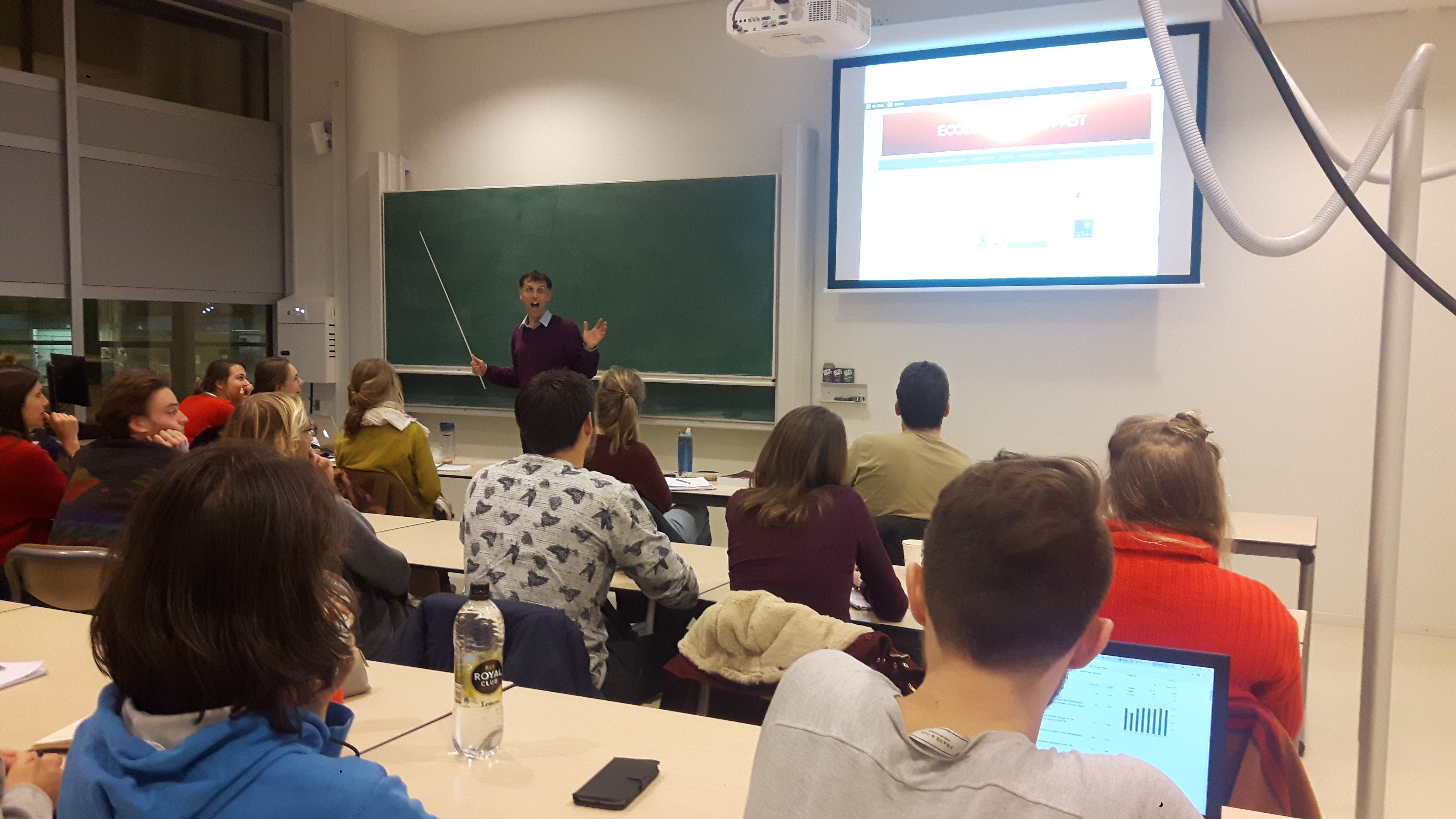
Me teaching human impacts on environmental change…
The first, ever, week of the Environments Through Time course at the University of Amsterdam has just finished. The course sits within the MSc Biological Sciences (Ecology & Evolution) and MSc Earth Sciences (Geo-ecosystem Dynamics) but is also avaliable to other masters students. In the first week we have thought about four main topics:
The week was completed with each student giving a three (3) minute presentation of their favourite paper. The papers presented ranged from the extinction of giant sharks, through forest-savannah transitions, to how climate change thwarted Ghengis Kahn. Next week we continue by disecting how chronologies are constructed.
The Enviornments Through Time course is taught by: William Gosling, Crystal McMichael, and Milan Teunissen van Manen.
October 24, 2017
 Two recent articles published in the journal Vegetation History & Archaeobotany, which caught my attention as an Associate Editor, explore early cultivation in Argentina and Czech Republic:
October 23, 2017
Open acess, online:
Loughlin, N.J.D., Gosling, W.D. & Montoya, E. (2017) Identifying environmental drivers of fungal non-pollen palynomorphs in the montane forest of the eastern Andean flank, Ecuador. Quaternary Research. DOI: 10.1017/qua.2017.73
October 20, 2017
Open acess, online:
Loughlin, N.J.D., Gosling, W.D., Coe, A.L., Gulliver, P., Mothes, P. & Montoya, E. (2017) Landscape-scale drivers of glacial ecosystem change in the montane forests of the eastern Andean flank, Ecuador. Palaeogeography, Palaeoclimatology, Palaeoecology. DOI: 10.1016/j.palaeo.2017.10.011
October 19, 2017
 Title: When was the South Pacific colonised? A lake sediment approach to understanding climate:human drivers of ecosystem change on remote Pacific Islands
 Location: University of Soithampton (Geography & Environment)
Supervsiory team: Dr. Sandra Nogué, Prof Mary Edwards, Prof. David Sear, Dr. William Gosling (University of Amsterdam), Prof. Inger (Tromso University), Prof. Janet Wilmshurst (Landcare research and University of Auckland)
Rationale: The Pacific islands of Polynesia were among the last places on earth to be colonised by humans. The precise dates of colonisation are debated – a situation which arises from the different sources of evidence (1, 2). New lake sediment records from the Cook Islands (Atiu, Mangaia) and Samoa (Upolu) and Tonga show very clear evidence of disturbance, but what is unclear is to what extent the signal represents the arrival of humans or a change in climate (2). A key question for the analysis of sedimentary records is the ability to distinguish natural variability in the environment of Pacific Islands from that arising from the arrival of humans in a temporal and spatial context. We aim to use a multi-proxy approach based on SedDNA, lipid biomarkers, fossil charcoal, and pollen preserved in lake sediments to identify: a) the presence of humans and/or livestock that were brought with them, and b) the related environmental change. Multiproxy approaches supported by statistical analysis, will be deployed to four sites where we already have good chronological controls and high resolution records of palaeoclimate. We are well placed to apply new methods and higher resolution analyses to address fundamental questions about the response of remote pacific islands to climate and human forcings.
October 11, 2017
Goni, M.F.S., Desprat, S., Daniau, A., Bassinot, F.C., Polanco-Martinez, J.M., Harrison, S.P., Allen, J.R.M., Anderson, R.S., Behling, H., Bonnefille, R., Burjachs, F., Carrion, J.S., Cheddadi, R., Clark, J.S., Combourieu-Nebout, N., Mustaphi, C.J.C., Debusk, G.H., Dupont, L.M., Finch, J.M., Fletcher, W.J., Giardini, M., Gonzalez, C., Gosling, W.D., Grigg, L.D., Grimm, E.C., Hayashi, R., Helmens, K., Heusser, L.E., Hill, T., Hope, G., Huntley, B., Igarashi, Y., Irino, T., Jacobs, B., Jimenez-Moreno, G., Kawai, S., Kershaw, A.P., Kumon, F., Lawson, I.T., Ledru, M., Lezine, A., Liew, P.M., Magri, D., Marchant, R., Margari, V., Mayle, F.E., McKenzie, G.M., Moss, P., Mueller, S., Mueller, U.C., Naughton, F., Newnham, R.M., Oba, T., Perez-Obiol, R., Pini, R., Ravazzi, C., Roucoux, K.H., Rucina, S.M., Scott, L., Takahara, H., Tzedakis, P.C., Urrego, D.H., van Geel, B., Valencia, B.G., Vandergoes, M.J., Vincens, A., Whitlock, C.L., Willard, D.A. & Yamamoto, M. (2017) The ACER pollen and charcoal database: a global resource to document vegetation and fire response to abrupt climate changes during the last glacial period. Earth System Science Data 9, 679-695. DOI: 10.5194/essd-9-679-2017
October 10, 2017
Online, open access:
Gosling, W.D., Julier, A.C.M., Adu-Bredu, S., Djagbletey, G.D., Fraser, W.T., Jardine, P.E., Lomax, B.H., Malhi, Y., Manu, E.A., Mayle, F.E. & Moore, S. (2017) Pollen-vegetation richness and diversity relationships in the tropics. Vegetation History and Archaeobotany. DOI: 10.1007/s00334-017-0642-y
 Ecology of the past