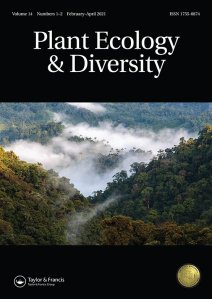
Gosling WD, Maezumi SY, Heijink BM, Nascimento MN, Raczka MF, van der Sande MT, Bush MB, McMichael CNH. 2021. Scarce fire activity in north and north-western Amazonian forests during the last 10,000 years. Plant Ecology & Diversity. DOI: 10.1080/17550874.2021.2008040
The second in my series highlighting papers in the recent volume of Palaeoecology of Africa (published entirely open access online) focuses on the research articles. The research articles make up the ‘guts’ of the volume, comprising 10 of the 24 papers. Three of these are from western Africa (Dinies et al.; Gosling et al.; Lemonnier & Lézine), two from eastern Africa (Githumbi et al.; Kinyanjui et al.), two from central Africa (Richards; Gaillard et al.), and three from southern Africa (Chevalier et al.; Hill & Finch, Hill et al.). These research articles present new data and key insights into past environmental change in Africa, which fall into two broad categories, providing information on: (i) how we can extract information from pollen data sets, and (ii) the processes operating to drive vegetation.
As a Subject Editor for Plant Ecology & Diversity I would like to take a moment to highlight two recent papers published under the theme “Global Change & Vegetation”.
The first Somoldi et al. takes us back to the roots of the concept of “Potential Natural Vegetation” (PNV) cover which has long been widely used and often debated in the literature. In their research article Somoldi et al. revisit the German text of the article that originally set out this idea (Tüxen 1956) and provide (re-) translated versions of key sections. The purpose of this is, the authors argue, to get a tighter definition and encourage a more precise usage of the term to avoid miss-use and miss-interpretation of the concept. They argue that the PNV concept is still a valid one despite the increasing human modification of landscapes and environments, but that its usage should be restricted more closely to the idea as it was originally formulated by Tüxon.
The second, Huntley & Allen, use palaeoecological data to test the hypothesis related to the expansion of pine woodlands during the Holocene (last 11,700 years) in Scotland. The examination of multiple sites in the Scottish Highlands reveals a dynamic mosaic landscape, and that the trajectory of change was influenced by climate, dispersal and preceding vegetation patterns. This new understanding of trajectories of change can help to anticipate how landscapes in the Scottish Highlands might alter under ongoing climate change.
References and links to the articles are below, please check out the journal for a wide range of articles related to Evolution & Systematics, Global Change & Vegetation Dynamics, Environment & Plant Functioning, Biotic Interactions and Biogeography. We accept articles on all these themes in standard “original research” format, shorter “rapid communications”, longer “reviews” and opinion related “perspectives”. Therefore, if you have a article that fits with these themes please consider submitting to Plant Ecology & Diversity.
The second of the online seminar series associated with the INQUA funded Mapping Ancient Africa (MAA) project will take place on Monday 13 December at 16:00 (CET).
The seminar will be given via Zoom. The link for the seminar can be obtained from the MAA Slack page, or from seminar chair and MAA hub coordinator Lynne Quick.
For further information on seminars in this series visit the MAA schedule page.
The recently published volume of the Palaeoecology of Africa series contains a number of different types of papers: research articles, reviews, perspectives and data papers. One of the key reasons I was motivated to become involved in the project was to help mobilise palaeoecological data from Africa towards open access datasets (African Pollen Database, Neotoma). To hopefully get greater recognition to the great work done over the years and to help facilitate synthetic work that will provide a greater understanding of spatial variance in past climate change. Ultimately, four short data papers were included in the volume: an enhanced c. 16,000 year pollen record from the Bale Mountains in Ethiopia (Gil-Romera et al. 2021), two pollen and charcoal record from the southern Cape Coast in South Africa, c. 3200 and 650 years long respectively (du Plessis et al. 2021a; du Plessis et al. 2021b), and a c. 700 year long record from Madagascar (Razanatsoa et al. 2021). The records provide new insights in to landscape scale environmental change driven by both humans and climate. To find out more check out the open access articles and the data at:
The first of the online seminar series associated with the INQUA funded Mapping Ancient Africa (MAA) project will take place on Monday 6 December at 16:15 (CET).
The seminar will be given via Zoom. The link for the seminar can be obtained from the MAA slack page, or from seminar chair and MAA PI Stephanie Kaboth-Bahr.
For further information on seminars in this series visit the MAA schedule page.
I am delighted to announce the publication of the new volume in the Palaeoecology of Africa series. I had the privilege to guest edit this with Anne-Marie Lézine and Louis Scott. The final version is now available OPEN ACCESS online.
Gosling, W.D., Lézine, A.-M. & Scott, L., eds. (2021) Quaternary Vegetation Dynamics: The African Pollen Database. Series editor: Runge, J. Palaeoecology of Africa: Volume 35. CRC Press. ISBN: 9780367755089 DOI: 10.1201/9781003162766
The Science in Archaeology 2 course, run as part of the minor in “Archaeology Today” by the Amsterdam Centre for Ancient Studies and Archaeology (ACASA), is currently underway. This year I have again contributed to this course with a weeks worth of activity related to detecting past human impacts. During this week we have focused on what sorts of evidence contained within the sedimentary record can be used to track human actions. We focused in particular on the manipulation of fire regimes and the the abundance of animals in landscapes (i.e. extinctions vs. introductions of domestic species). To illustrate how past human activities can be detected in landscapes I tapped into some recent publications I have been involved with (eastern Andean flank, Samoa and Mauritius) and the students selected papers in line with their own focus to discuss. Here is what they came up with…
The kick off meeting of the INQUA funded Mapping Ancient Africa project took place on the 14 and 15 October 2021. This hybrid meeting linked up face-to-face meetings in Kenya, South Africa, Germany and the USA online. In total around 35 people participated in the meeting over the two days. It was great to start to get researchers back into rooms together, and to take advantage of the online link ups to connect people within regions who could not travel, and people in different continents. The purpose of the meeting was to introduce the researchers to each other and to start to think about how we can work together to deliver the project goals of collating and synthesising data related to past climate, vegetation and hominin activity from across the continent.





 Ecology of the past