Environments Through Time paper presentations

November 6, 2018
WDG

The 2018 edition of the University of Amsterdam masters course “Environments Through Time” is now up and running. The course sits at the interface between ecology, physical geography and archaeology and seeks to provide students with a better understanding of how long-term (>100’s years) datasets can provide insights in to past environmental change.

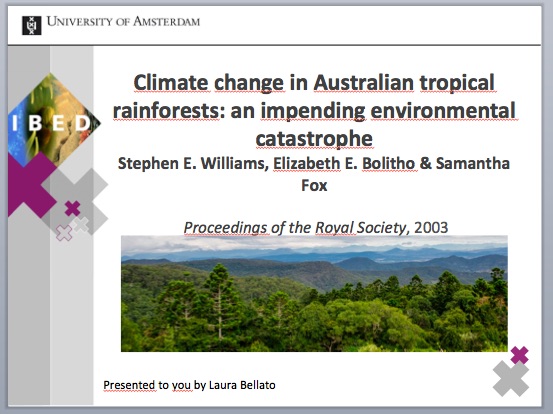
In the first week of the course the students had to present their ‘favourite’ paper in just three (3) minutes! Quite a challenge and lots of fun. This years selection of papers themed around:

  • mega-fauna extinctions (Bakker et al., 2016; Gill et al., 2009; van der Kaars et al., 2017),
  • impacts of human land use practices (Bitusik et al., 2018; Carson et al., 2014; Chepstow-Lusty et al., 2009; Gauthier et al., 2010; Tisdall et al., 2018), and
  • climatic drivers of vegetation change (Haug et al., 2001; Tierney et al., 2017; Tudhope et al., 2001).

For full list of papers presented see below.

In the second and third weeks (now ongoing) students get to deconstruct published chronologies and conduct time series analsis of multi-proxy datasets. Data for these excercises is frequently is extracted from databases such as Neotoma, Pangea, NOAA – paleoclimatology datasets database and the Global Charcoal Database – which shows the importance of these open access databases for developing effective research led eductation, as well as pushing forward to frontiers of research.

Environments Through Time is taught in English, delivered by myself (William Gosling), Crystal McMichael and Milan Tunissen van Manen and currently has 31 registered students from MSc Biological Sciences and MSc Earth Sciences degrees.

Full list of papers presented by students on the Environments Through Time course in 2018 Continue Reading


Columbus’ environmental impact in the New World: Land use change in the Yaque River valley, Dominican Republic

August 29, 2018
WDG

Open access:

Hooghiemstra, H., Olijhoek, T., Hoogland, M., Prins, M., van Geel, B., Donders, T., Gosling, W.D. & Hofman, C. (2018) Columbus’ environmental impact in the New World: Land use change in the Yaque River valley, Dominican Republic. The Holocene. Online DOI: 10.1177/0959683618788732

INQUA 2019: The changing tropical landscape

July 26, 2018
WDG

20th Congress of the International Union for Quaternary Research (INQUA)

Abstract submission is now open for INQUA 2019 in Dublin Ireland (25-31 July 2019). Please consider submitting to the special session I am co-organizing on landscape change in the tropics. Submissions welcome from the fields of biogeography, palaeoecology, geomorphology, volcanology, and archaeology. Click here to submit your abstract.TITLE: The changing tropical landscape
ORGANIZERS: William D. Gosling and Crystal N.H. McMichael (University of Amsterdam)

Eighteenth century explorers marveled at the diversity of tropical ecosystems seemingly untouched by human activity. As a result of these observations, the notion of tropical stability, in terms of vegetation and climate, came to underpin theories of evolution, ecology, and biogeography. Gradually, however, it has become apparent that tropical landscapes have changed markedly through time in response to global climate cycles, (a)biotic factors, and human activity. For example, Continue Reading

AFQUA 2018 – day 4

July 17, 2018
WDG

AFQUA: The African Quaternary environments, ecology and humans
2ndInternational Conference and Workshops
14-22 July 2018-07-15 National Museum, Nairobi, Kenya

Day 4

Yesterday (day 3) was excursion day of the AFQUA conference (photos to follow). Day 4 of the meeting was back in the National Museum Nairobi and kicked off with a session on “African archaeological landscapes”. The opening talk reviewed the career of Karl Butzer who coined the term ‘geoarchaeology’ back in the 1970’s when writing about his work integrating geological, archaeological and anthropological information (C.A. Cordova). Two talks then followed highlighting work on Lake Makagadikgadi from the perspective of archaeology and landscapes (D.S.G Thomas) and geochemical fingerprinting of stone tools to determine their source (D.J. Nash).

To take us up to lunch Boris Vanniere and Daniele Colombaroli gave a ‘double header’ plenary talk highlighting the exciting advances in the development of the Global Charcoal Database and how understanding past fire histories in Africa is key to interpreting environmental change. The after lunch session continued the palaeo-fire theme with records from Lake Botswana (C.E. Cordova), Lake Bosumtwi (W.D. Gosling – me), and Madagascar presented (A. Razafimanantsoa); as well as work on the usefulness of the morphometric’s of charcoal in determining the plant of origin (L.Bremond).

In the final session of the day we were back to “Southern Africa” as a theme. Under which banner we were “boggled” by sea-surface and sub-surface temperature reconstructions (M.A. Berke), shown how to extract climate records from Hyrax middens (B.M. Chase) and given insights into the past flora of the Cape Floristic region from fossil pollen records spanning 130,000 years (L.J. Quick).

Columbus’ footprint in Hispaniola

May 30, 2018
WDG

Open access for 50 days with this link: https://authors.elsevier.com/c/1X6ja7tFrJFBkG

Castilla-Beltrán, A., Hooghiemstra, H., Hoogland, M.L.P., Pagán-Jiménez, J., van Geel, B., Field, M.H., Prins, M., Donders, T., Malatesta, E.H., Hung, J.U., McMichael, C.H., Gosling, W.D. & Hofman, C.L. Columbus’ footprint in Hispaniola: a paleoenvironmental record of Indigenous and Colonial impacts on the landscape of the central Cibao Valley, northern Dominican Republic. Anthropocene. DOI: 10.1016/j.ancene.2018.05.003

The impact of people on islands

January 19, 2018
WDG

Since being appointed as an Associate Editor of Vegetation History & Archaeobotany last year I have the pleasure of working on a number of exciting and interesting manuscripts from the tropics. I am particularly delighted that the first of these (Astudillo, 2018) has now been published. I particularly liked this manuscript because of: (i) the close relationship that was shown between the historical and fossil records, and (ii) the clear signal shown from working on a island system. This linkage is something I have been thinking about in my own research on Mauritius recently (Gosling et al., 2017) and is, I believe, particularly valuable to do because it demonstrates the validity of techniques to track human activity when applied in contexts without historical documentation. The impact of people on the Galapagos is shown by Astudillo (2018) from investigation of multiple proxies (charcoal, phytoliths and macrofossils) to build up a comprehensive picture of human impacts on one of the most famous places for biodiversity on Earth. Hopefully this study is just the start of investigations into past human impacts on the Galapagos islands, and I hope that you enjoy reading the manuscript!

Continue Reading

Environments Through Time – weeks 2 & 3

November 19, 2017
WDG

Britte reconfiguring the chronology for Lake Pata

Britte reconfiguring the chronology for Lake Pata

The second and third weeks of the Environments Through Time course at the University of Amsterdam has focused on obtaining practical experience of developing chronologies, analyzing multi-variate data-sets, and conducting time series analysis. The focus of the course has been on Quaternary environmental change, however, the skills learnt can be applied to almost any time-scale so long as you have time control points you want to tie together, and multiple things you can track changing through that time.

Over the two week period the students worked on a previously published paper that they had selected that contains: (i) chronological information (at least 3 control points), and (ii) multiple variables that change through the time series (at least 9 variables). In week two they deconstructed the chronologies and generated their own revised versions. For example students have (re-)calibrated radiocarbon dates, made different decisions on dates to include/exclude, and used different approaches to constructing the age vs. depth model, e.g. contrasting linear point-to-point vs. Bayesian methodologies. In week three they have taken the data-set(s) associated with their paper and re-evaluated it in light of the revised chronologies using cluster analysis, ordination techniques, and wavelets.

The joy of wavletes

The joy of wavletes

Through this exercise students have gained experience of how to critically assess scientific literature and gained an appreciation of where re-analysis of data-sets can (and cannot) make a difference. Personally I have be delighted with the high level of engagement and enthusiasm for the material and have been excited to have a chance to delve into literature that I would not otherwise be aware of.

For more information on this course see: Environments Through Time – week 1


More on “Persistent effects of pre-Columbian plant domestication on Amazonian forest composition”

October 20, 2017
WDG

Crytsal McMichael (University of Amsterdam)

Discussion on human impacts on Amazonian forest…

McMichael, C.H., Feeley, K.J., Dick, C.W., Piperno, D.R. & Bush, M.B. (2017) Comment on “Persistent effects of pre-Columbian plant domestication on Amazonian forest composition”. Science 358. DOI: 10.1126/science.aan8347

Junqueira, A.B., Levis, C., Bongers, F., Peña-Claros, M., Clement, C.R., Costa, F. & ter Steege, H. (2017) Response to Comment on “Persistent effects of pre-Columbian plant domestication on Amazonian forest composition”. Science 358. DOI: 10.1126/science.aan8837

Exploring ancient cesspits in Deventer (Netherlands)

June 26, 2017
WDG

Jippe Kreuning

University of Amsterdam MSc Biological Sciences student Jippe Kreuning investigated the contents of cesspits in the Dutch city of Deventer for his research project. Jippe investigated fossil pollen, seeds and other biological remains to discover what people in the ancient city were eating. In doing so Jippe gained new insights into ancient trade routes.

To find out more about Jippe’s project watch his video courtesy of FOLIA YouTube channel (in Dutch)

Jippe Kreunings zoektocht naar versteende poep

Blog at WordPress.com.