Gosling, W.D., Cornelissen, H. & McMichael, C.N.H. (2019) Reconstructing past fire temperatures from ancient charcoal material. Palaeogeography, Palaeoclimatology, Palaeoecology520, 128-137. DOI: 10.1016/j.palaeo.2019.01.029
Hooghiemstra, H., Olijhoek, T., Hoogland, M., Prins, M., van Geel, B., Donders, T., Gosling, W.D. & Hofman, C. (2018) Columbus’ environmental impact in the New World: Land use change in the Yaque River valley, Dominican Republic. The Holocene. Online DOI: 10.1177/0959683618788732
The montane cloud forests of South America are some of the most biodiverse habitats in the world, whilst also being especially vulnerable to climate change and human disturbance.
Today much of this landscape has been transformed into a mosaic of secondary forest and agricultural fields. This thesis uses palaeoecological proxies (pollen, non-pollen palynomorphs, charcoal, organic content) to interpret ecosystem dynamics during the late Quaternary, unravelling the vegetation history of the landscape and the relationship between people and the montane cloud forest of the eastern Andean flank of Ecuador. Two new sedimentary records are examined from the montane forest adjacent to the Río Cosanga (Vinillos) and in the Quijos Valley (Huila). These sites characterise the natural dynamics of a pre-human arrival montane forest and reveal how vegetation responded during historical changes in local human populations.
Non-pollen palynomorphs (NPPs) are employed in a novel approach to analyse a forest cover gradient across these sites. The analysis identifies a distinctive NPP assemblage connected to low forest cover and increased regional burning. Investigation into the late Pleistocene Vinillos sediments show volcanic activity to be the primary landscape-scale driver of ecosystem dynamics prior to human arrival, influencing montane forest populations but having little effect on vegetation composition.
Lake sediments at Huila from the last 700 years indicate the presence of pre-Hispanic peoples, managing and cultivating an open landscape. The subsequent colonization of the region by Europeans in the late 1500’s decimated the indigenous population, leading to the abandonment of the region in conjunction with an expansion in forest cover ca. 1588 CE. After approximately 130 years of vegetation recovery, montane cloud forest reached a stage of structural maturity comparable to that seen in the pre-human arrival forest. The following 100 years (1718-1822 CE) of low human population and minimal human impact in the region is proposed as a shifted ecological baseline for future restoration and conservation goals. This ‘cultural ecological baseline’ features a landscape that retains many of the ecosystem service provided by a pristine montane forest, while retaining the cultural history of its indigenous people within the vegetation. Continue Reading
The final day of talks at AFQUA 2018 took a more applied approach in the first session “Applying the Quaternary: The role of the past in supporting the future”. This session focused on how we can focus Quaternary science to produce outputs that directly meet concerns and needs of society. Examples included the quantification of the fossil charcoal record to provide insights into the nature and impact of fires in the past (C. Adolf), how we can use information on past vegetation change and disturbance factors to anticipate how ecosystems on Madagascar might respond to future changes (E. Razanatsoa), and how climate histories can be extended through tree ring data (D. Colombaroli).
Yesterday (day 3) was excursion day of the AFQUA conference (photos to follow). Day 4 of the meeting was back in the National Museum Nairobi and kicked off with a session on “African archaeological landscapes”. The opening talk reviewed the career of Karl Butzer who coined the term ‘geoarchaeology’ back in the 1970’s when writing about his work integrating geological, archaeological and anthropological information (C.A. Cordova). Two talks then followed highlighting work on Lake Makagadikgadi from the perspective of archaeology and landscapes (D.S.G Thomas) and geochemical fingerprinting of stone tools to determine their source (D.J. Nash).
To take us up to lunch Boris Vanniere and Daniele Colombaroli gave a ‘double header’ plenary talk highlighting the exciting advances in the development of the Global Charcoal Database and how understanding past fire histories in Africa is key to interpreting environmental change. The after lunch session continued the palaeo-fire theme with records from Lake Botswana (C.E. Cordova), Lake Bosumtwi (W.D. Gosling – me), and Madagascar presented (A. Razafimanantsoa); as well as work on the usefulness of the morphometric’s of charcoal in determining the plant of origin (L.Bremond).
In the final session of the day we were back to “Southern Africa” as a theme. Under which banner we were “boggled” by sea-surface and sub-surface temperature reconstructions (M.A. Berke), shown how to extract climate records from Hyrax middens (B.M. Chase) and given insights into the past flora of the Cape Floristic region from fossil pollen records spanning 130,000 years (L.J. Quick).
Castilla-Beltrán, A., Hooghiemstra, H., Hoogland, M.L.P., Pagán-Jiménez, J., van Geel, B., Field, M.H., Prins, M., Donders, T., Malatesta, E.H., Hung, J.U., McMichael, C.H., Gosling, W.D. & Hofman, C.L. Columbus’ footprint in Hispaniola: a paleoenvironmental record of Indigenous and Colonial impacts on the landscape of the central Cibao Valley, northern Dominican Republic. Anthropocene. DOI: 10.1016/j.ancene.2018.05.003
For those of you I have not had the pleasure of meeting yet, please allow me to introduce myself. My name is Yoshi Maezumi. I have recently been awarded a Marie Curie Fellowship for my research proposal FIRE: Fire Intensity in Rainforest Ecotones. I will have the honor of working with an extraordinary team of international, interdisciplinary researchers including Will Gosling, Crystal McMichael, Emiel van Loon, and Boris Jansen from the University of Amsterdam, Boris Vannière from the Université de Franche-Comté, Jose Iriarte from the University of Exeter, and Francisco Cruz from the University of São Paulo. Together we will examine the long-term role of fire in shaping Amazon Rainforest Ecotones.
My research is focused on paleofire (fire in the past) in Neotropical savanna and rainforest ecosystems. My current post-doctoral research at the University of Exeter is investigating the role indigenous fire management practices had on shaping the composition, structure, and flammability of modern Amazonian rainforests.
Recently introduced to a book by Bill Gammage entitled The Biggest Estate on Earth: How the Aborigines Made Australia. Gammage identifies five uses of indigenous fire: 1) to control wildfire fuel; 2) to maintain diversity; 3) to balance species; 4) to ensure abundance; 5) to locate resources conveniently and predictably. Gammage argues that our current regime is struggling with number one. These stages of fire management provide some really interesting food for thought for my Marie Curie Fellowship as I aim to develop new paleoecological techniques to analyze paleofire that will be used to model natural and anthropogenic drivers of paleofire activity.
I have been thinking a lot about what we do and do not know about paleofire. One of the ways we reconstruct past fire activity is through the use of charcoal preserved in lake sediments. Charcoal can tell us a lot about what past fires were like including what kind of plants were burning, how often fires occurred, and potentially how big a fire was. One of the more elusive components is paleofire intensity, or how hot a particular fire was. The temperature of a fire has important ecological implications, as hotter fires tend to cause more ecological damage. Lots of factors can contribute to fire intensity including droughts, fuel loads, vegetation composition and structure, fuel moisture, etc. All of this is to say that, fire intensity is complicated. Nevertheless, one of the main objectives of my Marie Curie research will be to compile what we currently know about the effect of modern fire intensity on the charcoal formation to figure out how that information can be used to interpret charcoal from the palaeorecord.
If you would like to join me on this ‘intense’ paleofire journey, (punny, I know, I just couldn’t resist), I am starting a weekly science blog called Her Science that will highlight the trials, tribulations, and triumphs of my Marie Curie research over the next few years.
My name is Nina Witteveen and I’m doing a research project for my master (Biological Science) with Crystal McMichael and William Gosling. I’m analyzing phytoliths to reconstruct the vegetation changes of Campo Libre (Napo, Ecuador) of the past 30,000 years. It is so exciting to count phytoliths of such an old age!
Simon Scholz is currently doing a charcoal analysis and two years ago, Maaike Zwier performed a physical analysis in the sediment. With all these results combined, I will investigate how climate changes and human influence have changed the vegetation of Campo Libre. Hopefully this research will give more insight into the effect of a changing climate on this biodiversity hotspot!
I’ve completed my thesis for the Biology bachelor at the UvA under the supervision of Crystal and Will. Together with other students we performed phytoliths, pollen and charcoal analysis from sediment of Well-Aaijen (Limburg, the Netherlands). More specifically, I’ve looked at the vegetational changes during the transition from hunter-gatherers to farmers through pollen and phytolith analysis. I’m very happy to be working with Crystal and Will again, this time in a more tropical setting!
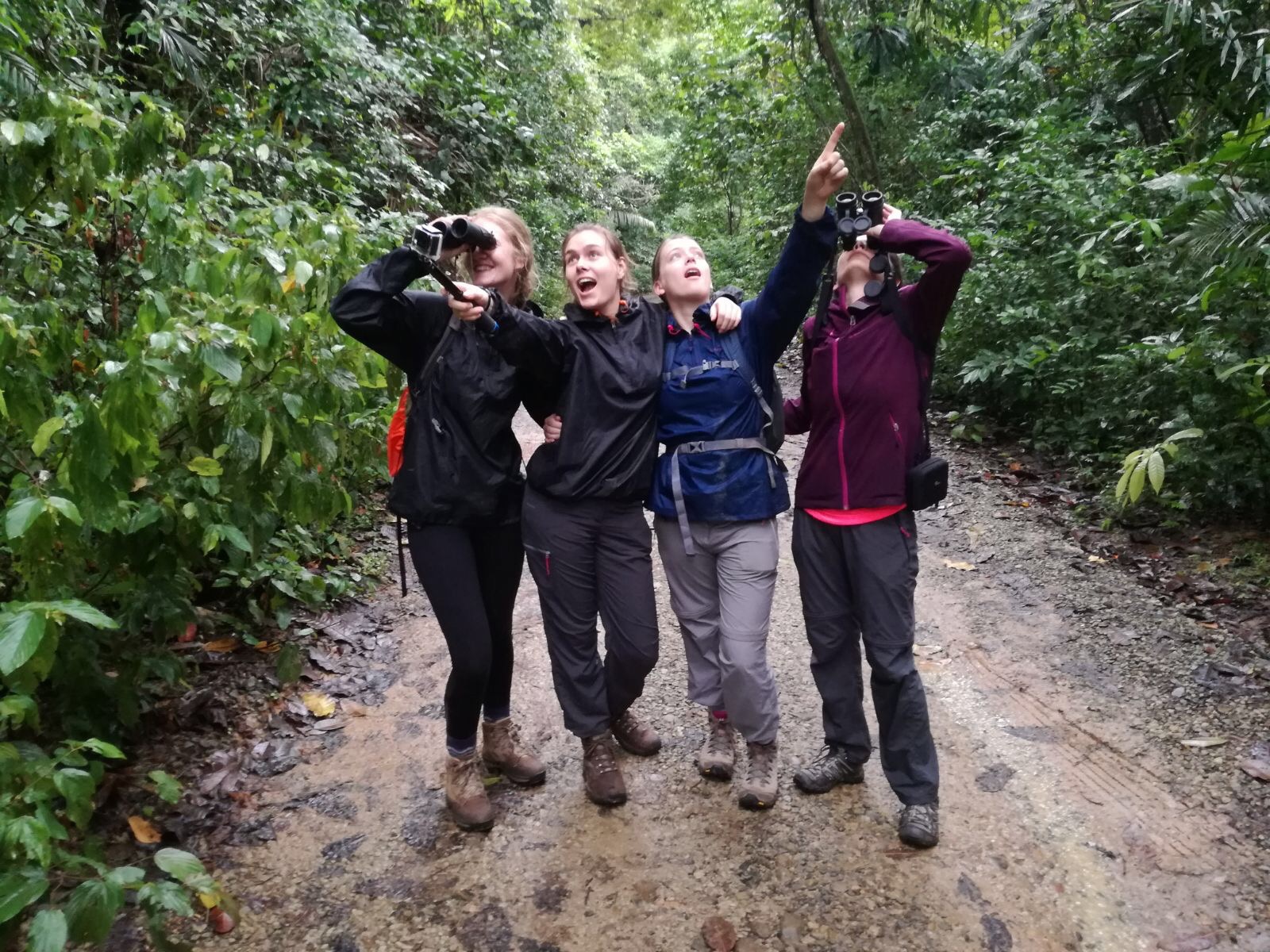
In January of this year, I travelled to Panama with Veerle Vink, Britte Heijink and Crystal McMichael. It was a great experience! Surrounded by Howler Monkeys, we made our way through streams and Geonoma palms to collect soil surface samples for future phytolith analysis. Definitely a highlight of my fieldwork so far! I am now back in the microscope lab, and always up for a (paleo)chat 🙂
Valencia, B.G., Bush, M.B., Coe, A.L., Elizabeth, O. & Gosling, W.D. (2018) Polylepis woodland dynamics during the last 20,000 years. Journal of Biogeography online. DOI: 10.1111/jbi.13209
 Gosling, W.D., Cornelissen, H. & McMichael, C.N.H. (2019) Reconstructing past fire temperatures from ancient charcoal material. Palaeogeography, Palaeoclimatology, Palaeoecology 520, 128-137. DOI: 10.1016/j.palaeo.2019.01.029





 Ecology of the past