The call for sessions for the next edition of the Society for Tropical Ecology’s, European Conference of Tropical Ecology is open until 8 July 2025. The meeting will be held in Passau (Germany) and will cover all aspects of tropical ecological research. To make sure that your interests are well represented submit a session idea now by visiting the conference web site: https://gtoe2026-passau.de/
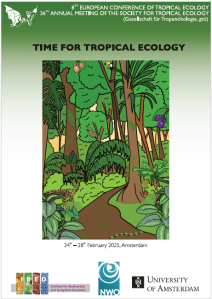
36th Annual Meeting of the Society for Tropical Ecology
24-28 February 2025, Amsterdam
The 8th European Conference of Tropical Ecology took place in Amsterdam (The Netherlands) from 24 to 28 February 2025. This meeting was organized for the Society for Tropical Ecology. The event was hosted by the Institute for Biodiversity & Ecosystem Dynamics (University of Amsterdam), held at Hotel Casa, and the main sponsor was the NWO (Dutch Science Foundation).
During the conference around 250 scientists delivered 150 oral and 69 poster presentations. The science spanned the full breadth of tropical ecology, ranging from interactions of coral dwelling crabs, through carbon cycling dynamics in forests, to the governance of hunting activity. The six keynote speakers were paired under three topics “Human legacies in the tropics”, “Tropical ecosystem dynamics”, and “Protecting tropical ecosystems”. Within each topic we invited a senior scientist and a ‘rising star’ to provide their perspective on a particularly hot-button issue. If you want to find out more about what was presented all the abstracts are now published, open access, in the Society for Tropical Ecology’s journal Ecotropica.
Open access: Gosling, W.D. & McMichael, C.N.H., eds. (2025) Time for tropical ecology: Abstracts of the 8th European Conference of Tropical Ecology, Amsterdam, The Netherlands; 24.-28.2.2025. The Society for Tropical Ecology, Ecotropica, 26 (1-2): 1-222. https://doi.org/10.30427/ECOTROP202501
The European Conference of Tropical Ecology will take place in Amsterdam between 24 and 28 February 2025. The call for session ideas is currently open (deadline 19 August). So please visit the conference web pages to find out more and submit your idea that will help shape the program and make this conference a success.
To find out how to submit your session idea click here.
As part of my MSc Biological Sciences (University of Amsterdam) research project entitled “Assessing the effect of human induced fire regime changes on vegetation in the Drakensberg mountains” (for further details click to see previous post). I’ve travelled to Africa, where I’ll be staying a month. During this mini blogpost series I’ll take you with me on my travels!
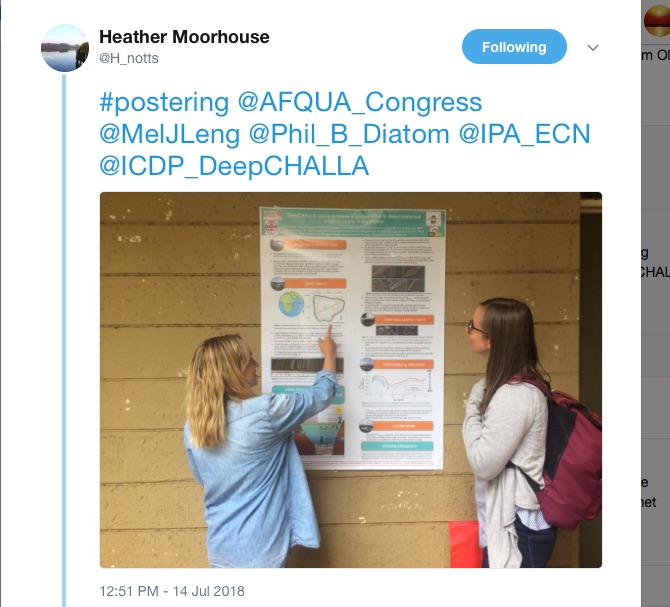
During the first poster session, I presented my poster which went into detail on how we are developing a proxy to reconstruct past fire using micro-Fourier Transformed Infrared Spectroscopy (µFTIR). These reconstructed fire temperatures can then be compared with phytolith or pollen data to assess the effects of different fire temperatures on local vegetation over time. The presentation and poster were well received!
After my poster presentation there were two more congress days which were filled with interesting talks and beautiful posters.
The second part of the Mapping Ancient Africa session at the INQUA Rome congress contained eight talks. Busisiwe Hlophe (University of the Witwatersrand) kicked us off by showing us the power of looking at wood anatomy preserved in charcoal microfossils to determine the nature of past vegetation and climate. RahabKinyanjui (National Museums of Kenya) presented phytolith work from archaeological sites revealing a mixed woody and grassy vegetation associated with archaic Homo sapiens in Kenya.
Three talks from the Cape Region in South Africa then followed with Saul Manzano (University of Leon), StellaMoscher (University of Utah), and Asithandile Ntsondwa (Nelson Mandela University) using various palaeo ecological approaches to explore climate, vegetation and fire regime shifts during the Holocene. Adele Julier (University of Portsmouth) then took us a little further north to Namibia to think about the challenges of parameterising modern pollen-vegetation relationships in arid regions. The final southern African talk was given by Gemma Poretti (University of Cape Town) explored a new approache to tracking change in past rainfall patterns using charcoal material.
On Wednesday 19 July 2023 the Mapping Ancient Africa session of the INQUA Rome congress took place. We were delighted to have an full program of speakers despite some late cancellations. The first session featured seven speakers.
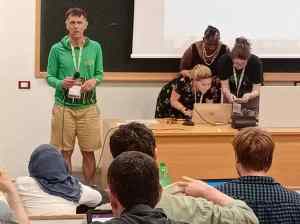
No panic as we set up for session 1…
The first two talks focused on southern Africa. The first talk by Liviu Giosan (Woodshole Oceanographic Institute) focused on new sediment cores extracted from the Okavango – Makgadikgadi region and new efforts to obtain sediment cores that can provide information on the dispersal of hominins. Brian Chase (CNRS) then looks us to the Karoo highlighting recent findings that suggest that this currently arid region was more habitable in the past and that a proliferation of stone tools suggests past peoples utilised the region extensively (Carr et al., 2023).
The Netherlands Annual Ecology Meeting (NAEM) 2019 takes place in the 12 and 13 February. This annual showcase of predominantly Dutch based ecological research will take place, as usual, at Conference Centre “De Werelt” (Lunteren). I am particularly excited this year as, along with Marielos Pena Carlos and Patrick Jansen, I am co-convening a session on “Tropical Ecology”. The first time I have contributed to the program in this way. Our session will be on the second day of the conference and contain the following exciting presentations:
15:00 Predator avoidance and prey tracking in a Neotropical forest (Constant Swinkels, Wageningen University & Research)
15:20 The role of fig volatiles in pollinator specificity and fig diversity (Aafke Oldenbeuving, Naturalis Biodiversity Center)
15:40 Mangrove Atlantis: Can mangroves keep up with extreme land-subsidence? (Celine van Bijsterveldt, Royal Netherlands Institute for Sea Research)
16:00 Break
16:10 The fate of forests in agro-forest frontier landscapes, implications for conservation (Madelon Lohbeck, Wageningen University & Research)
16:30 Trends in the variability of Specific Leaf Area of paramo vegetation during succession (Marian Cabrera, University of Amsterdam)
16:50 Succession dynamics of tree and soil fungal communities in regenerating tropical rainforests are strongly influenced by regional species pool and abiotic factors (Irene Adamo, Naturalis Biodiversity Center)
My first AFQUA conference really began the day before the conference proper started in the Kenyan immigration queue where I met a number of fellow delegates who were flying in from all over the world. It was great to start to put faces to names of people who’s work I had read for many years. Once out of the airport transfer to the hotel was smooth, and it was with some excitement that the following morning I made the short walk from the hotel to the famous Nairobi National Museum for the start of the conference.
Day 1
Prof. Andy Cohen (one of my fellow delegates in the immigration line) kicked off the AFQUA conference with a plenary giving an overview of African continental drilling projects. He traced the dream of the recovery of long continental records back to Daniel Livingstone and Neil Opdyke’s workshop from 1980 that set out the dream of obtaining long records from the continent. He then went on to give examples of how multi-millennial lake records, including Lake Malawi, can be used to understand the tempo of ecological change.
The first session of the conference, entitled “East Africa”, included: exciting evidence of Deinotherium the largest land mammal of the Quaternary (J.-P. Brugal), the use of d13C in determining homonin ecology (V.M. Iminjili), and evidence from a new c. 200,000 year old site at Natodomeri (Kenya) that contains evidence of homonids, elephids, giant lions and pigmy hippos (F.K. Manthi).
The second session of AFQUA covered “The environmental context for homonin evolution and dispersal”. This started with geochemical data from Chew Bahir that sheds light on potential drivers of climatic shifts (F. Schabitz), and included examination of changes climate between c. 500,000 and 320,000 years ago that coincided with the shift from hominid use of large cutting tools to smaller implements (R. Potts), and discussion of the environment the route which hominids took out of Africa (F. Henselowsky).
“Global distribution patterns of mycheterotrophic plants”. The research of Sofia Gomes (Naturalis Biodiversity Centre) is captured by Milan Teunissen van Manen (@MilanaTvM).
Ancient human disturbances may be skewing our understanding of Amazonian ecology. The research of Crystal McMIchael (University of Amsterdam) is captured by Judith Westveer (@water_science).
Today the Dutch ecological community has convened at the Netherlands Annual Ecology Meeting (NEAM) in the forest near Lunteren. The meeting was kicked off by plenary lectures by Trisha Atwood and Han Olff who talked to the theme of “Ecosystem functioning in a changing world”. Trisha highlighted the importance of animals in modifying plant communities and their consequent importance for understanding changes in carbon storage. Han illustrated the complexity of ecological networks and posed the significant challenge of understanding changes in competing networks. Following the plenaries I chose two sessions to follow. The first on “Plant Ecology” and the second on “Ecosystem Resilience”. There were many exciting talks in both sessions, two of which grabbed my attention. Mara Baudena (Utrecht University) highlighted the complexity of modelling forest-grassland interactions in Africa, while Sofia Gomes (Naturalis Biodiversity Centre) showed surprising (to me) variation in mychorizal fungi across the globe.Furthermore four talks were presented by researchs at my home, the Institute for Biodiversity & Ecosystem Dynamics (University of Amsterdam):
Crystal McMichael“Ancient human disturbances may be skewing our understanding of Amazonian ecology”
Milan Teunissen van Manan“Species specific responses in leaf wax n-alkane composition from six tropical tree species”
Kenneth Rijsdijk“Assessing the resiliance of insular species to past climate change”
Seringe Huisman“Characterization of phytoliths in premontance western Amazonian forests”
So an exciting day, now for food and beer, and back on it tomorrow! Follow live on Twitter #NAEM2018












 Ecology of the past