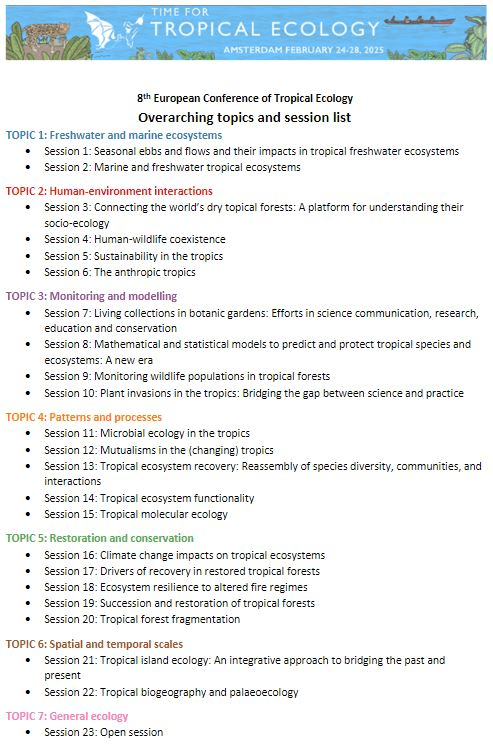
The European Conference of Tropical Ecology will take place in Amsterdam between 24 and 28 February 2025. The event will be centered around thematic oral and poster sessions. There are twenty-three different thematic sessions organized into seven broad topics:
In this article I summarize and describe the scientific research that was performed near Botopasi in Suriname, which was published in Ecology as ‘Pre-contact and post-colonial ecological legacies shape Surinamese rainforests’ (https://doi.org/10.1002/ecy.4272).
Figure 1: Our research team in the field
Background
In October 2021, between COVID-19 restrictions, I joined archaeologist dr. Cheryl White and her team to excavate the remnants of a ‘lost village’ of Saamaka Maroons in the Surinamese rainforest. Maroons are the descendants of enslaved Africans, who, in the late 1600s, fled plantations to live in freedom in the Surinamese rainforests. Dr. White has been investigating the first villages and the movements of Suriname’s Maroon communities for decades and is an expert in this topic.
Our wonderful research team consisted of Farisha Kartosemito B.Sc., Sushmeeta Ganesh B.Sc., Jõvan Samson B.Sc., Agir Axwijk B.Sc., Santosh Singh M.A., Thanya Fonkel MPA, Harrold Sijlbing, Dombi Lö, Gerno Eduards & Farik Eduards. We were welcomed in the village Botopasi, and after a day of hard work in the field, we enjoyed delicious Surinamese food and played troefcall!
As an ecologist, I was interested in the ecological effects of past human activities on the forest ecosystem. In these rainforests, Maroon and Indigenous communities often burn and remove trees near their homes to grow a variety of crops like cassava, tayer, maize and banana. After some years, the cultivation site is abandoned and forests can grow back. But do those forests recover back to their original state?
What did the forest look like before people arrived and settled in the landscape of Boven Suriname?
To study how Maroon communities have shaped Surinamese forests over time, I made a reconstruction of the landscape of the past (going back thousands of years). The landscape was near an archaeological sites called ‘Beng Tau’, where Maroons lived in the 17th century. We used plant fossils and charcoal remains to reconstruct the forest from the past, to research if people were using fire and growing crops, and how the forests recovered from that.
Results and implications
Figure 2: Phytoliths from the banana plant
The charcoal remains and plant fossils, particularly from maize and banana, confirmed Saamaka Maroons settled in the area since ca. 1700 and practiced slash-and-burn agriculture was near the archaeological site called ‘Beng Tapu’ (Figure 2). The site may have been a cooking area, because remnants of pottery with maize, rice and banana were found. Within 1 km of Beng Tapu, we found large fragments of charcoal, and plant fossils from maize and banana. Smaller charcoal fragments and banana were found within 5 km of the archaeological site. Nowadays, agriculture is practiced within 8 km of the archaeological site and Suriname river. The area used for agriculture likely expanded over time.
How did the forest recover from these activities?
Within 1 km of the archaeological site, forests were burnt and used multiple times. Here, forests have a lower biomass than further away from Beng Tapu, meaning fewer or smaller trees have grown back. Also, Attalea and Oenocarpus palm trees increased. Still today, the Saamaka Maroon community uses the maripa palm to make oil. Therefore, the number of maripa palms may have increased due to human activities like cooking and oil production! Attalea and Oenocarpus palms are also adapted to open conditions and fire, showing the influence people had on the environment and how the forest responded to fires.
Further (2-7 km) away from the archaeological site, where disturbances were fewer, the forests recovered much better but Astrocaryum palms grew back in higher numbers in the understory of the forests. What makes these palms so resilient? We are still uncertain. The forests furthest away (>8km) from Beng Tapu showed little signs of disturbances.
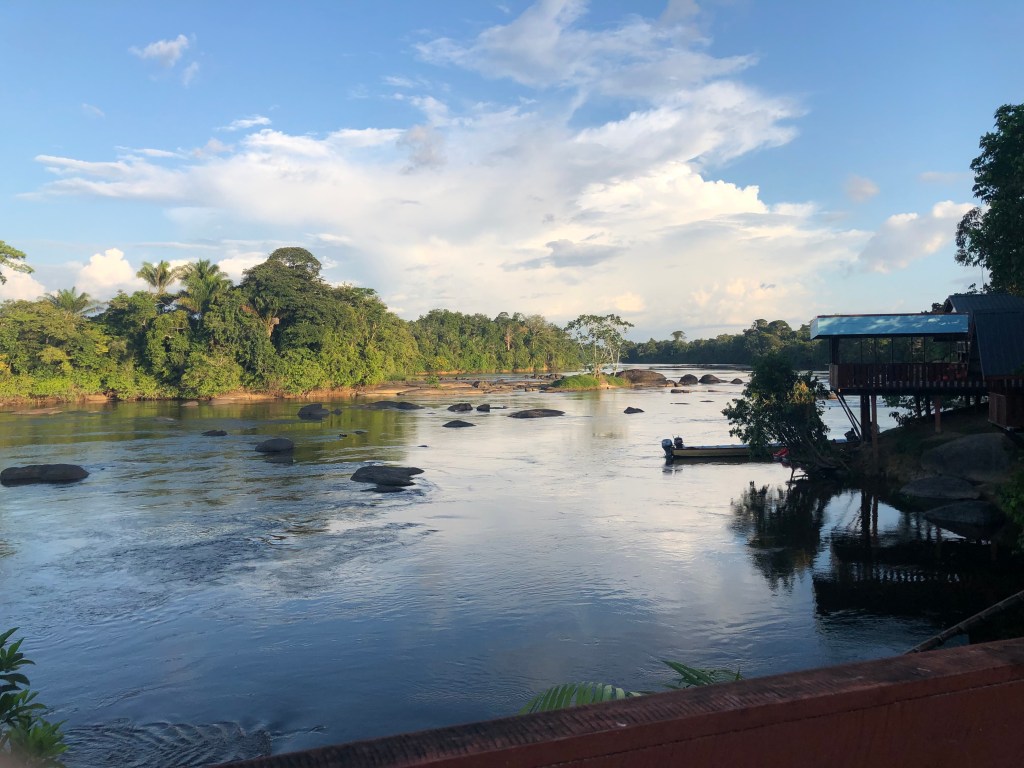
Figure 3: View from the Suriname River
A long human history, and an Indigenous archaeological site?
The Saamaka Maroons were not the first people to have inhabited the forests near Botopasi. Charcoal fragments show that people were in region (the ca. 20 km radius we studied) already 2000 years ago, and fire events occurred ca. 2000, 1700,1500, 1300, 1200 and 800 years ago. We don’t know which Indigenous Cultures may have inhabited this region, because of limited archaeological and historical research here. Large charcoal fragments were found ca. 7 km away from Beng Tapu, across the Suriname River. Could this be an Indigenous archaeological site?
Conclusion
Our results show the timing, intensity and frequency of past disturbances are very important for good forest recovery and some disturbances from the past can still impact the modern vegetation.
Unravelling the past not only tells us about the ancestors of Maroons and the lives of Indigenous communities before the 1500s. The past also helps us to understand how forests respond to human impacts. To better guide conservation strategies, we need to do more archaeological and ecological research in Surinamese rainforests.
Next to the Suriname River, past human activities shaped the forest andincreased local palm abundances. The broader forested region showed a healthy recovery. These results indicate that the Saamaka Maroon community preserved most of the forests they inhabited since the 1700s. We can learn from traditional knowledge about which management practices are sustainable to keep forests healthy.
If you want to know more about the “hows” of this research…dive with me into the methodology!
During the delivery of this years BSc Palaeoeclogy course at the University of Amsterdam (UvA) I discussed with a number of students about the nature and purpose of understanding the ecology of the past. This lead me to highlighting the research of Nick Loughlin (@PalaeoNick) from his PhD at The Open University and the subsequent work that he has done. I though it might be interesting to also share this here…
Nick Loughlin during his PhD field work in Ecuador
Nick’s study sought to understand better the ecological history of the biodiverse eastern Andean flank in Ecuador. To achieve this he went into the field and recovered sediments from a lake and a sedimentary section exposed by a road cutting. He analysed the sediments to reveal vegetation change (pollen analysis), fire histories (charcoal analysis), and past animals in the landscape (non-pollen palynomorphs, or NPPs). To extract extra ecological information from his samples he developed the methodological approach for examining NPPs in a tropical setting (Loughlin et al. 2018a). He then combined all the different palaeoecological approaches to reveal the drivers of vegetation change during the last glacial period (in the absence of humans; Loughlin et al. 2018b), and during the last 1000 years (when indigenous and European human populations radically altered the landscape; Loughlin et al. 2018c). The insights gained from Nicks research provided empirical evidence of how humans have been modifying this biodiversity hotspot on the timescales relevant to the lifecycles of tropical trees. These findings and ideas were collated in his PhD Thesis at The Open University which was supervised by Encarni Montoya, Angela Coe and myself (Loughlin, 2018a). Subsequently, Nick has been working to broaden the impact of his work and to communicate his findings to the broader scientific and conservation community. This has lead to two new publications focused on understanding baseline ecological function and conservation implications (Loughlin et al. 2022, Nogué et al. 2022).
Evidence of past ecological change recovered from Lake Huila (Ecuador) revealed how past peoples had modified the landscape of the eastern Andean biodiversity hotspot.
The arch of research carried out by Nick, I think, really demonstrates the important of understanding the ecology of the past – without his detailed investigation of microfossils we could not have seen the impacts of indigenous communities on the past Andean landscape, or identify the consequences of the European depopulation; or been able to estimate the timescales of the ecological change!
Week 1 (last week) we got everyone up to speed with the fundamentals of palaeoecology (including: key principles, depositional environments, dating methods) and laboratory skills (pollen, phytolith and macrofossil identification). This week (week 2) we are out and about (coring sediments, surveying vegetation and visiting the archaeology department). By the end of the week the students will (should!?) have generated sufficient data in the laboratory and field to be able to identify the location from which their mini-project “mystery slides” were taken. Next week (week 3) will be number crunching to generate the statistical support for their ideas and inferences.
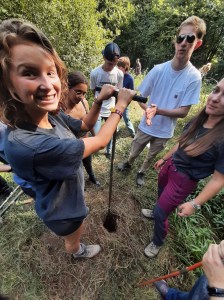
Students collecting sediments using a Russian corer at Langenboom (September, 2022). These samples were recovered in collaboration with the BosGroep Zuid Nederland as part of an ongoing project to gain new insights into the nature of the past landscape in the Netherlands and aid conservation efforts.
The festive period blog post related to the recent volume of Palaeoecology of Africa (published entirely open access online) picks out the four Perspective articles. We included Perspective articles within the volume to place the volume in context and showcase some topical ideas, with the overall objective of stimulating further debate on past environmental change in Africa.
The opening two papers of the volume are both Perspectives. Louis Scott opens the volume with a short history of the Palaeoecology of Africa series. He sketches out the rich and varied history of the publication which, commenced in 1966 as a collection of eight reports (van Zinerden Bakker 1966), includes seven conference proceedings, and has been edited at various times by Eduard Meine van Zinerden Bakker, Joey Coetzee, Klaus Heine and currently Jürgen Runge. The second article, Lézine et al., tracks the rise and revival of the “African Pollen Database” (APD) from its formation in 1996, through to its decline in 2007, and up to its re-initiation in 2019 from which this volume of PoA has sprung. Personally, I think the huge enthusiasm shown to participate in this volume and to contributing to collaborative initiatives like the APD, demonstrate the strength of the field and can only bode well for future research.
The other two Perspective papers showcase nicely some of the motivation behind the enthusiasm for palaeoecological research. Lynne Quick focuses in on the hyper-diverse Cape Floristic Region of southern Africa and what records of past vegetation and climate change can tell us to reveal these origins and assist in the conservation and management of this ecological wonder today. The final perspective, by Lindsey Gillson, rounds off the volume by thinking more broadly about how palaeoecological research can be utilised in the development of conservation policy in Africa. She focuses particularly on how these records can provide insights into drivers of change in the past (climate, fire, and herbivory) and how this can then be used to guide conservation and enrich our understanding how the landscape we see in Africa today came to be.
To find out more download all the articles for free:
As a palaeoecologist and biogeographer I am delighted to have become a Subject Editor for Plant Ecology & Diversity (PE&D). In my new role for the journal I hope to handle a broad range of articles within my area “Global Change & Vegetation Dynamics: Past, Present & Future”. As Subject Editor, as well as organizing general submissions, I would also like to promote a range of articles focused on scientific themes that build upon key publications.
The first of these themes will be “long-termecology” and will build upon the recent ‘monster’ Grubb Review written by John Birks (Birks, 2019). The Birks manuscript covers a vast range of topics centred on the contribution of Quaternary botany to understanding modern ecology and biogeography. Topics covered within the Birks manuscript include:
Vegetation range shifts
Extinction events
Human impacts on ecosystems
Biodiversity trends
Conservation
I plan to pull together the “long-term ecology” set of manuscripts for PE&D during 2020, and contributions are welcome on any of the issues and research areas highlighted in the Birks manuscript.
14:10-14:30: Characterization of phytoliths in mid-elevation Andean forestsSeringe Huisman (University of Amsterdam/Treub grant awardee)
14:30 –14:50: Extinction-driven changes in frugivore communities on tropical islands: worldwide and in MauritiusJulia Heinen (University of Copenhagen, Denmark)
14:50 – 15:10: Are the current Amazonian fires unprecedented?Crystal N.H. McMichael (University of Amsterdam)
15:10 – 15:30: On the relationship between tiger conservation and water managementJasper Griffioen, Hanne Berghuis & Ewa van Kooten (Utrecht University)
15:30-16:00: TEA
16:00 – 16:45: Assembling the diverse rain forest flora of SE Asia by evaluating the fossil and molecular record in relation to plate tectonicsRobert J. Morley (Palynova, and Southeast Asia Research Group, Royal Holloway University of London, UK)
The International Conference on Past Plant Diversity, Climate Change, and Mountain Conservation was aimed to address this question, with a focus on mountain (montane) species. As climate warms, there are several outcomes for montane species. They can migrate upslope, go extinct, or adapt to the warming conditions. Given these options, we got together to discuss our most recent datasets, and the best strategies for the conservation of montane species. Effective conservation strategies are crucial for the survival of many rare and endemic montane species, because climate is indeed warming, regardless of what Trump or Fox News tries to tell people.
The Netherlands Annual Ecology Meeting (NAEM) 2019 takes place in the 12 and 13 February. This annual showcase of predominantly Dutch based ecological research will take place, as usual, at Conference Centre “De Werelt” (Lunteren). I am particularly excited this year as, along with Marielos Pena Carlos and Patrick Jansen, I am co-convening a session on “Tropical Ecology”. The first time I have contributed to the program in this way. Our session will be on the second day of the conference and contain the following exciting presentations:
15:00 Predator avoidance and prey tracking in a Neotropical forest (Constant Swinkels, Wageningen University & Research)
15:20 The role of fig volatiles in pollinator specificity and fig diversity (Aafke Oldenbeuving, Naturalis Biodiversity Center)
15:40 Mangrove Atlantis: Can mangroves keep up with extreme land-subsidence? (Celine van Bijsterveldt, Royal Netherlands Institute for Sea Research)
16:00 Break
16:10 The fate of forests in agro-forest frontier landscapes, implications for conservation (Madelon Lohbeck, Wageningen University & Research)
16:30 Trends in the variability of Specific Leaf Area of paramo vegetation during succession (Marian Cabrera, University of Amsterdam)
16:50 Succession dynamics of tree and soil fungal communities in regenerating tropical rainforests are strongly influenced by regional species pool and abiotic factors (Irene Adamo, Naturalis Biodiversity Center)












 Ecology of the past