Nick and Will with Carman (director of the Pindo Mirador biological station)
Three members of the PCRG (William Gosling, Encarni Montoya and Nick Loughlin) visited Ecuador (November-December 2013) to develop collaborations with Ecuadorian institutions, recover more lake sediments, and find new potential sites for projects. Below are some photos from:
Lake Pindo,
Lake Huila, and
Lake Erazo.
Full reports on specific aspects of the fieldwork to follow.
Hello! I’m Adele and I started my PhD about a week ago. It’s been a little intense but I can almost find the lab without a map now, so it is probably time to introduce myself.
I’ll be studying pollen-vegetation relationships in Ghana, as part of the NERC funded project ‘500,000 years of solar irradiance, climate and vegetation changes’. This means I’ll be using pollen traps to figure out how pollen outputs vary between (and sometimes within) different vegetation types in Ghana. I will also be trying my hand at chemotaxonomy and video making. I’m heading out to Ghana (along with Phil Jardine) in just over a week to do my first lot of field work which will involve seeing the plots, collecting existing traps, replacing them with new ones, and setting up some new sites. I’m very excited.
Hayley Keen: “Continual pollen counting, second lot of Argon dating done, and first set of wood macrofossils back and ready for identification!”
Frazer Bird: “At the start of September I began working as a technician as part of Encarni’s project. I am looking at the midges from the core we collected together on our last field trip. Things are going well, although the midges are hard to find in the older sections the preservation in early sequences is great. The resolution of this core looks to be fantastic also so and hopefully we will get some interesting results when we compare all the proxies. Away fromthe lab I presented at INTECOL 2013 in London, The talk seemed to go down well and was noted as highly commended by the judging panel. Great publicity all round for the midges!!!”
Bryan Valencia: Has been on field work in Peru during this time he presented a talk on climate change to the Asociación para la Conservación de la Cuenca Amazónica, and gave interviews to local journalists and two TV stations. He also collected sediments from two locations, and manged to obtain a new US visa. He is now working on the final stages of submitting his thesis.
Phil Jardine: Phil has been busy ordering in microscopes and other equipment for the Lake Bosumtwi project (the first of which arrived today), and setting up the trip to Ghana that he’ll be going on with new PhD student Adele Julier in late October. He’s also been attempting to learn more about geochemistry, which has proved challenging.
Lake Pindo: We have finally the results of 6 samples radiocarbon dated from NRCF through our collaborator Dr Pauline Gulliver, and we have sent 4 more to “range find” the key interval of interests for the FORSENS project. We have started the midges’ analysis although it seems this going to be focused to the upper 4 meters of sediment. We would like to discern possible preservation issues in tropical records for this proxy. Some samples for a preliminary screening looking for diatoms ahve been collected and sent to the new FORSENS collaborator Teresa Vegas-Vilarrúbia. MS samples have been also collected for the first three drives and we hope to run this analysis next month.
Lake Banos: We have started the pollen prep. for the upper section of the record.
Management tasks: We are now ready for the tropical record Lake Marcacocha pollen prep., collaborating with an ongoing project lead by Alex Chepstow-Lusty. On a different topic, I have started the organisation of department seminars, so I would like to highlight if you have any potential speaker, please contact me.
Publications: a co-authorship in a paper published in Perspectives in Plant Ecology, Evolution and Systematics authored by Valentí Rull and his research group in the Botanical Institute of Barcelona is now available on line (click here)
William Gosling: “I have been promoted to Senior Lecturer (hooray),started work on the new level 2 environmental science module, been working on a new paper from the Erazo study site, and had a holiday!”
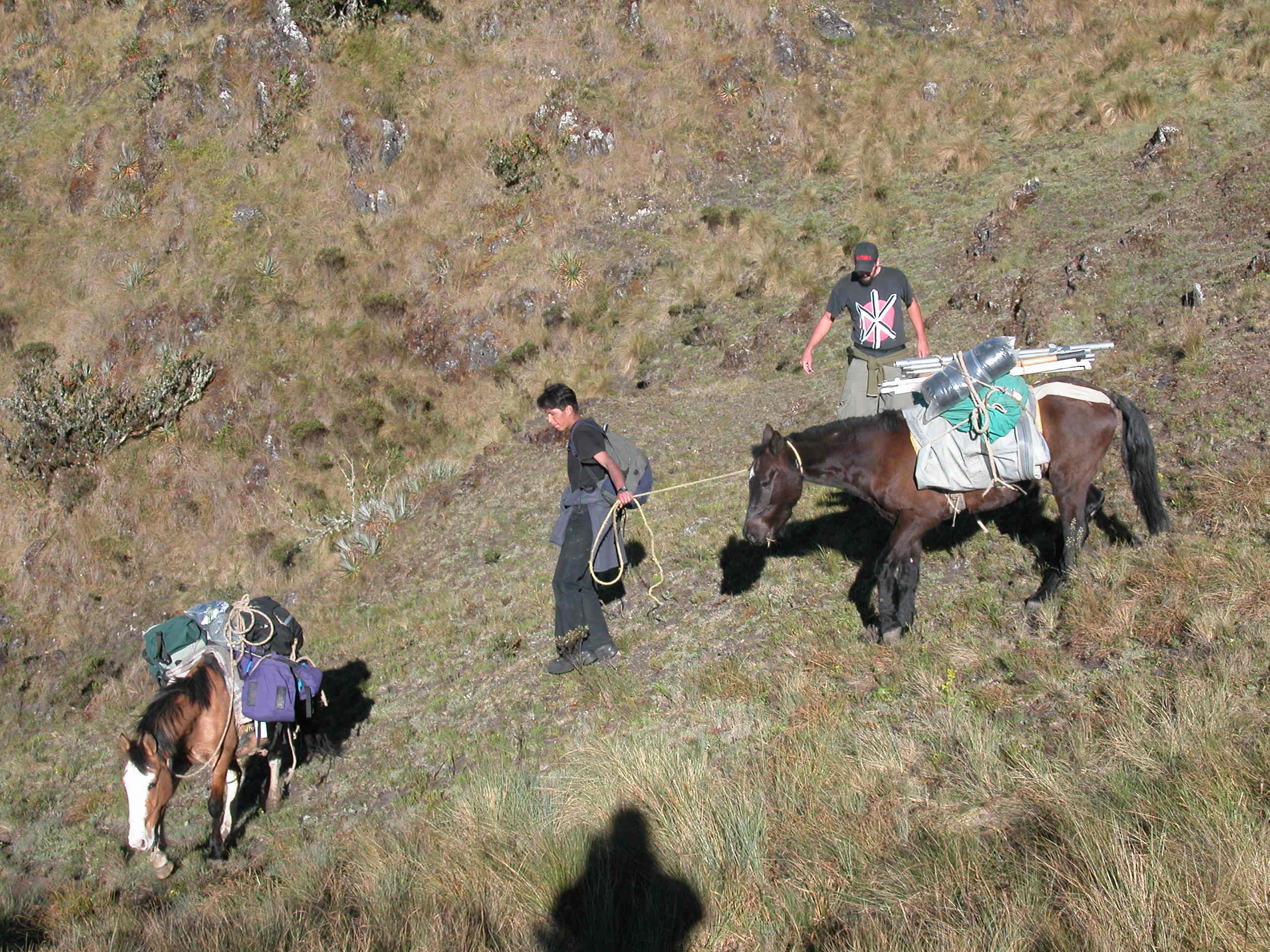
Trecking with sediment corer in the high Andes of Peru
When it comes to collecting sediments from lakes its all about having the right tools for the job. Working in remote areas of the tropics we tend to favour the Colinvaux-Vohnout corer; supplied by Vince Vohnout at Geo-core). The advantages of this system are:
its light-weight nature (can be backpacked or donkeyed into field sites), and
the cam system (which allows hammering to penetrate tough sediments).
Eric Martinez carrying an Avon Redstart back out from Laguna Khomer Kotcha (Williams et al., 2011a)
With the right platform (two banana boats and an A-frame) we have manged to retrive c. 20 m of sediment from 20 m of water (c. 40 m of drill rod extended); Lake Pacucha, Peru (Hillyer et al., 2009). More typically we use two Avon Redstart inflatables and a platform following the design of Colinvaux et al. (1999).
I am glad to say that after almost two months out of the office running around with 8 bags of equipment, Frazer and I have finished our tour of the Americas. As the work has been so diverse, we would like to split our comments and impressions into two different posts, we hope you enjoy them!
The last two months of 2012 were exceptionally busy!
On the research front
Grants took centre stage for much of my time. First writing for the NERC December 1st deadline was pressured as usual, and second response to reviewers comments on the July submission was interesting.
Paper writing proceeded with reviewer and co-author comments on three manuscripts hopefully desitined for Review of Palaeobotany and Palynology (lead by Hayley), Palaeo3 (lead by Macrarena) and The Holocene (with Joe Williams) respectively.
Two tasks dominated the non-research activity: 1) teaching the Geological Record of Environmental Change (S369) exams assessment and assigment, and 2) as Post Graduate Tutor keeping up with NERC developments for the new Doctoral Training Partnerships.
PCRG members on field work in Cayabe-Coca National Park (2012). Left to right: Hayley, Encarni, William and Frazer. Encarni and Frazer have returned to Ecuador Jan-Feb 2013 to collect further sedimentary cores. More on the blog soon…
Finally all that remains is to say “Happy New Year”from the PCRG and on with 2013… 🙂
Two NERC algorithm funded PhD studentships are currently available with the PCRG. The projects are focused on understanding past environmental change in west tropical Africa and Amazonian-Andean Ecuador. Both projects will involve field work and build on on-going research within the lab.
Closing date 31/01/2013
One project will work on samples collected during fieldwork in 2012 near Papallacta (Ecuador).
Further project details and how to apply below… Continue Reading
One of the key goals of the fieldtrip to Ecuador (August-September) was to sample organic and volcanic (tephra) layers from sedimentary exposures with the aim of obtaining new information about past envrionmental change in the region. Our Ecuadorian collaborator, Dr Patricia Mothes (Instituto Geofisico), had identified four of sites she thought might be useful too us: El Fatima Dique, Mera “2” Dique, El Rosol and Vinillos.
At the Fatima site, near Puyo, a thin organic bed was sampled sandwiched between volcanic ash deposits. Wood macrofossils from this deposit have been dated to the last glacial period.
For further descriptions of what we found and field photos read on…
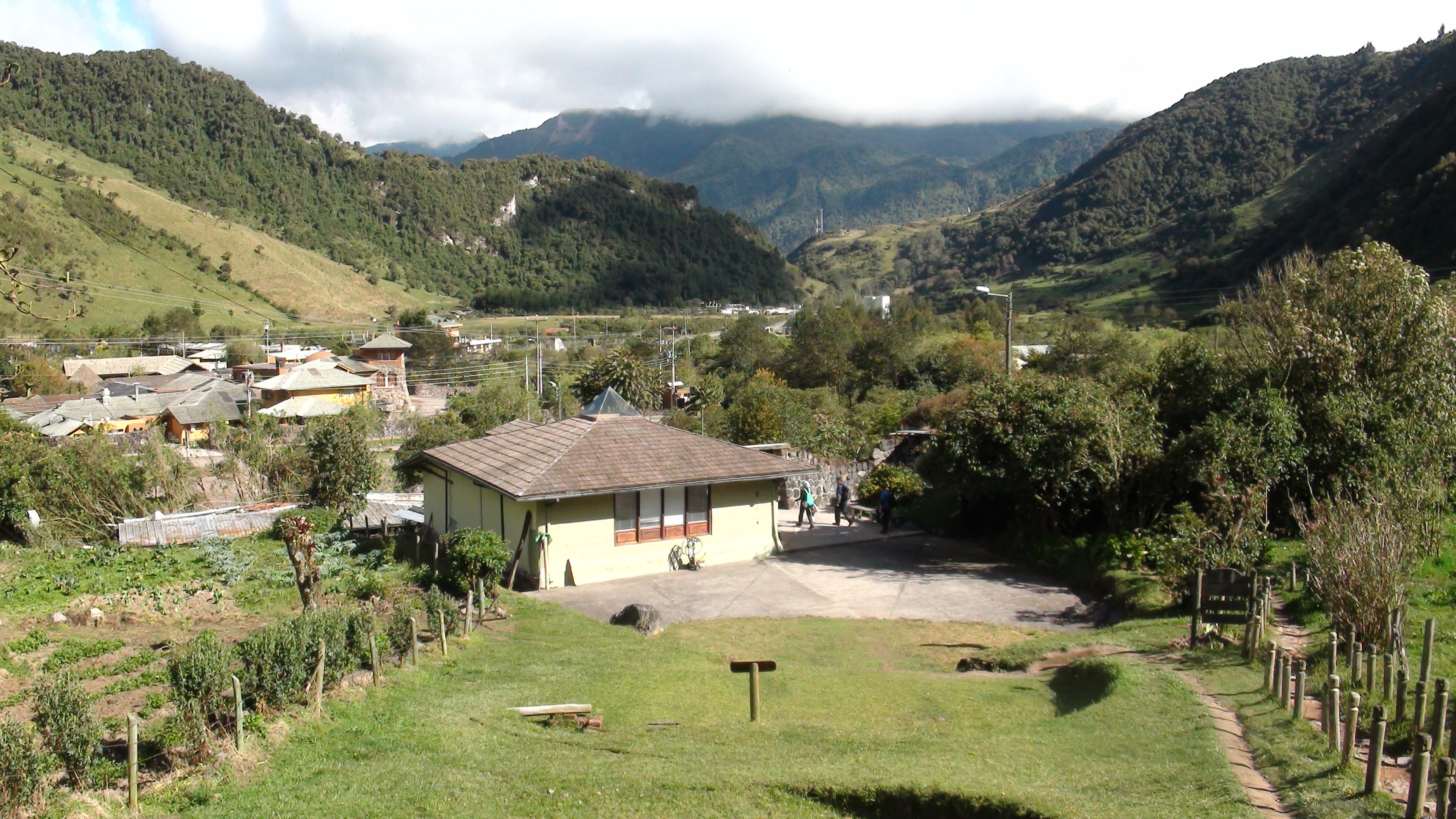
The second part of our Ecuadorian expedition took in lakes and sections close to the towns of Papallacta and Cosanga. The variation in climatic conditions was marked as we experienced first hand the transition from freezing fog and driving rain to burning sun and heat within a few tens of kilometers as we travelled from >4000 m down to around 1000 m elevation.
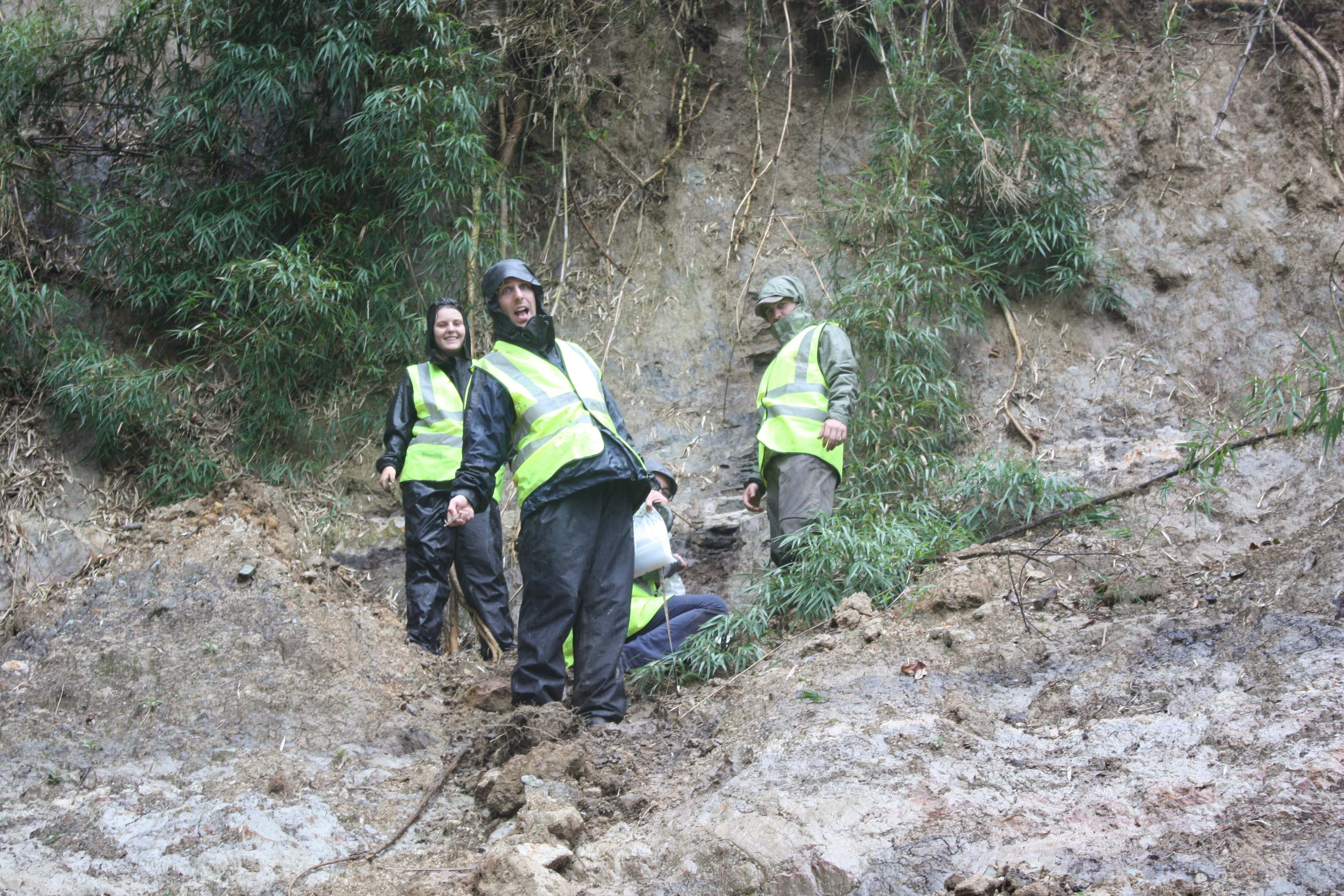
Sampling the sedimentary section at Vinillos was hampered by a tropical downpour. Sediments recovered from here include volcanic ash, mud slide deposits including large wood macrofossils and fine grained organic sediments probably deposited in still water environments.
Preparing to recover a short core from a pond near the antenas at Cujuca. Short cores will be used for Chironomid analysis.
Tomorrow we will attempt to recover short cores from two more lakes. Then our final few days here in Ecuador will be spent visiting partners and packing up.







 Ecology of the past