Zuccarelli Freire, V.N., Ziegler, M.J., Caetano-Andrade, V., Iminjili, V., Lellau, R., Rudd, R., Stokes, F., Viegas, D.H., Antonosyan, M. & Jha, D.K. Addressing the Anthropocene from the Global South: Integrating Paleoecology, Archaeology and Traditional Knowledge for COP Engagement. Frontiers in Earth Science 12, 1470577. DOI: 10.3389/feart.2024.1470577
INQUA fellow Alfred Hougnon continues his research into past environmental change in the Dahomey Gap (Benin). In the fourth video documenting his progress a short background to the project, and insights into field work, are given. Field work took place near the Ewe-Adakplame forest in the south east of Benin and involved the recovery of sediments using a Russian corer. The video also shows how interactions and engagement with the local community was developed during the research expedition.
To find out more above Alfreds project read posts on:
After visiting the SASQUA conference and presenting my work there (see SASQUA Conference post), we travelled to the University of Kwa-Zulu Natal in Pietermaritzburg (UKZN), where I would be staying for three weeks. During this period, my goal was to meet with local experts and to visit my site of study in the Drakensberg mountains. This would help me gain more insight into the environment I’m studying and provide me with an opportunity to collect more samples.
Pietermaritzburg
After the SASQUA congress finished, we flew from Port-Elisabeth to Durban. This would be my first time in one of the highly urbanised parts of South-Africa. We drove about an hour from Durban to Pietermaritzburg, better known locally as PMB, and I immediately noticed the stark difference between the countryside of the Western cape and the urbanised areas of Kwa-Zulu Natal. The city was rough around the edges and felt generally less safe than the laid-back countryside. Luckily, my accommodation was located in one of the better neighbourhoods close to campus. Macho the adorable dog of the AirBnB owners further assured my feeling of safety.
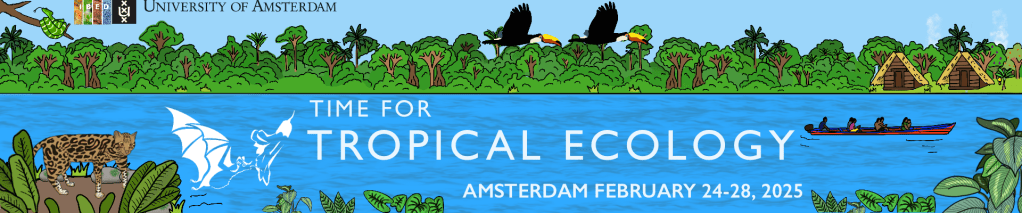
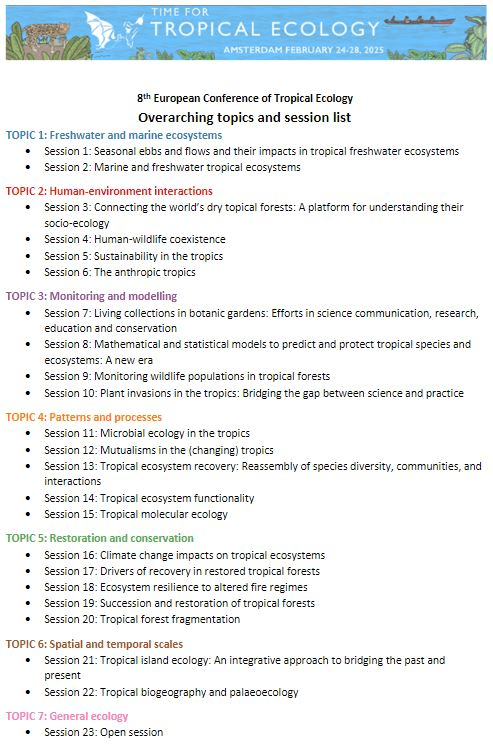
The European Conference of Tropical Ecology will take place in Amsterdam between 24 and 28 February 2025. The event will be centered around thematic oral and poster sessions. There are twenty-three different thematic sessions organized into seven broad topics:
During the Mapping Ancient Africa writing workshop in Kenya (3-6 June 2024) Stefanie Kaboth-Bahr conducted a series of short interviews with the scientists attending. Below you can find part 2 (of 2) of the interviews with the participants in the workshop. Watch the videos to find out their scientific stories and top tips for academic writing. Watch all the Mapping Ancient Africa videos on the Mapping Ancient Africa YouTube Playlist.
The participants (part 2 of 2)
Ruth Kiely (University of Amsterdam, Netherlands)
Husna Mashaka (Arizona State University, USA & National Museums of Kenya, Kenya)
During the Mapping Ancient Africa writing workshop in Kenya (3-6 June 2024) Stefanie Kaboth-Bahr conducted a series of short interviews with the scientists attending. During the interviews she asked the participants and instructors to describe their scientific background, what had motivated them to take part in the writing workshop, and what they thought the most important thing they had gained from it. You can now meet the first four of these scientists now by watching the videos below, or catch up with all the latest videos on the Mapping Ancient Africa YouTube Playlist.
The participants (part 1 of 2)
Olugbenga Boboye (University of Ibadan, Nigeria)
Angela Effiom (University of the Witwatersrand, South Africa)
Heijink, B.M., Zwarts, A., Witteveen, N.H., Watson, J., Ebbenhorst, A., Veenman, F., Kessel, M., León-Yánez, S., Guevara-Andino, J., Endara, M., Rivas-Torres, G., Bush, M.B. & McMichael, C.N.H. (2024) Past fire and vegetation change in the hyperdiverse forests of the Ecuadorian Amazon. Plants 13. DOI: 10.3390/plants13152048
On the 25 July 2024 the 19th Mapping Ancient Africa (MAA) seminar, entitled Climate frameworks for the Middle Stone Age and Later Stone Age in Northwest Africa, was delivered by Solène Boisard (University Montreal). In the seminar Solène presented two lines of evidence for past climate change in north-western Africa over the last c. 70,000 years. One from mechanistic climate models (via the PastClim package, for more details see: Leonardi et al. 2023) and one from reconstructions based on archaeological evidence. She found good agreement between the two approaches and linked climatic changes to the transition from Middle Stone Age to Late Stone Age technologies.