Hugo de Vries prize 2025

December 16, 2025
WDG

The annual PhD thesis prize from the Koninklijk Nederlandse Botanische Vereniging (Royal Dutch Botanical Association) is now open. The prize of EURO 5000 will be awarded to the best PhD thesis defended between January and December 2025 at a Dutch university. The subject matter of the thesis is broadly defined within the field of botany, and includs topics such as taxonomy, (palaeo- / macro-) ecology, and cell biology.

For details of past winners, and how to nominate someone for this years prize visit:
https://www.knbv.eu/hugo-de-vries-prijs/

The winner of the prize last year was one of our blog contributors, Nina Witteveen, read about her thesis and award here.


Hugo de Vries Prijs 2024

December 2, 2024
WDG

The annual PhD thesis prize from the Koninklijk Nederlandse Botanische Vereniging (Royal Dutch Botanical Association) is now open. The prize of EURO 5000 will be awarded to the best PhD thesis defended between January and December 2024 at a Dutch university. The subject matter of the thesis is broadly defined within the field of botany, and includs topics such as taxonomy, (palaeo- / macro-) ecology, and cell biology.

For details of past winners, and how to nominate someone for this years prize visit:
https://www.knbv.eu/hugo-de-vries-prijs/

Mapping Ancient Africa: Video of seminar 16

April 15, 2024
WDG

The 16th Mapping Ancient Africa seminar took place online on Friday 12th April 2024. The seminar was delivered by Stéphanie Bodin (Senckenberg Research Institute and Natural History Museum Frankfurt). In the seminar Stéphanie demonstrated how the examination of ancient charcoals found in caves used for shelter by hunter-gather populations living in Ethiopia at the end of the African Humid Period (4,000-2,000 years ago) can provide insights into vegetation and human selection of woody resources.

Details of this seminar can be found here. You can find more Mapping Ancient Africa seminar videos on the “Ecology of the Past” YouTube channel.

INQUAlogo

Mapping Ancient Africa: Video of seminar 15

March 26, 2024
WDG

The 15th Mapping Ancient Africa seminar took place online on Friday 15th March 2024. The seminar was delivered by Bruk Lemma (Martin Luther University Halle-Wittenberg, Germany; Ethiopian Biodiversity Institute – EBI). In the seminar Bruk presented recent advances made in the application of biomarker and stable isotope techniques in revealing the climate dynamics of the Bale Mountains in Ethiopia. He showed that it is possible to identify some plant types using these approaches, but that degradation of the signal in the sedimentary environment is possible.

Details of this seminar can be found here. You can find more Mapping Ancient Africa seminar videos on the “Ecology of the Past” YouTube channel.

INQUAlogo

Job: PhD Caribbean Palaeoecology

September 9, 2022
WDG

The Palaeoecology Research Group within the Department of Archaeology at the Max Planck Institute for Geoanthropology, Jena, Germany is pleased to announce a new vacancy for a doctoral student exploring human-environment interactions in the Caribbean. The position will be based in Jena, Germany for a period of 3 years with the option for extensions and supervised by Dr. Yoshi Maezumi.

The Palaeoecology Research Group analyses palaeoecological and archaeobotanical proxies from sedimentary archives, including pollen, phytoliths, charcoal and stable isotopes to examine topics including the legacy of human land-use on ecosystems, spatio-temporal patterns of natural and human-driven fire activity, and the influence of natural and human disturbance regimes on the biogeographic distribution of plants and animals in past ecosystems.

Closing date: 30 September 2022

For full details and how to apply click here.

For further information contact Dr. Yoshi Maezumi.

AFQUA 2018 – day 2

July 16, 2018
WDG

AFQUA: The African Quaternary environments, ecology and humans
2ndInternational Conference and Workshops
14-22 July 2018-07-15 National Museum, Nairobi, Kenya

Day 2

The second day of the AFQUA conference commenced with the second session on “East Africa” and Prof. Tom Johnson asking the question “Should we drill Lake Victoria?”… and a request for ideas from people to join in with ideas for the proposals for obtaining new sedimentary records from the lake. The East Africa session continued with exploration of Lake Kivu using organic biomarkers to see if past lake ‘explosions’ could be detected (M.E. Berke) and the use of strontium isotopes to detect past climate from lakes in the Turkana Basin (H.J.L. van der Lubbe).

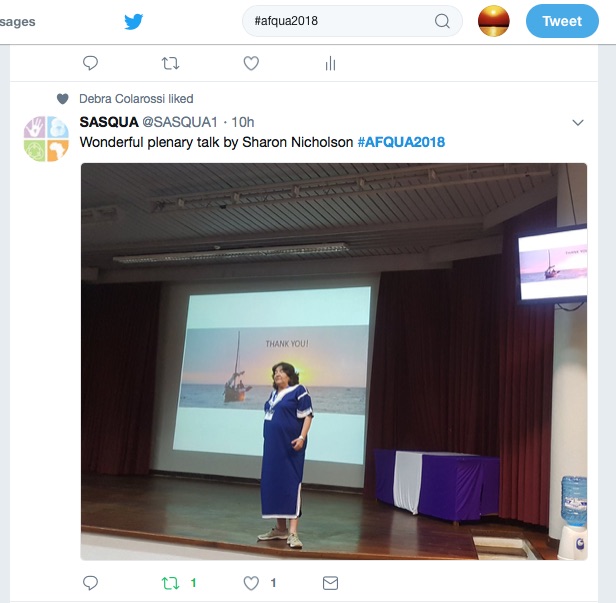
Before lunch the second plenary talk of the conference was delivered by Prof. Sharon Nicolson who made it very clear that the Inter Tropical Convergence Zone does NOT play an important role in controlling rainfall patterns across Africa (see Nicholson, 2018).

After lunch the first oral sessions covered “Southern Africa” and included d13C records from Bobab trees (S. Woodborne and E. Razanatsoa), early human finds in cascade tufas (M.A. Pickford), and quantitative climate reconstructions from pollen using the CREST software (M. Chevalier). After the break we were back for “Quantitative palaeoclimatology, modelling and data-model comparison” thinking about what is abrupt (M. Claussen), the impact of atmospheric CO2 on plants (V.J. Hare), and connectivity between lakes in the Kenyan rift (R. Dommain). Then it was off to the hotel bar to watch the football…

Fields and feasts

July 28, 2017
WDG

If you have exciting new research on past ecological change similar to this please consider submitting it for consideration to be published in Vegetation History & Archaeobotany.

If you have exciting new research on past ecological change please consider submitting it to Vegetation History & Archaeobotany.

Two articles recently published on-line in the journal Vegetation History & Archaebotany (of which I am an Associate Editor) recently caught my attention.These explore:

For more detailed thoughts on these papers read on…

Continue Reading

Predicting the future by understanding the past: Climate change

October 9, 2014
WDG

As part of the 500,000 years of solar irradiance, climate and vegetation changes” Natural Environments Research Council funded (NE/K005294/1) project we have produced a wall chart explaining the type of research we do and how it can help to place on-going, and projected, climate change in context. The wall chart is designed for use in schools and universities. To obtain a copy of this, and other wall charts, please contact the British Ecological Society (direct wall chart link here).

Understanding Climate Changes

An interview with Adele Julier

May 26, 2014
philjardine

Following on from Wes Fraser’s insightful and revealing interview, cactus-hugger Adele Julier tells us about her academic background and her role on the Lake Bosumtwi pollen chemistry project.


For more videos check out the “Ecology of the past” YouTube channel.

Blog at WordPress.com.