Phytoliths, starch grains and diatoms

May 29, 2024
WDG

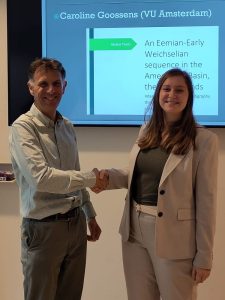
Caroline Goossens receives the Florschütz Award.

On Friday 24 May 2024 the Palynologische Kring (Dutch palynological society) held a seminar series and laboratory workshop at the Institute for Biodiversity & Ecosystem Dynamics (University of Amsterdam). During the afternoon we had the annual meeting of the society, the presentation of our MSc Thesis prize, four seminars and two laboratory demonstrations. The MSc thesis prize “Florschütz Award” was won by Caroline Goossens (VU Amsterdam) for her thesis entitle: “An Eemian-Early Weichselian sequence in the Amersfoort Basin, the Netherlands”; the project was supervised by Natalie Van der Putten, Cees Kasse and Jeroen Schokker. We hope that Caroline will present her thesis at a future Palynologishe Kring meeting.
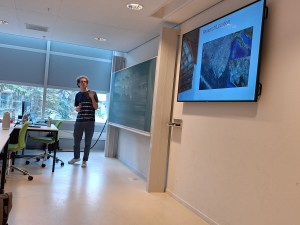
Teye Aukes presenting on the diatoms of ancient Rome

The talk series was kicked off by Nina Witteveen (University of Amsterdam) who presented part of her PhD thesis (currently awaiting defense), entitled: “Long-term forest recovery in Amazonia insights from phytolith analysis”. Nina discussed the impact of past peoples on the vegetation of Suriname based on her work identifying phytoliths in soil samples collected at varying distances from an archaeological site. The second talk was given my Amanda Henry (Leiden University) who demonstrated how the analysis of starch grains extracted from archaeological context can provide insights in to past diets. She used these evidences to suggest that early humans and Neanderthals had a similar diversity of plants in their diets. The third talk was given by University of Amsterdam MSc researcher Teye Aukes and focused upon his identification of diatoms from an swampy lagoon environment near Ostia (Italy). He drew conclusions from these data about the antiquity of salt production in ancient Rome. The final talk was given online by Welmoed Out (Moesgaard Museum) who presented a detailed analysis of inter- and intra-analyst variability in phytolith morphometric analysis.

After the seminars we moved upstairs to the microscope laboratory where Nina Witteveen and Ana Smuk (University of Groningen) showed off phytoliths from their study site in South America and the Netherlands.

Some of the Palynologische Kring members enjoying some refreshment after the event.

Wei PhD thesis 2023

April 17, 2024
WDG

Wei, C. (2023) Morphometrics of modern and fossil Poaceae pollen from South America. PhD Thesis, University of Amsterdam, Amsterdam. ISBN:

Abstract

Poaceae (the grass family) is one of the most diverse angiosperm families on Earth, comprising close to 12,000 species. The history of grass-dominated biomes extends back over 20 million years, yet the spatial and temporal development of these biomes and the underlying drivers remains unresolved. This thesis addresses these questions in South America, focusing on modern grass pollen and ancient samples dating from the early Miocene to the present. The thesis reveals several key points: (i) Grass pollen size varies significantly both among genera and species and within species. Pollen size shows no correlation with (a)biotic factors, indicating its limited utility as a generally applicable proxy for reconstructing past vegetation and climate; (ii) Grass pollen exhibits high diverse on surface ornamentation. The morphotypes identified by descriptive terminology are well-supported by a combination of SEM images of pollen surface patterns and computational image analysis. The findings reveal that pollen sculpture is unrelated to (a)biotic variables but is diverse across the phylogeny; (iii) Tropical grass pollen morphology suggests a gradual rather than punctuated evolution, based on the trend toward a less dense ornamentation of the exine since c. 23 Ma. The changes in the exine of grass pollen since the early Miocene might be driven by evolutionary processes (evolutionary drift and/or directional selection), and potentially immigration at the continental scale. In summary, the thesis reveals the trajectory of grass pollen morphological changes over time and examining the drivers that have contributed to their evolution and geographical expansion at the continental scale.

Handle: http://hdl.handle.net/11245.1/1f4f5550-1069-423a-ace3-2192ac4160c6

PhD Thesis: Morphometrics of modern and fossil Poaceae pollen from South America

December 19, 2023
WDG

On November 17, 2023, Caixia Wei (魏彩霞) accomplished a pivotal milestone by successfully defending her thesis titled “Morphometrics of Modern and Fossil Poaceae Pollen from South America” at the distinguished Agnietenkapel (University of Amsterdam). During the defense ceremony, Caixia showcased her professional knowledge and expertise in the field of paleoecology in a relaxed and cheerful manner. The committee members, promoters (Carina Hoorn, William Gosling, Phillip Jardine), and attendees (~50 people) responded with frequent smiles, laughter, and numerous rounds of applause! After the defense, a delightful reception and dinner were held, where Caixia was showered with an abundance of hugs, kisses, heartfelt wishes, and thoughtful gifts. These wonderful memories will support Caixia on her journey ahead…

For a glimpse into the event, you can watch Caixia’s insightful 10-minute project presentation here:

Additionally, most of Caixia’s thesis is available for download at this link:

Continue Reading

The Ecology of the Past: Inagueral lecture

January 12, 2023
WDG

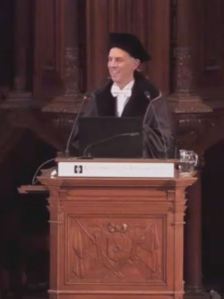
William Gosling giving his oratie “The Ecology of the Past” at the Aula (University of Amsterdam), 22 December 2022.

On the 22 December I gave my oratie (inaugural lecture), entitled “The Ecology of the Past”, related to my appointment as Professor of Palaeoecology & Biogeography at the University of Amsterdam. I really enjoyed the opportunity to mark this personal milestone with some many colleagues, friends and family. In case you missed the event you can watch it online via the universities portal by clicking here (or on the photo).

Note: (1) to flip between seeing the slides and the video feed just click on the screen, (2) running time of lecture until 50 minutes.

Reference

Gosling, W.D. (2022) The Ecology of the Past
Inaugural speech, University of Amsterdam.

Identifying drivers of forest resilience in long-term records from the Neotropics on ALPHA’s lab meeting

August 4, 2020
Majoi Nascimento

Hello everyone,

My name is Majoi Nascimento, I just started a new job as a postdoc researcher at the University of Amsterdam working on an ERC project named ALPHA (Assessing Legacies of Past Human Activities in Amazonia with Crystal McMichael). The main focus of ALPHA is to investigate the role of human disturbance and recovery processes that have occurred over the past few millennia in Amazonia, and their effects on the biodiversity and carbon dynamics that are observed there today. To do a good job, it is important that we understand the concepts of disturbance and recovery, but also the processes that underlie forest resilience. That is the reason why we decided to read and discuss this work from Adolf et al. 2020 “Identifying drivers of forest resilience in long-term records from the Neotropics”, published in the journal Biology Letters, during one of our lab meetings.

Continue Reading

“Can you go back?” by Mark Bush – Part 2

September 21, 2019
WDG

Mark Bush

Mark Bush

The second of three guest blog posts by Prof. Mark Bush (Florida Institute of Technology). Click here to read Part 1.

The next two days were spent in motorized dugouts sitting on our gear bags, with tarps pulled over us. Every now and then the driving rain would relent and we would see macaws and toucans flying across the Aguarico River. We stayed one night in a village that had been abandoned due to recent floods, another with Siona hunters who were preparing their blow darts (for monkeys). There were very few houses along the river and we hardly saw another boat in three days. Then we arrived, well almost. We had turned off the main channel onto the tiny Zancudo river.  Little used, this stream was a jumble of fallen trees that the Siona chopped their way through. A large tree just beneath the surface posed a problem that was solved by stripping the bark from Cecropiatrees and laying it inside surface facing up, backing up, revving the engine, and aiming straight for the bark. The slick insides of the Cecropiaallowed the canoes to shoot the trunk and on we went. Then we reached the marsh. When I say ‘marsh’ it was a forest of Montricardia arborescens. This is an aquatic Aroid that grows about 3 m high. The trunks are about 3-5 cm in diameter and is THE favored hangout for caiman and anaconda (I have since learned). No Siona in their right mind gets out of a boat in such a marsh and so we were stuck……so close but yet so far. Our only chance of getting through the marsh was to hop out of the boats and pull them through.

The author pulling a canoe through the marsh at Zancudococha in 1988. Photo: Miriam Steinitz-Kannan.

The author pulling a canoe through the marsh at Zancudococha in 1988.
Photo: Miriam Steinitz-Kannan.

We had two boats and so the most dispensable members of the team, Paulo de Oliveira and I, were given the job of hauling the boats. A couple of happy hours later we were through the marsh and onto the lake.

Our first jobs were to find somewhere dry enough to camp, unload, set up camp, and survey the lake. Paul Colinvaux the team leader always launched an inflatable and surveyed the lake on first arrival. Meanwhile the rest of us set up camp. About 20 minutes into all this activity there was the unmistakable crack of a shotgun. In a few more minutes the Chief’s sons emerged from the forest with the news that they had shot a large tapir. The tapir fed the group for the next few days, but I ate tuna and a sausage that had turned blue and slimy, unable to reconcile my role in, what to me, was an unfortunate outcome of our petitioning the Siona to bring us to their sacred lake. The coring was more successful than at Cuyabeno in that we recovered 5m of sediment, but it was clearly a young system and wouldn’t answer our research question. This expedition was a disappointment scientifically, but an incredible snapshot along the gradient of Amazonian development.

To be continued…

Tribute to Daniel Livingstone and Paul Colinvaux

January 26, 2018
WDG

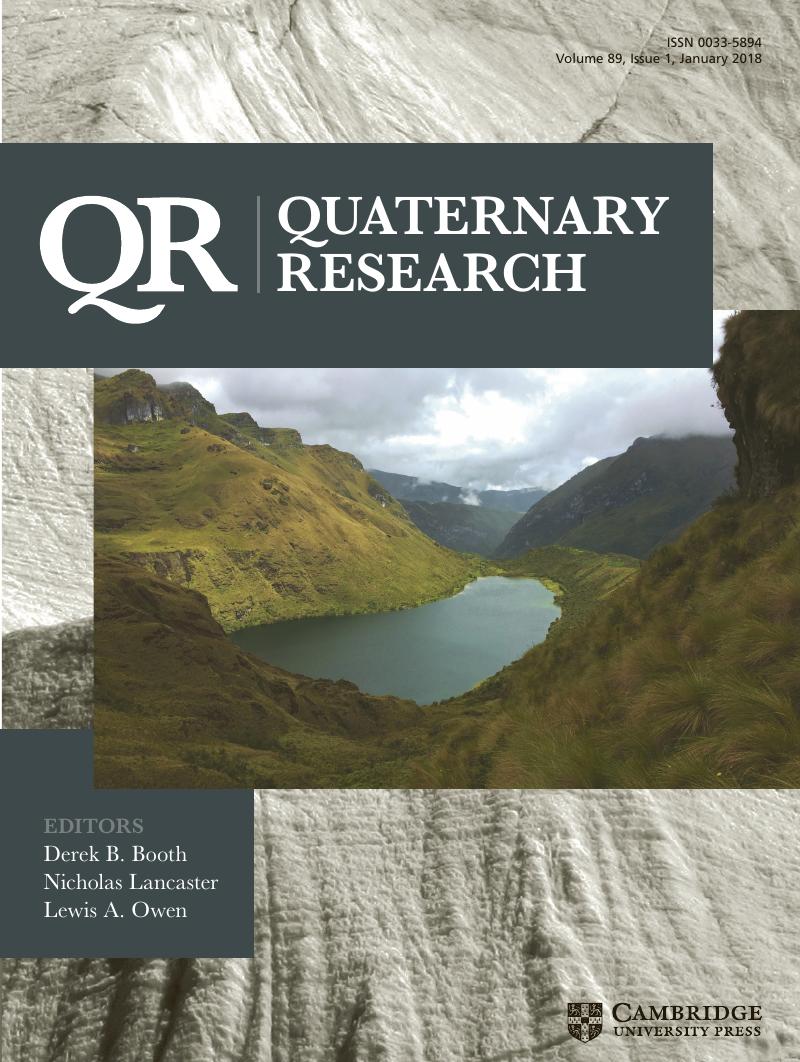
Mark Bush and I are proud to announce that a tribute to Prof. Daniel Livingston and Prof. Paul Colinvaux has recently been published in Quaternary Research. Dan and Paul were both pioneers of tropical pal(a)eoecology and both died in the spring of 2016 . To mark their passing Mark and I have guest edited ten new papers on palaeoecology drawn from researchers, and regions, of the tropics in which Dan and Paul worked (Bush & Gosling, 2018). We would like to thank Quaternary Research Senior Editor Derek Booth for giving us this opportunity and assisting greatly in the process of compiling the manuscripts. We would also like to thank all to contributing authors for their hard work and dedication to the project. We hope that you will enjoy reading the manuscripts and find them a fitting tribute to the life and work of these two great researchers.

Quaternary Research
Special Issue: Tribute to Daniel Livingstone and Paul Colinvaux
Volume 89 – Special Issue 1 – January 2018 Continue Reading

Exploring the Llanos de Moxos, Bolivia

November 1, 2017
cmcmicha

By Crystal McMichael

The Llanos de Moxos in Bolivia is an area the size of England that has one of the highest densities of archaeological sites in the Amazon basin. I travelled there for the first time earlier this month for the fourth International Meeting of Amazonian Archaeology. As the airplane crossed from the Andes into the Amazon plains, I could tell this was a very different ‘Amazonia’ compared with the forests that I know from Peru, Ecuador, and western Brazil. The Llanos de Moxos is a seasonally flooded savanna and it was so…open! I immediately realized that the perception of ‘Amazonia’ varies widely among individuals, and I think that is one of the reasons why those of us who study the human history of Amazonia tend to disagree so frequently.

This slideshow requires JavaScript.

Continue Reading

Rubicon project to link fossil pollen with plant traits

July 20, 2017
WDG

Dear Ecology of the past blog readers,

This time you are reading a message from a non-expert in paleoecology. My name is Masha and I will spend the next two years on a very exciting postdoctoral fellowship funded by NWO (Dutch National Science Foundation) under their Rubicon scheme in close collaboration with William Gosling (University of Amsterdam).

Continue Reading

Vegetation History & Archaeobotany

February 12, 2017
WDG

vhaI am delighted to report that I have recently been appointed as an Associate Editor for the journal Vegetation History & Archaeobotany (VHA). The journals scope is global and covers Quaternary environmental and climatic change, with a specific focus on the Holocene and pre-historic human impacts on landscapes; often linking palaeoecological and archaeological research. My remit with VHA is to provide expertise on tropical, and in particular South American, studies. Recent articles in VHA with a South American focus include:

I hope that over the next few years we can publish some more exciting articles on the tropics in VHA and I would therefore like to encourage you to submit interesting high quality original research, reviews, or short articles for our consideration.

To find out more about the journal and submit an article click here.

Continue Reading

Blog at WordPress.com.