Anthropogenic impact and environmental sustainability
Evolution of organisms and ecosystems
Dynamic Earth
Organisms, ‘omics and biogeochemistry
Opportunities to join the PCRG here at the OU through this scheme will be adverstised shortly. If you are interested in PhD projects in any of the above areas keep an eye out for further details of CENTA projects and opportunities over the next few weeks.
To find out more about CENTA visit the DTP website by clicking here.
Course description: “Ecosystems is about the relationships between living organisms. Gain an understanding of the natural world and how the web of life works, with illustrations from around the world.”
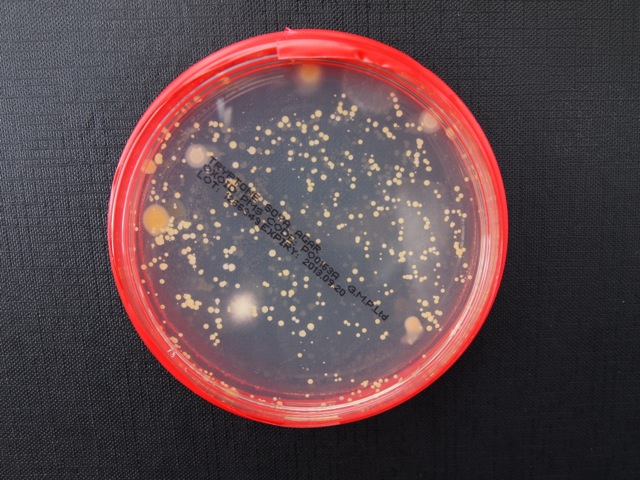
Will’s BES T-shirt logo swabbed at Greenman; for more microbes on festival kit visit the “Hall of shame” on http://www.besfest.org
August was a month for travel with PCRG members heading for Peru (Bryan, and he is still there), Greenman festival (William), INTECOL conference (William and Frazer), and the Royal Geographic Society annual meeting (William, Encarni, Frazer and Hayley). Detailed reports of the UK based travels are already on the blog, and hopefully we will get a post from Bryan on his Peruvian adventure once he is back.
Back in Milton Keynes work progressed with:
Hayley producing a revised full draft of her pollen counting methodology manuscript,
Frazer starting with the first tentative attempts to apply his chironomid training data set to fossil chironomid records,
Phil trialing inverted microscopes and training on the FTIR,
Encarni plotting field work in Ecuador (more travel for November-December),
The PDRA project will descover more about past vegetation and climate change in Lake Bosumtwi (Ghana)
We are seeking a PDRA to study past climate and vegetation change in tropical West Africa as part of the NERC-funded “500,000 years of solar irradiance, climate and vegetation changes” project. You will join a multidisciplinary collaborative research team and will work with an international network of project partners. The project will utilise cutting-edge organic geochemical techniques to generate the longest continuous record of fossil pollen chemistry change. The study will build upon previous research into the sediments recovered from Lake Bosumtwi (Ghana). The data generated will shed new light on the role of climate in driving vegetation change in the tropics.
You will already hold a PhD, or be near to completing your PhD, in a relevant scientific discipline with a background in the Earth or Environmental sciences. You must have substantial experience of organic geochemistry or tropical palynology, with well-developed self-management skills and the ability to prioritise effectively.
The PDRA will work with an associated PhD student looking at modern pollen-vegetation relationships in the same region.
The PDRA will be part of an international team; partners based at University of Nottingham, Oxford Brooks University, Imperial College London, Oxford University, University of Texas at Austin and the Forestry Research Institute of Ghana
Understanding how vegetation responded to past climate change requires the development of well constrained relationships between living floras, environment and climate. This project will help constrain the great uncertainty which exists as to how tropical ecosystems are represented in the fossil record by examining the relationship between modern vegetation and the pollen it produces. The project will analyse modern pollen rain using a combination of traditional microscopic analysis [1] and cutting edge geochemical techniques [2]. We anticipate that the findings will provide new insight into past vegetation and climatic change.
For further information on the project and how to apply see the full advert: NERC PhD advert. Prior to applying please check eligibility for NERC funding by clicking here.
Closing date: 25th April, interviews will be held at The Open University during May.
Four new workstations installed in the Past Environmental Change microscope lab
Excitement in February saw the arrival of a new research grant within the PCRG, to look at pollen and spore chemistry from Lake Bosumtwi (watch this space for new post-doc and PhD studentship positions), and (just in time) the expansion of benches in the microscope lab which will ensure that the new people will have spaces to sit in! In addition, we had a paper published with long time friends and collaborators at the University of Leeds; Roucoux et al. (2013).
Despite the disruption of the lab refit Hayley and Frazer have been cracking on with pollen and chironomid analysis. Encarni and Frazer returned from field work in Ecuador and half the samples have so far made it back to The Open University; we now wait with anticipation for customs to release the other box!
Four shiny new workstations from the other side – woo
All applications must be pre-approved by the host institution so if you are interested in applying for a project through The Open University expressions of interest are required by 25th January 2013.
The last two months of 2012 were exceptionally busy!
On the research front
Grants took centre stage for much of my time. First writing for the NERC December 1st deadline was pressured as usual, and second response to reviewers comments on the July submission was interesting.
Paper writing proceeded with reviewer and co-author comments on three manuscripts hopefully desitined for Review of Palaeobotany and Palynology (lead by Hayley), Palaeo3 (lead by Macrarena) and The Holocene (with Joe Williams) respectively.
Two tasks dominated the non-research activity: 1) teaching the Geological Record of Environmental Change (S369) exams assessment and assigment, and 2) as Post Graduate Tutor keeping up with NERC developments for the new Doctoral Training Partnerships.
PCRG members on field work in Cayabe-Coca National Park (2012). Left to right: Hayley, Encarni, William and Frazer. Encarni and Frazer have returned to Ecuador Jan-Feb 2013 to collect further sedimentary cores. More on the blog soon…
Finally all that remains is to say “Happy New Year”from the PCRG and on with 2013… 🙂







 Ecology of the past