Scales of change (ecological, geological, and human).
Humans as drivers of environmental change.
Extra-terrestrial forcing of environmental change.
Earth system feedbacks.
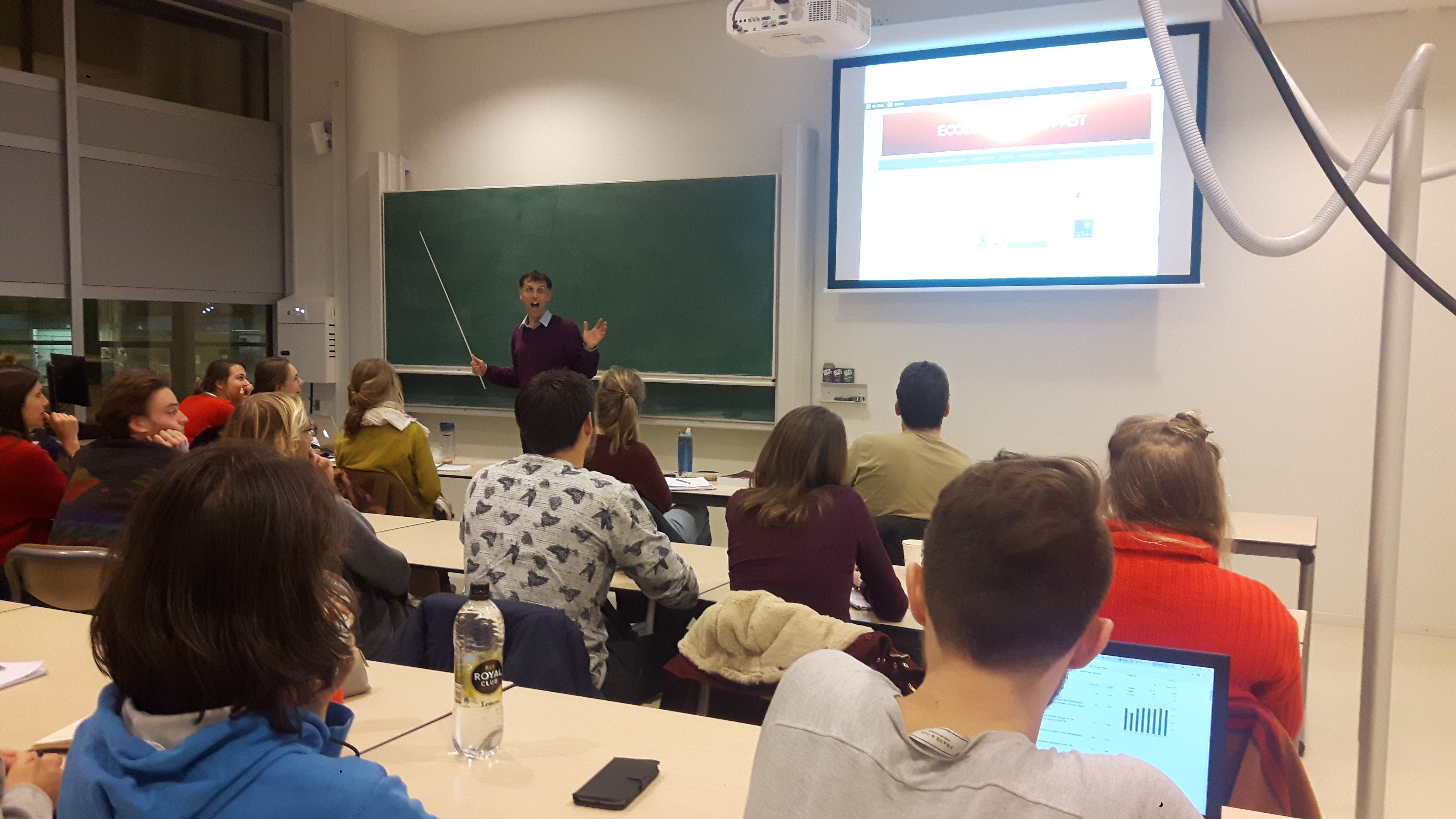
The week was completed with each student giving a three (3) minute presentation of their favourite paper. The papers presented ranged from the extinction of giant sharks, through forest-savannah transitions, to how climate change thwarted Ghengis Kahn. Next week we continue by disecting how chronologies are constructed.
Researchers in the Institute for Biodiversity and Ecosystem Dynamics (IBED) at the University of Amsterdam have been studying the páramos and Andean ecosystems for over 50 years. These highly diverse ecosystems are currently restricted to mountain-tops (resembling an archipelago of islands in the sky), but in the past dominated large surface areas throughout the Northern Andes. Climate change determined the degree of páramo fragmentation and connectivity in the past, and site-specific results have been integrated into a GIS-environment (visualization) for southern Colombia and the entire Northern Andes by IBED researchers Suzette Flantua and Henry Hooghiemstra.
Watch the ‘Time machine: Ice ages in the Andes’ video and see its presentation at the recent IBED Open Day:
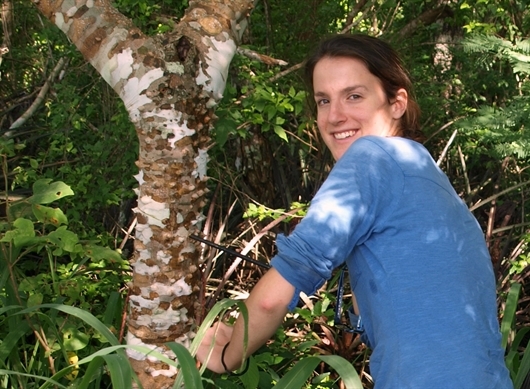
IBEDs Crystal McMichael hard at work sampling sediments in the Andes
Insights into recent field work in Ecuador by a team lead by Crystal McMichael can be found in a recent blog from our collaborators at the Instituto Geofisico, Escuela Politecnica Nacional, Quito (Ecuador).
This time you are reading a message from a non-expert in paleoecology. My name is Masha and I will spend the next two years on a very exciting postdoctoral fellowship funded by NWO (Dutch National Science Foundation) under their Rubicon scheme in close collaboration with William Gosling (University of Amsterdam).
An international team of scientists have reconstructed the longest ever record of past sunshine using pollen trapped in lake sediments collected in Ghana, Africa. The study published today in Scientific Reports enables us to understand past changes in solar input to the global system over the past 140,000 years. Previously we have had to rely upon computer models to mathematically determine past solar inputs to the Earth. “This work really is a first; being able to peer back in time to understand how the Sun has driven our global system over many of thousands of years is a very exciting prospect” said joint-lead author Dr. Phillip Jardine of The Open University.
The Sun is a key component of our natural environment, driving a multitude of processes at Earth’s surface, from photosynthesis generating energy within plants, through to global-scale circulation patterns in our oceans and atmosphere. Understanding more about how the Sun has behaved in the past, and the influence this had on Earth’s environment, will help scientists predict future climate change.
Dr. Jardine used a technique pioneered by one of his co-authors, Dr. Wesley Fraser of Oxford Brookes University, to determine past changes in solar input, specifically changes in ultraviolet (UV) radiation. Plants protect themselves from the harmful nature of ultraviolet radiation by incorporating a number of specific chemical compounds into their tissues that absorb and dissipate the energy of UV radiation. Pollen grains of flowering plants are also provided protection by these UV-absorbing chemicals, thus act as a long-term recorder of ultraviolet radiation from the Sun.
Pollen grains are readily trapped in lake sediments, where they can be preserved for millions of years. By extracting material from Lake Bosumtwi, Ghana, the pollen that was released by flowering plants thousands of years ago can be separated from the lake sediment and chemically analysed for UV-absorbing chemical compounds. It is this chemical signature within the ancient pollen grains that provides us with information about past levels of solar ultraviolet radiation.
“What we present here is a new opportunity to explore how the Earth has changed” said Dr. William Gosling (University of Amsterdam). “I am particularly excited about this because it will means that we can gain a better understanding of why vegetation changed in the past, and consequently this will allow us to anticipate better what the likely impacts of projected future climate change will be.”
15:00-15:30 Frank Wesselingh & the PRIDE team How high can you get? Mountain uplift driving diversification in Pontocaspian lakes before humans bring down the unique aquatic biota?
15:30-16:00 Christiaan van Baak Mediterranean-Paratethys connectivity during the late Miocene to recent
– 16:00-16:15 tea/coffee break –
16:15-17:15 Keith Richards Studies in Caspian palynology: Vegetation, climate and sea level change
Zoe and William just after the graduation ceremony (UvA)
Two students (Zoe van Kemenade and Tessa Driessen) have recently completed projects looking at past environmental change on Samoa working in the Research Group of Palaeoecology & Landscape Ecology at the University of Amsterdam (UvA). Zoe’s project, part of her BSc Future Planet Studies (major Earth Sciences) at UvA, was entitled “A multi‐proxy analysis on the effect of climate and human activity on the environment of Samoa during the Holocene” and investigated charcoal, macro-fossils, and algae. Tessa’s project, “Biodiversity, fire and human dynamics on Samoa over the last 9200 years”, was completed as an internship during her MSc in Environmental Biology at Utrecht University (UU) that was co-supervised by Rike Wagner-Cremer. Tessa focused on the fossil pollen record to reconstruct past vegetation change. Both projects were conducted in cooperation with Jon Hassel and David Sear (both University of Southampton) who provided access to the Samoan sediments; for more on the Southampton Pacific Islands projects check out their blog Palaeoenvironmental Laboratory at the University of Southampton.
The results from both projects, and work by the University of Southampton team, will be presented at this years GTO conference (European conference of tropical ecology) in Gottingen next week.
William giving his personal view on the work of Tessa at her gradation ceremony (UU)
Next to La Meuse river, near the villages of Welland Aijen, there is a large archaeological site with a long history of human occupation, including the remains of a large Mesolithic hunter gatherer community (see Marion Zijlema article for more details) The history of the site is deeply linked to the expansion and flooding of the river. In collaboration with archaeologists (Hanneke Bos) four UvA bachelor students are going to study the fossil pollen, phytoliths and charcoal from the Well-Aijen site to captured the environmental change that accompanied the human occupation. Yesterday (20 January – WDG late uploading post, sorry!) we visited the site to see what it was like, and to test out some equipment!
This slideshow requires JavaScript.
We decided to bring out the Livingstone corer (Geo-core), which is usually used from a boat in a lake (e.g. Lake Erazo), to test its capacities on terrestrial sediment. Knowing that the peat formation was not deep below and given that the corer-system gives a nice continuous record, it seemed worthy of giving it a try. We ended up learning a lot about how the corer functions and about problem solving in the field – almost everything that could go wrong, did go wrong. We really fought for every centimeter of sample! The team never suffered from low spirits though, despite it all. With jokes and hot tea on site we ended up having a very fun and insightful expedition. Any remaining low morale or cold feet quickly faded by the sight of pie at the end of the day.
Past environmental change on Mauritius has been the focus of research with the Palaeoecology & Landscape Ecology group at the University of Amsterdam (UvA) for a number of years. This research has been lead by Erik de Boer and Henry Hooghiemstra and has already resulted in a number of key publications on the environmental history of the island (de Boer et al., 2013, 2014, 2015). One current past environmental change research project working on Mauritius is being undertaken by Jona de Krui; a student within the UvA BSc Biology program supervised by myself and Erik. Jona’s is working on a study site (modern day swamp) on the north-east of the island and is focused on improving our understanding changes in the:
vegetation (macro-fossils) over the last c. 1000 years.
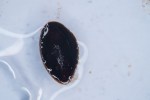
Jona has now completed the analysis of all his samples and we are currently collating the data sets; however, a number of the macro-fossils which he has discovered remain unidentified. Below are images of the unknown macro-fossils if you have any suggestions on identifications please comment, or get in touch directly.









 Ecology of the past