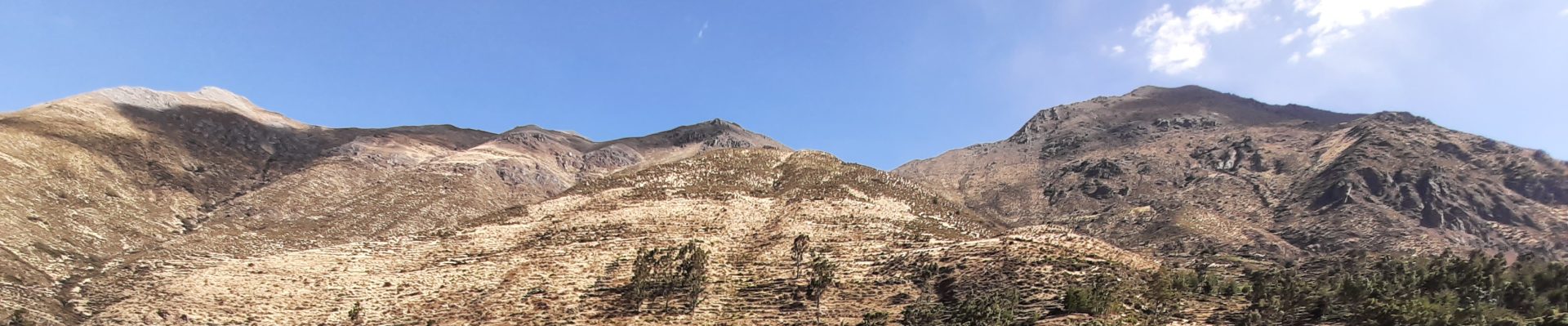
Gosling PhD thesis 2004

April 10, 2014
WDG

Gosling, W.D. (2004) Characterisation of Amazonian forest and savannah ecosystems by their modern pollen spectra.  PhD Thesis, Department of Geography, University of Leicester.

PhD-wdg

WDG Bolivia (2002)

Abstract:

Controversy surrounds the Quaternary palaeoenvironmental history of Amazonia. It is unclear whether moist evergreen forest, savannah or seasonally dry forest dominated the Amazon basin at the last glacial maximum (c. 21,000 years B.P.). In part the uncertainty surrounding the palaeoenvironmental history of Amazonia stems from a poor understanding of the ecological significance of the fossil pollen records from the region. In order to improve interpretations of the fossil pollen record it is essential to better understand the nature of the pollen rain produced by modern ecosystems.

In this thesis, three Neotropical ecosystems equivalent to those alluded to above were characterised by their modern pollen rain. This was achieved by examining samples collected in artificial pollen traps located within permanent (50 x 200 m) vegetation plots in the Noel Kempff Mercado National Park area, Bolivia. In each plot 10 traps were sampled for one field season (September 1998 to September 1999, or September 2000 to September 2001) and 5 traps were sampled from two additional field seasons (between 1998 and 2001). Pollen counts of at least 100 grains were made for each trap. In total 318 pollen taxa were distinguished, of which 116 were identified. The characteristic pollen from each of the three ecosystems were determined through a series of steps: spatial and temporal variations were explored using Spearman’s Rank correlations, the distinctive taxa of each ecosystem were identified using Principal Components Analyses (PCA), and the representativity of the pollen for each ecosystem was examined by comparing pollen and vegetation abundances. These analyses revealed a small number of taxa that can be used to characterize these ecosystems. Further PCA showed that it is possible to differentiate between the ecosystems by assessing the relative proportions of Didymopanax, Alchornea, Anadenanthera, Melastomataceae/Combretaceae, Moraceae/Urticaceae, Myrtaceae, Palmae, Pteropsidia (trilete), Poaceae and Solanum. These findings mean that it is now possible to detect these ecosystems in the fossil pollen record and consequently further information regarding the nature of the vegetation change in the Amazon basin can be gained.

Supervisors: Dr. Francis Mayle (University of Leicester, now at University of Reading) and Dr. Nicholas Tate (University of Leicester)

Examined by: Prof. Henry Lamb (University of Aberystwyth) and Prof. Andrew Millington (University of Leicester, now at Texas A & M), April 2004.

To borrow a copy from University of Leicester Library (item ID 7507349613), or download directly: Volume 1, Volume 2, and CD, or via the University of Leicester FigShare.

Continue Reading

Tropical pollen database online

April 7, 2014
WDG

PollenTo facilitate the our ability to identify pollen in the fossil record we have been building a searchable digital tropical pollen database. Our work builds upon the architecture provided by Bush & Weng (2007) for their Neotropical pollen database (Palaeoecology labFlorida Institute of Technology). We have used Bush & Weng’s freeware tool and expanded it to include an additional 364 pollen and spore types from tropical Africa. The images are of pollen reference material collected over the career of Prof. Dan Livingstone and curated in the Department of BiologyDuke University; full collection details of each specimen are indicated on each individual electronic record. In conjunction with the open access publication “Atlas of the tropical West African pollen flora” (Gosling et al., 2013) we have made the entire updated pollen database available. We hope that this will prove to be a useful tool for palynologists working in Africa and the wider tropics and that it will encourage others to develop the database further.

Continue Reading

Problem solving in the Anthropocene

April 3, 2014
WDG

DSCN3814William Gosling on:

Barnosky, A.D. & Hadly, E.A. (2014) Problem solving in the Anthropocene. The Anthropocene Review, 1, 76-77.

The short communication by Barnosky & Hadly examines the current fundamental environmental ‘problem’ for human populations  through the lens of the “Anthropocene” concept, i.e. will some human populations:

  1. continue to develop using a “business as usual” model that has been shown to elevate environmental risk to all human populations, or
  2. alter societal practice in an attempt to reduce the environmental risks now and for future generations.

Barnosky & Hadly straightforwardly and succinctly present the case that, based on the weight of evidence from the collective scientific endeavour of the global community, humans are now fundamental altering the functioning of planet Earth; a view further supported by the recently published Intergovernmental Panel on Climate Change report (IPCC, 2014).Throughout the period of anatomically modern human existence (Homo sapiens sapiens, the last c. 200,000 years) populations have experienced a variety of environmental changes. Exposure to environmental change has had both positive and negative impacts on societal development (e.g. Gosling & Williams, 2013; Hodell et al., 1995).

Continue Reading

The Anthropocene Review – reviewed

March 26, 2014
WDG

AnthropoceneReviewThe Anthropocene Review is a new journal focusing on the impact of humans on planet Earth through time; information on the latest publications can be found on the associated blog.

Given that much of the research we are interested in relates human-environment interactions in the past we decided to take a closer look at the range of articles being covered by this journal. Our thoughts on seven articles published in the first issue of The Anthropocene Review will appear in a series of blog posts soon. To get started here are a list of the papers we will be covering:

Full Anthropocene Review table of contents here.


Blog evolution

March 18, 2014
WDG

@PalaeolimOver the next few months the “Palaeolimnology et al.” blog will be changing. The first noticeable change will be the title of the blog to “Ecology of the past”. The idea behind changing the name is to have a title that it easily informs the reader about the broad area of our interests.

The changes have been precipitated by three key factors:

  1. A re-definition of the “Palaeoenvironmental Change Research Group” at The Open University (OU), in part as a response to my impending departure,
  2. My desire to have a blog people within the Paleo and Landscape Ecology Group at the University of Amsterdam (UvA) can feel comfortable contributing to, and
  3. The fact this blog has been running for over 3 years and it is probably time for a refresh.

Changes to the static pages and blog content will happen over the next few weeks.

Continue Reading

PCRG February

March 7, 2014
WDG

William on Bainbridge

My first fieldwork from the OU, in 2005, was pollen trapping on the Galapagos. Here I am looking beardy on Bainbridge.

February was an exciting month for me principally because of the finalization of my move to the University of Amsterdam (UvA) where I will become head of Paleo and Landscape Ecology in September. The decision to leave The Open University (OU) has been a difficult one. When I joined the OU as a RCUK Research Fellow in Ecosystem Science in 2005 I would not have believed that I would be in a position to take on a job such as the one in Amsterdam only nine years later. Building the group here during the last nine years has been a lot of fun and I have got to work with some great people. Stand out moments include:

  • Obtaining my first grant as Principle Investigator (c. US$20,000 from the National Geographic for field work in Bolivia),
  • Recruiting, and graduating, my first PhD research students (Joe Williams and Macarena Cardenas),
  • Being invited to participate in large international research efforts (notably the Lake Bosumtwi project),
  • Co-editing my first book (Bush et al., 2011), having my first student to publish a paper getting it in Science (Cardenas et al., 2011), and helping to write a popular science text co-published by the Natural History Museum (Silvertown et al., 2011)

There have been many more amazing things here but I don’t want to swamp this post with a retrospective of my OU career…

Ongoing excitement within the PCRG is happening on a number of fronts:

Continue Reading

New job: Paleo & Landscape Ecology

February 21, 2014
WDG

IBED-UvA-logoI am delighted to announce that later this year I will be moving to the Institute of Biodiversity & Ecosystem Dynamics at the Universiteit van Amsterdam. I will be taking up an Associate Professor position as head of the Paleo & Landscape Ecology group. I am excited, and honoured, by this appointment and look forward to intergrating my ongoing program of research with the world class team in Amsterdam. Over the next few months I am sure further details will appear on the blog about the move as plans evolve towards my start date in September. Exciting times…

In the light of my departure, at that of Emma Sayer (bound for Lancaster), The Open University, Department of Environment, Earth & Ecosystems is now advertising two posts (details below). I have enjoyed my time at the OU and I think there are still good teaching and research opportunities for academics here. If anyone whats to contact me about the posts then I am happy to discuss.

Lectureship  Environmental Science (Advert)
Lectureship / Senior Lectureship in Earth or Environmental Science (Advert)

PCRG January

February 12, 2014
WDG

January 2014 has been pretty mad for me but included presenting a poster at the Quaternary Research Association annual meeting, and taking on the role of chair of the British Ecological Society Eduaction, Training and Careers Committee“.

Tardigrade egg found in Ghanaian pollen trap by Adele

Tardigrade egg found in Ghanaian pollen trap by Adele

Here is a summary of what other people have been up to:

  • Lottie Miller: submission and approval of thesis corrections (hooray), working on British Ecological Society grant application.
  • Hayley Keen: is finishing up lab work (macro charcoal – done, XRF – done, wood macrofossils – thin sectioned, awaiting identification, pollen – just 4 more samples!); and dealing with minor review revisions to first submitted paper (hooray).
  • Frazer Bird: finished the data collection for two Ecuadorian lakes (Banos and Pindo) and will hopefully begin to write up this data soon; attended the NERC stats course (very useful; would advise everyone to try and get on it).
  • Nick Loughlin: has split and logged the sediment cores recovered from Lake Huila (Ecuador) during recent fieldwork, and begun preparing the samples for pollen.
  • Adele Julier: has been preparing pollen trap samples from Ghana and  learning tropical pollen.
  • Emily Sear: has mostly been on holiday and we are still waiting for the post card! She has also been working at getting results that make sense from the MS2.
  • Phil Jardine:   has been oxidising spores to see what it does to the chemistry, generating FTIR data with the oxidised samples and starting the numerical analysis, and editing film footage from the 2013 Ghana trip.
  • Encarni Montoya: has been doing pollen lab and analysing pollen from Baños, and comparing the midges trends from Pindo and Baños with Frazer.
  • Wes Fraser: Reported back to Royal Society on finding from research grant – paper containing exciting results to follow in next couple of months.
Some pollen from Adele's pollen traps in Ghana

Some pollen from Adele’s pollen traps in Ghana

We have also had 4 papers published with 2014 dates on them:

  • Cárdenas, M.L., Gosling, W.D., Pennington, R.T., Poole, I., Sherlock, S.C. & Mothes, P. (2014) Forests of the tropical eastern Andean flank during the middle Pleistocene. Palaeogeography, Palaeoclimatology, Palaeoecology, 393: 76-89. doi: 10.1016/j.palaeo.2013.10.009
  • Fraser, W.T., Watson, J.S., Sephton, M.A., Lomax, B.H., Harrington, G., Gosling, W.D. & Self, S. (2014) Changes in spore chemistry and appearance with increasing maturity. Review of Palaeobotany and Palynology, 201, 41-46. doi:10.1016/j.revpalbo.2013.11.001
  • Miller, C.S. & Gosling, W.D. (2014) Quaternary forest associations in lowland tropical West Africa. Quaternary Science Reviews, 84, 7-25. doi: 10.1016/j.quascirev.2013.10.027
  • Sayer, E.J., Featherstone, H.C. & Gosling, W.D. (2014) Sex & Bugs & Rock n Roll: getting creative about public engagement. Trends in Ecology & Evolution, 29, 65-67. doi: 10.1016/j.tree.2013.12.008

PCRG October to December

December 20, 2013
WDG

The latter half of 2013 seems to have been incredibly busy and I have not managed to get my monthly update posts completed since October. Rather than a rapid series of backdates here is a quick summary of what I think the main activities through this period have been!

Thesis defence: Congratulations to both Lottie and Natalie for sucessfully defending their PhD theses! Exeptional effort and hard work from both of you. Well done.

Publications: Four articles have gone through the final stages and been published in top journals. Well done to Lottie, Maca, Wes for leading three of those publications covering Lake Bosumtwi, Erazo and pollen/spore chemistry respectively. Personally I am delighted that the revised tropical pollen atlas is now online and open access. The final stages of publication of the atlas with Review of Palaeobotany and Palynology were hard work but great to see it online and avaliable. Thanks to Lottie and Dan Livingstone for their invaluable contributions.

Grant: We have been awarded further 14C dates from NERC radiocarbon facility to improve the chronology on Laguna Khomer Kotcha Upper so that the timing of temperature osscilations revealed by new chironomid analysis (by Frazer Bird) can be related to the last global degalciation (c. 18,000 years ago) and the Younger Dryas cooling event (c. 12,800 – 11,500 years ago). This research builds on that of former PCRG PhD student and current research collaborator Joe Williams (Williams et al., 2011; Williams et al., 2012).

Teaching: I have been working primarily on the Geological record of environmental change (S369) presentation, and writing the landforms section for the new level 2 environmental science module.

Fieldwork: Trips to Ghana (Adele and Phil) and Ecuador (Nick, Encarni and Will) have been super successful; AND all the samples have made it back! See posts elsewhere on the blog for details of field work fun.

I am sure other stuff has happened… more in the New Year… and maybe some more pictures when I can get back on my newly “optimized” (killed) office computer 🙂

Blog at WordPress.com.