The Journal of Biogeography is keen to highlight the current call for contributions to a special issue entitled: “The legacy of Alexander von Humboldt: Exploring the links between geo- and biodiversity” to find out more visit the special issue web pages here.
Veerle and I trying to protect ourselves from the mosquitos.
Hi all!
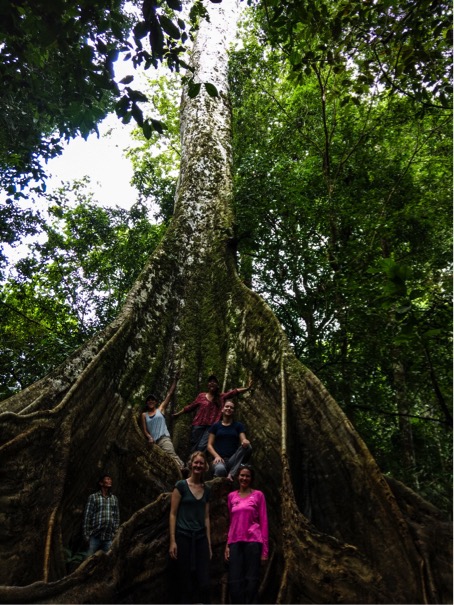
My name is Britte Heijink and I’m doing my MSc Biological Science thesis research project with Crystal McMichael and William Gosling. I travelled with Veerle Vink and Crystal to the Colombian part of Amazonia to collect samples for my project. At Amacayacu National Park, we collected soil cores from different locations in the plot. Now that we’re back in Amsterdam, I’m analysing the soils to reconstruct the fire and vegetation history from the plot using charcoal and phytoliths. I am specifically looking to see if humans have been present in the system and how they potentially affected the vegetation at Amacayacu.
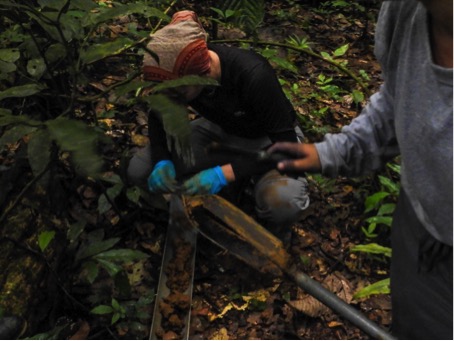
Here I’m Sampling pieces of soil cored by Louisa and checking for large pieces of charcoal
I’ve completed my bachelor thesis for Bèta-Gamma (Liberal Arts and Sciences) under the supervision of Crystal and Will here at the UvA. I’m really excited to work with them again, and already looking forward to our meetings at the Oerknal 😉 I will be finished by the end of September, and then possibly return for a literature study.
One of the most wonderful experiences in my academic career so far has been the fieldwork to Panama and Colombia with Crystal, Veerle, and Nina. It was a lot of hard work, and 90% of our time was spent covered in mud, sweat, and insect repellant, but the experience of working in a tropical rainforest was completely worth it! Veerle and I will write another blog about our fieldwork soon. Come see us in the microscope lab if you want to hear our dangerous and amazing stories before that!
Cheers,
Britte
Our last day in the Amazon was spend with some of the local students, Louisa Fernando Gomez Correa and Mariana Gutierrez Munera.
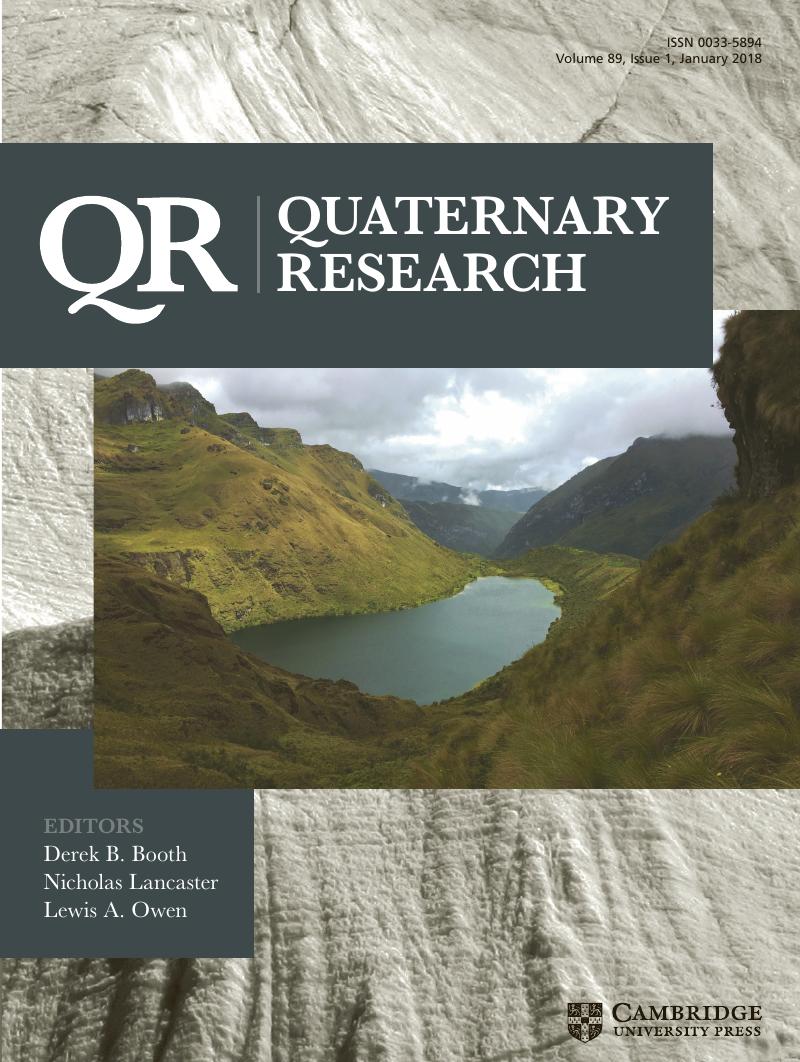
Mark Bush and I are proud to announce that a tribute to Prof. Daniel Livingston and Prof. Paul Colinvaux has recently been published in Quaternary Research. Dan and Paul were both pioneers of tropical pal(a)eoecology and both died in the spring of 2016 . To mark their passing Mark and I have guest edited ten new papers on palaeoecology drawn from researchers, and regions, of the tropics in which Dan and Paul worked (Bush & Gosling, 2018). We would like to thank Quaternary Research Senior Editor Derek Booth for giving us this opportunity and assisting greatly in the process of compiling the manuscripts. We would also like to thank all to contributing authors for their hard work and dedication to the project. We hope that you will enjoy reading the manuscripts and find them a fitting tribute to the life and work of these two great researchers.
On Jan 1, 2018 I (Crystal McMichael) get to ring in the New Year in the best way possible by heading off to the tropics to do fieldwork! And this time I get to take two students with me. Britte Heijink and Veerle Vink are both in the Biological Sciences MSc program (Ecology and Evolution track), and they are going to work on research projects that are associated with a recent grant that I was awarded through the Smithsonian Tropical Research Institute CTFS-ForestGEO Research Grants Program.
Veerle examines a cliff exposure during the Palaeoecology course, and has loved microfossils ever since!
Britte (far left) raises her first sediment core during the Palaeoecology course in 2016!
We are seeking to recruit a Neotropical palaeoecologist to join the recently funded “The past peoples of Amazonia: Assessing ecological legacies” project(PIDr. Crystal McMichael, funding NWO, based within the Department of Ecosystem & Landscape Dynamics). The project aims to reconstruct cultural histories from lake sediments in northwestern Amazonia, and link past human activities with modern ecological observations. The project involves analyzing microfossils (including pollen, phytoliths, and charcoal), and the development of a transfer function that estimates past human impacts in tropical forest systems.
We are particularly looking for a candidate with expertise and experience, in:
Fieldwork in remote areas.
Neotropical pollen.
Quantitative analysis, including familiarity with R and Geographical Information Systems.
Focus on Global Ecology, including: global biodiversity patterns and ecosystem functioning, human impacts on biodiversity, biogeography of species interactions, and/or global changes in ecosystems, biodiversity and ecosystem services.
Title: When was the South Pacific colonised? A lake sediment approach to understanding climate:human drivers of ecosystem change on remote Pacific Islands
Supervsiory team:Dr. Sandra Nogué, Prof Mary Edwards, Prof. David Sear, Dr. William Gosling (University of Amsterdam), Prof. Inger (Tromso University), Prof. Janet Wilmshurst (Landcare research and University of Auckland)
Rationale: The Pacific islands of Polynesia were among the last places on earth to be colonised by humans. The precise dates of colonisation are debated – a situation which arises from the different sources of evidence (1, 2). New lake sediment records from the Cook Islands (Atiu, Mangaia) and Samoa (Upolu) and Tonga show very clear evidence of disturbance, but what is unclear is to what extent the signal represents the arrival of humans or a change in climate (2). A key question for the analysis of sedimentary records is the ability to distinguish natural variability in the environment of Pacific Islands from that arising from the arrival of humans in a temporal and spatial context. We aim to use a multi-proxy approach based on SedDNA, lipid biomarkers, fossil charcoal, and pollen preserved in lake sediments to identify: a) the presence of humans and/or livestock that were brought with them, and b) the related environmental change. Multiproxy approaches supported by statistical analysis, will be deployed to four sites where we already have good chronological controls and high resolution records of palaeoclimate. We are well placed to apply new methods and higher resolution analyses to address fundamental questions about the response of remote pacific islands to climate and human forcings.
Supervisory team: Prof. David Sear, Prof. Justin Sheffield, Prof Ian Croudace (National Oceanographic Centre, Southampton).
Rationale: Because of their small size and isolation, islands in the Pacific have limited and fragile natural resources, making them more vulnerable to climate hazards and stresses than are continents1. Pacific Island Nations (PINS) also occupy the region of the earth’s surface most immediately impacted by ENSO events. The impacts of El Nino events are felt across 3,975 islands, 13 island nations, affecting a population of 12.9 million who rely on rainfall for freshwater and food security. To date our understanding of the mechanisms of drought, their frequency and duration, and their biophysical effects in PINs remain poorly quantified. In addition island types experience droughts differently, varying according to their location, topography, geological history and ecology. Droughts are also thought to have been important drivers of the human colonization of the Pacific2. Drought frequency is likely to increase in the tropical pacific but again its specific impacts are largely unknown. This PhD seeks to develop a step change in our understanding of droughts based on novel coupling of long term data on drought frequency with process based drought modelling.

 The Journal of Biogeography is keen to highlight the current call for contributions to a special issue entitled: “The legacy of Alexander von Humboldt: Exploring the links between geo- and biodiversity” to find out more visit the special issue web pages here.






 Ecology of the past