During the Mapping Ancient Africa workshop in Rome I conducted short interviews with the scientists involved. The first of these, Alfred Houngnon can be viewed here, below are four more, and more will follow as I get them uploaded. I hope they provide interesting insights into the diverse range of skills and backgrounds our scientists have.
Interview 2: Busisiwe Hlophe (University of the Witwatersrand)
Interview 3: Angela Effion (University of the Witwatersrand)
Interview 4: Bahru Zinaye Asegahegn (University of Cologne)
Interview 5: Michela Leonardi (University of Cambridge)
To find out more about the Mapping Ancient Africa project click here.
The thirteenth Mapping Ancient Africa seminar was delivered by Andrea Manica on the 18th May 2023. In the seminar Andrea introduced the pastclim R package and gave examples of how it can be applied to address questions related to human evolution and dispersal.
On Wednesday 11 May 2023 I was delighted to give a online seminar for the African Pollen Database group on integrating palaeoecological data into educational programs. Thanks to Sarah Ivory, Chris Kiahtipes, and Alejandra Domic for inviting me and organizing this series.
I covered topics including the motivation of students, designing a MSc level course, and setting up BSc/MSc research projects. My presentation was centered around my personal experience of running courses for BSc Biology and Future Plant Studies students (Palaeoecology), and for MSc Earth Science and Biological Science students (Environments Through Time) at the University of Amsterdam. It was nice to get a wider perspective from discussion with the audience and to pick up some additional ideas and advice. If you have other thoughts on this topic please feel free to comment on this post.
The entire African Pollen Database online seminar series is now available to watch via the associated YouTube channel. So to find more click here.
Ondrej Mottl and Suzette Flantua will be presenting an African Pollen Database (APD) practical tutorial about working with paleoecological data in R ! Please join us Wed, April 26 at 9am EDT (time zone converter). Please email sji15@psu.edu for the zoom link and instructions.
At this workshop, you will learn to use the new Ratepol package (info here and here):
search for APD sites from Neotoma in R
begin making age models
calculate rates of change for vegetation from pollen records
For more information, check out the schedule below and see past workshops here.
The seminar delivered by Emma Mbua (National Museums of Kenya) on the 13th April 2023 was the twelfth in the Mapping Ancient Africa series. The seminar highlighted new finds from archaeological sites in eastern Africa that have yielded bones of various animals, including early humans.
Socorro Dominquez and Simon Goring will be presenting an African Pollen Database (APD) practical tutorial about working with paleoecological data in R ! Please join us Wed, April 5 at 10am EST. Please email sji15@psu.edu for the zoom link.
At this workshop, you will learn to:
search for APD sites and filter data from Neotoma in R
make simple pollen diagrams
do simple analysis like look at change in taxa across time
For more information, check out the schedule below and see past workshops here.
The 11th Mapping Ancient Africa seminar took place on Thursday 16 March (2023). The seminar was delivered by Hannah Keller (Yale University) and highlighted her ongoing research into ostrich egg shells and environmental change she is undertaking as part of the “Malawi Ancient Lifeways and Peoples” project.
The 9th Mapping Ancient Africa seminar, and first of 2023, took place on Thursday 19 January. The seminar was delivered by Celine Vidal (University of Cambridge) and showcased recent work on the dating of volcanic deposits to constrain the age of hominin fossils in eastern Africa.
Vidal, C.M., Lane, C.S., Asrat, A., Barfod, D.N., Mark, D.F., Tomlinson, E.L., Tadesse, A.Z., Yirgu, G., Deino, A., Hutchison, W., Mounier, A. & Oppenheimer, C. (2022) Age of the oldest known Homo sapiens from eastern Africa. Nature601, 579-583. https://doi.org/10.1038/s41586-021-04275-8
Vidal, C.M., Fontijn, K., Lane, C.S., Asrat, A., Barfod, D., Tomlinson, E.L., Piermattei, A., Hutchison, W., Tadesse, A.Z., Yirgu, G., Deino, A., Moussallam, Y., Mohr, P., Williams, F., Mather, T.A., Pyle, D.M. & Oppenheimer, C. (2022) Geochronology and glass geochemistry of major Pleistocene eruptions in the Main Ethiopian Rift: Towards a regional tephrostratigraphy. Quaternary Science Reviews 290, 107601. https://dx.doi.org/10.1016/j.quascirev.2022.107601
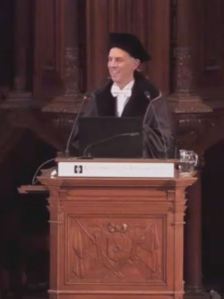
William Gosling giving his oratie “The Ecology of the Past” at the Aula (University of Amsterdam), 22 December 2022.
On the 22 December I gave my oratie (inaugural lecture), entitled “The Ecology of the Past”, related to my appointment as Professor of Palaeoecology & Biogeography at the University of Amsterdam. I really enjoyed the opportunity to mark this personal milestone with some many colleagues, friends and family. In case you missed the event you can watch it online via the universities portal by clicking here (or on the photo).
Note: (1) to flip between seeing the slides and the video feed just click on the screen, (2) running time of lecture until 50 minutes.
Chevalier, M. (2022) crestr: an R package to perform probabilistic climate reconstructions from palaeoecological datasets. Climate of the Past18, 821-844. DOI: 10.5194/cp-18-821-2022








 Ecology of the past