The final day of talks at AFQUA 2018 took a more applied approach in the first session “Applying the Quaternary: The role of the past in supporting the future”. This session focused on how we can focus Quaternary science to produce outputs that directly meet concerns and needs of society. Examples included the quantification of the fossil charcoal record to provide insights into the nature and impact of fires in the past (C. Adolf), how we can use information on past vegetation change and disturbance factors to anticipate how ecosystems on Madagascar might respond to future changes (E. Razanatsoa), and how climate histories can be extended through tree ring data (D. Colombaroli).
The fifth day of the AFQUA conference started with the second session on “Archaeological Landscapes”. Talks included: (i) a tribute to the work of Dick Grove in Quaternary work in Africa since the 1950’s, including possibly the earliest definition of the African humid period in his paper Grove & Warren (1968) (D.S.G. Thomas), and (ii) a highlight of new work on the Kisese II Rock Shelter in Tanzania (K. Ranhorn). Then to take us up to lunch Prof. David Nash treated us to a tour de force through the use of historical records in reconstructing past climates; including quotes from the fantastically named Holloway Helmore a missionary to Lekatlong in 1851 commenting on drough and how to turn this type of information into a regional/continental synthesis!
The afternoon session focused around the theme of “East Africa”. This session started with two talks on one of the “least known ancient civilization” in Ethiopia the Aksumite and pre-Aksumite peoples, and the resilience of these peoples to environmental and land-use change (V. Terwilliger and Z. Eshetiu). Other work presented on the morphometry of hominin skulls showing gradual development from 500,000 to 315,000 years ago which lead up to the appearance of anatomically modern humans (E. Mbua).
Yesterday (day 3) was excursion day of the AFQUA conference (photos to follow). Day 4 of the meeting was back in the National Museum Nairobi and kicked off with a session on “African archaeological landscapes”. The opening talk reviewed the career of Karl Butzer who coined the term ‘geoarchaeology’ back in the 1970’s when writing about his work integrating geological, archaeological and anthropological information (C.A. Cordova). Two talks then followed highlighting work on Lake Makagadikgadi from the perspective of archaeology and landscapes (D.S.G Thomas) and geochemical fingerprinting of stone tools to determine their source (D.J. Nash).
To take us up to lunch Boris Vanniere and Daniele Colombaroli gave a ‘double header’ plenary talk highlighting the exciting advances in the development of the Global Charcoal Database and how understanding past fire histories in Africa is key to interpreting environmental change. The after lunch session continued the palaeo-fire theme with records from Lake Botswana (C.E. Cordova), Lake Bosumtwi (W.D. Gosling – me), and Madagascar presented (A. Razafimanantsoa); as well as work on the usefulness of the morphometric’s of charcoal in determining the plant of origin (L.Bremond).
In the final session of the day we were back to “Southern Africa” as a theme. Under which banner we were “boggled” by sea-surface and sub-surface temperature reconstructions (M.A. Berke), shown how to extract climate records from Hyrax middens (B.M. Chase) and given insights into the past flora of the Cape Floristic region from fossil pollen records spanning 130,000 years (L.J. Quick).
The second day of the AFQUA conference commenced with the second session on “East Africa” and Prof. Tom Johnson asking the question “Should we drill Lake Victoria?”… and a request for ideas from people to join in with ideas for the proposals for obtaining new sedimentary records from the lake. The East Africa session continued with exploration of Lake Kivu using organic biomarkers to see if past lake ‘explosions’ could be detected (M.E. Berke) and the use of strontium isotopes to detect past climate from lakes in the Turkana Basin (H.J.L. van der Lubbe).
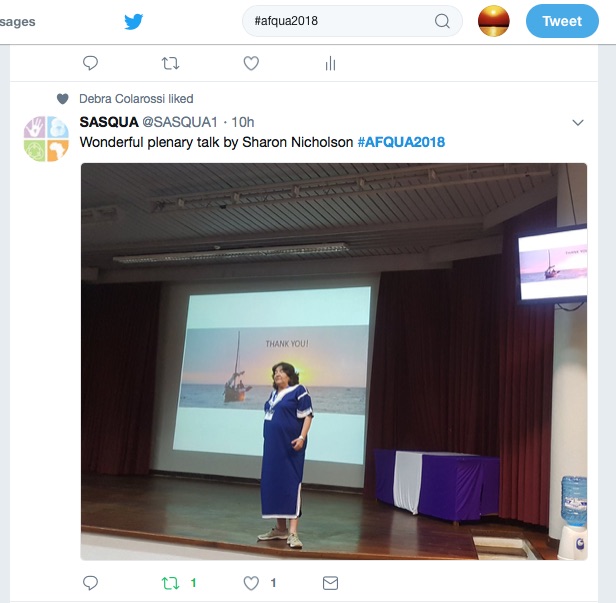
Before lunch the second plenary talk of the conference was delivered by Prof. Sharon Nicolson who made it very clear that the Inter Tropical Convergence Zone does NOT play an important role in controlling rainfall patterns across Africa (see Nicholson, 2018).
After lunch the first oral sessions covered “Southern Africa” and included d13C records from Bobab trees (S. Woodborne and E. Razanatsoa), early human finds in cascade tufas (M.A. Pickford), and quantitative climate reconstructions from pollen using the CREST software (M. Chevalier). After the break we were back for “Quantitative palaeoclimatology, modelling and data-model comparison” thinking about what is abrupt (M. Claussen), the impact of atmospheric CO2 on plants (V.J. Hare), and connectivity between lakes in the Kenyan rift (R. Dommain). Then it was off to the hotel bar to watch the football…
My first AFQUA conference really began the day before the conference proper started in the Kenyan immigration queue where I met a number of fellow delegates who were flying in from all over the world. It was great to start to put faces to names of people who’s work I had read for many years. Once out of the airport transfer to the hotel was smooth, and it was with some excitement that the following morning I made the short walk from the hotel to the famous Nairobi National Museum for the start of the conference.
Day 1
Prof. Andy Cohen (one of my fellow delegates in the immigration line) kicked off the AFQUA conference with a plenary giving an overview of African continental drilling projects. He traced the dream of the recovery of long continental records back to Daniel Livingstone and Neil Opdyke’s workshop from 1980 that set out the dream of obtaining long records from the continent. He then went on to give examples of how multi-millennial lake records, including Lake Malawi, can be used to understand the tempo of ecological change.
The first session of the conference, entitled “East Africa”, included: exciting evidence of Deinotherium the largest land mammal of the Quaternary (J.-P. Brugal), the use of d13C in determining homonin ecology (V.M. Iminjili), and evidence from a new c. 200,000 year old site at Natodomeri (Kenya) that contains evidence of homonids, elephids, giant lions and pigmy hippos (F.K. Manthi).
The second session of AFQUA covered “The environmental context for homonin evolution and dispersal”. This started with geochemical data from Chew Bahir that sheds light on potential drivers of climatic shifts (F. Schabitz), and included examination of changes climate between c. 500,000 and 320,000 years ago that coincided with the shift from hominid use of large cutting tools to smaller implements (R. Potts), and discussion of the environment the route which hominids took out of Africa (F. Henselowsky).
Yesterday was the second, and final, day of the Netherlands Annunal Ecology Meeting (NAEM) for 2018. Having stayed up rather later than I would normally for a Tuesday night, due to the the gezellig atmosphere, the scrambled eggs and coffee were very welcome for breakfast. We were then on with the conference with parallel sessions starting at 08:30.
First up I opted for the session on “Monitoring biodiversity change: Essential biodiversity variables and beyond” organised by Daniel Kissiling (University of Amsterdam) and Rob Jongman (Wageningen University & Research). In the session new IBED PhD research Zsofia Koma presented a nice talk on the potential of LiDAR for evaluating ecosystem change, and Franziska Schrodt (University of Nottingham) looked at how we can link biodiversity and geodiversity. I found the talk by Franziska highlighting the importance of linking the abiotic and biotic components of the landscape particulalry stimulating as it links very well with much ongoing work within both the Department of Theoretical & Computational Ecology (Biogeography & Macroecology) and Ecosystem & Landscape Dynamics (Biodiversity & Geodiversity in the tropics) here at IBED.
Having fun online at #NAEM2018
To take us to lunch were two plenary lectures on the theme of these were given by Katja Poveda (Cornell University) and Erik Polman (replacing Marchel Dicke; Wageningen University). Both talks illustrated the complexity of natural systems and landscapes.
After lunch I chose the “Animal Ecology” session charied by Chris Smit (University of Groningen) and Patrick Jansen (Wageningen Research & University). I really enjoyed the first two talks in this session which highlighted the complexity that animals add to ecosystems. First up Esther Rodriguez (PWN) showed the differential impact of European bison and wild horses on vegetation (Cromsigt et al., 2017). Then Annelies van Grinkel (University of Groningen) presented her work trying to discover if deer in the Netherlands are still scared of wolves after the absence of wolves from the Netherlands for the last 150 years; this included some nice camera trap footage of deer running away from hand soap!
Overall a fun meeting, I met lots of new people, and saw lots of great talks so will definatly be back next year. Thanks to all the organisers for putting on such as show.
“Global distribution patterns of mycheterotrophic plants”. The research of Sofia Gomes (Naturalis Biodiversity Centre) is captured by Milan Teunissen van Manen (@MilanaTvM).
Ancient human disturbances may be skewing our understanding of Amazonian ecology. The research of Crystal McMIchael (University of Amsterdam) is captured by Judith Westveer (@water_science).
Today the Dutch ecological community has convened at the Netherlands Annual Ecology Meeting (NEAM) in the forest near Lunteren. The meeting was kicked off by plenary lectures by Trisha Atwood and Han Olff who talked to the theme of “Ecosystem functioning in a changing world”. Trisha highlighted the importance of animals in modifying plant communities and their consequent importance for understanding changes in carbon storage. Han illustrated the complexity of ecological networks and posed the significant challenge of understanding changes in competing networks. Following the plenaries I chose two sessions to follow. The first on “Plant Ecology” and the second on “Ecosystem Resilience”. There were many exciting talks in both sessions, two of which grabbed my attention. Mara Baudena (Utrecht University) highlighted the complexity of modelling forest-grassland interactions in Africa, while Sofia Gomes (Naturalis Biodiversity Centre) showed surprising (to me) variation in mychorizal fungi across the globe.Furthermore four talks were presented by researchs at my home, the Institute for Biodiversity & Ecosystem Dynamics (University of Amsterdam):
Crystal McMichael“Ancient human disturbances may be skewing our understanding of Amazonian ecology”
Milan Teunissen van Manan“Species specific responses in leaf wax n-alkane composition from six tropical tree species”
Kenneth Rijsdijk“Assessing the resiliance of insular species to past climate change”
Seringe Huisman“Characterization of phytoliths in premontance western Amazonian forests”
So an exciting day, now for food and beer, and back on it tomorrow! Follow live on Twitter #NAEM2018
Hello all! You might have been wondering if I died in the middle of Amazonian nowhere, since I haven’t come back to writing a blog after we left for fieldwork in July. Given we were in an Amazonian region full of venomous snakes that could have been the case, but the good news is I just didn’t get around writing it because I got carried away by the findings of my project! We actually had a very successful field trip – apart from some minor issues like the lake swallowing equipment, sinking waist-high into the mud each step of our 7 hour long ‘trail’ to the lakes, and almost not getting my precious samples through airport security.

 I am delighted to be taking part in this years Palynologendagen (Palynology days) organised by the Palynologische Kring (Dutch Society for Palynology)




 Ecology of the past