UV radiation linked to mass extinction!

January 19, 2023
WDG

Recent research into the chemistry of ancient pollen grains has revealed a pulse of elevated UV radiation may have played a role in the end Permian mass extinction event (250 million years ago). To find out more:

APD Workshop Series: R, Databases, and You!

January 17, 2023
sji15

Interested in African paleoecology? Want to incorporate African pollen data into your research or teaching?

If you read nothing else, please take this survey before January 25!

The African Pollen Database (APD) has been relaunched, and the Neotoma Paleoecology Database now contains over 200 APD records.   Data stewards working with APD and Neotoma have been meeting regularly for the last two years to upload data, but we are now changing the format of our meetings in order to start focusing on helping people use APD data for research and teaching!

We are developing a schedule of practical tutorials on APD data workflows in R, using Rneotoma, and a few other topics to take place over next few months (see this video for general info).

This is open to anyone interested in African paleoecology (students, researchers, teachers, etc)!  If you or your students might be interested in taking part in one or all of these, please take this very brief survey by January 25 to let us know.  Also if you have other students or researchers you think should get this email, let Sarah Ivory (sji15@psu.edu) or Chris Kiahtipes (chris.kiahtipes@gmail.com) know.

Mapping Ancient Africa: Seminar 9

January 12, 2023
WDG

I am delighted to announce the first online Mapping Ancient Africa (MAA) seminar of the New Year will take place on 19 January 2023 (17:00-18:00 CET), this will be the ninth in our series.

  • Speaker: Céline Vidal (University of Cambridge)
  • Title: Age of the oldest known Homo sapiens from eastern Africa
  • Related publication: Vidal, C.M., Lane, C.S., Asrat, A., Barfod, D.N., Mark, D.F., Tomlinson, E.L., Tadesse, A.Z., Yirgu, G., Deino, A., Hutchison, W., Mounier, A. & Oppenheimer, C. (2022) Age of the oldest known Homo sapiens from eastern Africa. Nature 601, 579-583. DOI: 10.1038/s41586-021-04275-8

The seminar will be delivered via Zoom. The link for the seminar can be obtained from the MAA Slack channel or by contacting the chair of this seminar William Gosling. If you want to know more about the Mapping Ancient Africa project visit our web pages and please do not hesitate to get in contact if you want to get involved.

INQUAlogo

The Ecology of the Past: Inagueral lecture

January 12, 2023
WDG

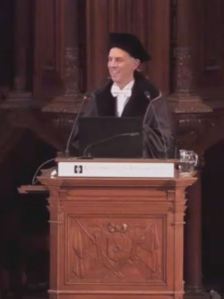
William Gosling giving his oratie “The Ecology of the Past” at the Aula (University of Amsterdam), 22 December 2022.

On the 22 December I gave my oratie (inaugural lecture), entitled “The Ecology of the Past”, related to my appointment as Professor of Palaeoecology & Biogeography at the University of Amsterdam. I really enjoyed the opportunity to mark this personal milestone with some many colleagues, friends and family. In case you missed the event you can watch it online via the universities portal by clicking here (or on the photo).

Note: (1) to flip between seeing the slides and the video feed just click on the screen, (2) running time of lecture until 50 minutes.

Reference

Gosling, W.D. (2022) The Ecology of the Past
Inaugural speech, University of Amsterdam.

Mapping Ancient Africa: Video of seminar 8

December 19, 2022
WDG

The seventh Mapping Ancient Africa online seminar took place on Thursday 15 December 2022. The seminar was delivered by Chantal Kabonyi (University of Bukavu) and chaired by Manu Chevalier (University of Bonn). The presentation was delivered in French with English slides.

  • Les trois derniers millénaires d’histoire environnementale autour du lac Kivu: De la dorsale congolaise à la dorsale congo-Nil 
  • [The last three millennia of environmental history around Lake Kivu: From the Congolese ridge to the Congo-Nile ridge]

Details of this seminar can be found here. You can find more Mapping Ancient Africa seminar videos on the “Ecology of the Past” YouTube channel.

INQUAlogo

Six research vacancies within the Institute for Biodiversity & Ecosystem Dynamics

December 13, 2022
WDG

Assistant and / or Associate Professor positions in:

  • Carbon cycle dynamics in terrestrial ecosystems
  • Biological feedbacks in the marine carbon cycle
  • Impacts of climate-related environmental change on ecological systems
  • Land cover and land use dynamics
  • Geomorphology and tropical landscape evolution
  • Aquatic ecotoxicology and water quality

Closing date for all positions 8 January 2023

Jobs: Two Assistant Professorships within Department of Ecosystem & Landscape Dynamics

December 7, 2022
WDG

I am pleased to announce two new vacancies within the Department of Ecosystem & Landscape Dynamics at the University of Amsterdam. These position are part of a recruitment drive across the Institute for Biodiversity & Ecosystem Dynamics triggered by new funding from the Dutch government (Earth & Environmental Science Sector Plan). Both positions will be at the Assistant Professor level (either Tenure Track, or directly tenured following a period of probation; dependent upon the experience of the successful candidate). For full detail, and how to apply, check out the below links:

Closing date: 8th January 2023

These positions are designed to compliment, and strengthen, existing expertise within the department in biogeochemistry, Earth surface science, landscape ecology and palaeoecology. We are looking for scientists who are engaged with laboratory, field and/or modelling focused research, have a proven track record of publishing, and are looking for a base to build their own research group. We are looking for enthusiastic and innovative educators keen to lead and develop practical and field based courses and projects for students in our BSc Future Planet Studies and MSc Earth Sciences degree programs.

If you have any question please do not hesitate to get in contact with me directly: William D. Gosling

If you are interested to join IBED but feel you do not fit to one of these position check out our other vacancies at by clicking here.

Long-term fire and vegetation change in northwestern Amazonia

December 6, 2022
WDG

Open access:

Heijink, B.M., Mattijs, Q.A., Valencia, R., Philip, A.L., Piperno, D.R. & McMichael, C.N.H. (2022) Long-term fire and vegetation change in northwestern Amazonia. Biotropica DOI: 10.1111/btp.13175

Science in Archaeology 2

December 2, 2022
WDG

This year I have a two week slot in the “Science in Archaeology 2” program that is part of the Minor “Archaeology Today: (Digital) science in Archaeology”. In my section of the course we have covered three key topics this year: humans and fire, humans and animals, and humans and domestication. For each topic there was a lecture and a discussion component, and students got to present their favourite scientific paper on one of these topics.

This year discussions have been particularly fun as we have such a broad range of students taking the minor. In addition to the ‘usual’ archaeologists we have, among others, historians, data science and environmental science students from a range of universities across the Netherlands. So regardless of your background if you are interested in archaeology then maybe this minor is for you…

Papers studied this year were:

Continue Reading

University of Amsterdam Toga!

December 1, 2022
WDG

Yesterday I picked up my Professorial Toga from Togamakerij Rhebergen on the Amsteldijk in Amsterdam. For me it was quite a moment as this item symbolizes so much work over so many years, and is thanks to the help, support and training of so many people. I am looking forward to my Oratie (inaugural lecture) on the 22 December and celebrating further with friends and family. I hope that you will agree that the hard work was worth it to have the privilege to wear this gown, and personal thanks to Helen Sahin of Togamakerij Rhebergen for making such a beautiful item of clothing for me!

Blog at WordPress.com.