Mapping Ancient Africa: Video of seminar 15

March 26, 2024
WDG

The 15th Mapping Ancient Africa seminar took place online on Friday 15th March 2024. The seminar was delivered by Bruk Lemma (Martin Luther University Halle-Wittenberg, Germany; Ethiopian Biodiversity Institute – EBI). In the seminar Bruk presented recent advances made in the application of biomarker and stable isotope techniques in revealing the climate dynamics of the Bale Mountains in Ethiopia. He showed that it is possible to identify some plant types using these approaches, but that degradation of the signal in the sedimentary environment is possible.

Details of this seminar can be found here. You can find more Mapping Ancient Africa seminar videos on the “Ecology of the Past” YouTube channel.

INQUAlogo

Mapping Ancient Africa: Writing workshop 2024

March 7, 2024
WDG

A workshop will be held at the National Museums of Kenya (Nairobi, Kenya) in June 2024. The aim of the workshop is to help authors prepare articles for the Mapping Ancient Africa (MAA) special issue proposed for publication in Quaternary International and lead by Dr. Stefanie Kaboth-Bahr. The workshop will be associated with the “1st Joint International Scientific Conference” (3-6 June). The MAA workshop is being organized by Dr. Rahab Kinyanjui, and the congress organization is being lead by Dr. Emmanuel Ndiema (click here to watch his 2022 MAA seminar) and Dr. Esther Kioko (Acting Director National Repository and Research).

For further information on attending the MAA workshop please contact Rahab directly.

To find out more about the Mapping Ancient Africa project click here.

INQUAlogo

Mapping Ancient Africa: Seminar 14

February 28, 2024
WDG

The first Mapping Ancient Africa online seminar of 2024 will take place on 28 February (17:00 CET). 

  • Speaker:  Mathias Vinnepand (Leibniz-Institute for Applied Geophysics Hannover, Germany)
  • Title: An age-depth model for Lake Bosumtwi (Ghana) to reconstruct one million years of West African climate and environmental change
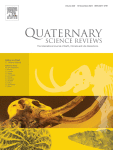
  • Related publication: Vinnepand, M., Zeeden, C., Wonik, T., Gosling, W., Noren, A., Kück, J., Pierdominici, S., Voigt, S., Abadi, M.S., Ulfers, A., Danour, S., Afrifa, K. & Kaboth-Bahr, S. (2024) An age-depth model for Lake Bosumtwi (Ghana) to reconstruct one million years of West African climate and environmental change. Quaternary Science Reviews 325, 108478. DOI: 10.1016/j.quascirev.2023.108478

The seminar will be delivered via Zoom. The link for the seminar can be obtained from the MAA Slack channel or by contacting the chair of this seminar (Stefanie Kaboth-Bahr). If you want to know more about the Mapping Ancient Africa project visit our web pages and please do not hesitate to get in contact if you want to get involved.

INQUAlogo

An age-depth model for Lake Bosumtwi (Ghana) to reconstruct one million years of West African climate and environmental change

January 8, 2024
WDG

Vinnepand, M., Zeeden, C., Wonik, T., Gosling, W.D., Noren, A., Kück, J., Pierdominici, S., Voigt, S., Abadi, M.S., Ulfers, A., Danour, S., Afrifa, K. & Kaboth-Bahr, S. (2024) An age-depth model for Lake Bosumtwi (Ghana) to reconstruct one million years of West African climate and environmental change. Quaternary Science Reviews 325, 108478. DOI: 10.1016/j.quascirev.2023.108478

New funding opportunity for African researchers

November 8, 2023
WDG

A new funding stream is about to open up (1 December 2023) to support African scientists to carry out PhD research at Dutch universities. The GROW research programme (Graduate Research on Worldwide Challenges) will fund 51 PhD positions to be based at one of five Dutch universities, including with the Institute for Biodiversity & Ecosystem Dynamics, at the University of Amsterdam.

To find out more click here.

Applications open 1 December 2023 and close 31 January 2024.

Mapping Ancient Africa: Scientists

August 25, 2023
WDG

During the Mapping Ancient Africa workshop in Rome I conducted short interviews with the scientists involved. The first of these, Alfred Houngnon can be viewed here, below are four more, and more will follow as I get them uploaded. I hope they provide interesting insights into the diverse range of skills and backgrounds our scientists have.

Interview 2: Busisiwe Hlophe (University of the Witwatersrand)

Interview 3: Angela Effion (University of the Witwatersrand)

Interview 4: Bahru Zinaye Asegahegn (University of Cologne)

Interview 5: Michela Leonardi (University of Cambridge)

To find out more about the Mapping Ancient Africa project click here.

INQUAlogo

Mapping Ancient Africa: INQUA Rome – session 2

August 24, 2023
WDG

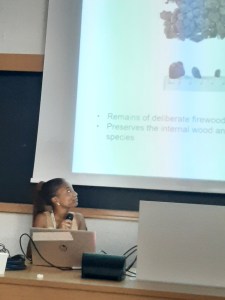
The second part of the Mapping Ancient Africa session at the INQUA Rome congress contained eight talks. Busisiwe Hlophe (University of the Witwatersrand) kicked us off by showing us the power of looking at wood anatomy preserved in charcoal microfossils to determine the nature of past vegetation and climate. Rahab Kinyanjui (National Museums of Kenya) presented phytolith work from archaeological sites revealing a mixed woody and grassy vegetation associated with archaic Homo sapiens in Kenya.

Three talks from the Cape Region in South Africa then followed with Saul Manzano (University of Leon), Stella Moscher (University of Utah), and Asithandile Ntsondwa (Nelson Mandela University) using various palaeo ecological approaches to explore climate, vegetation and fire regime shifts during the Holocene. Adele Julier (University of Portsmouth) then took us a little further north to Namibia to think about the challenges of parameterising modern pollen-vegetation relationships in arid regions. The final southern African talk was given by Gemma Poretti (University of Cape Town) explored a new approache to tracking change in past rainfall patterns using charcoal material.

Continue Reading

African lake studies: Dan Livingstone and the Duke University team

August 23, 2023
WDG

By Keith Richards

Every picture tells a story. This one is a snapshot I took of Dan Livingstone’s African palaeolimnology group in June1984, when I spent a few months at Duke University, North Carolina, at Dan’s invitation.  I had started work on the pollen analysis of a Holocene core from Cameroon that I’d collected in 1981 and Dan was keen to help me as far as possible. He was making plans for his lake coring projects a few years later in Cameroon (Barombi Mbo).  

Back row (L-R) is me (Keith Richards age 24), Margaret Adebisi Sowunmi, Alice Tucker, Lida Burney, George Kling and Dan Livingstone. Front row (L-R) is David Burney, Wendy Watson, Susan Gerbeth-Jones and Patricia G. Palmer.
Continue Reading

Mapping Ancient Africa: INQUA Rome session (updated)

July 16, 2023
WDG

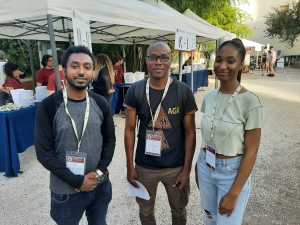
Mapping Ancient Africa participants at the INQUA Rome ice breaker event ready for action! Left to right: Bahru Zinaye Asegahegn, Alfred Houngnon, Busisiwe Hlophe.

The Mapping Ancient Africa (MAA) project has a double session of talks and a poster session at the INQUA congress in Rome 2023. Our session will be on Wednesday 19 July. Unfortunately a number of the originally planned speakers could not make it to Rome due to a combination of not obtaining visas, logistical challenges and ill health. We wish them all well and hope that they will continue to be involved in the project. Further, many thanks to all those who have agreed to step up and give a presentation at a late notice. Below is an updated schedule correct as of Sunday 16 July based on the information contained on the INQUA Rome App; if you are aware of any further problems or changes please let me know ASAP!

If you are at the INQUA Rome congress please come along to our talks and posters in Session 64: Mapping Ancient Africa: Climate, Vegetation & Humans.

Part 1: 08:30-11:00

  • Giosan et al. When the desert was a lake: Providing context for Homo sapiens development in the northern Kalahari
  • Chase et al. Paleolakes and socioecological implications of glacial “greening” of the South African interior
  • Blinkhorn et al. Evaluating refugia in recent human evolution in Africa
  • Aureli et al. Homo sapiens behaviour and adaptation in East Africa. New evidence from an open-air site in a modern Ethiopian savannah environment: the GOT10 site
  • Effiom et al. Late Holocene palaeoecological studies at Lake St Lucia, KwaZulu-Natal
  • Tallavaara et al. Pan-African Climate and Vegetation over the Quaternary and Implications for Human Distribution
  • Quick et al. Palaeoenvironments of the Cape Floristic Region: New research & current developments

Part 2: 11:00-13:00

Continue Reading

Mapping Ancient Africa: INQUA Rome session

July 3, 2023
WDG

The Mapping Ancient Africa (MAA) project has a double session of talks and a poster session at the INQUA congress in Rome 2023. Our session will be on Wednesday 19 July.

If you are at the INQUA Rome congress please come along to our talks and posters in Session 64: Mapping Ancient Africa: Climate, Vegetation & Humans.

Part 1: 08:30-10:30

  • Giosan et al. When the desert was a lake: Providing context for Homo sapiens development in the northern Kalahari
  • Chase et al. Paleolakes and socioecological implications of glacial “greening” of the South African interior
  • Biddulph et al. Spatiotemporal variability in the initiation and development of peatlands across the central Congo Basin
  • Blinkhorn et al. Evaluating refugia in recent human evolution in Africa
  • Aureli et al. Homo sapiens behaviour and adaptation in East Africa. New evidence from an open-air site in a modern Ethiopian savannah environment: the GOT10 site
  • Dembele Climatic fluctuations during the last millenium and their impact on political history and human settlements in West Africa
  • Porchier et al. Annually resolved hydroclimate variability in the East African Rift Valley at a time critical for hominin dispersion
  • Effiom et al. Late Holocene palaeoecological studies at Lake St Lucia, KwaZulu-Natal

Part 2: 11:00-13:00

Continue Reading
Blog at WordPress.com.